To the surprise of many —given the impact of the economic instability which has affected our country in recent times— it is very encouraging to see that Mexico City is currently hosting a wide range of cultural events of the first order. In the visual arts field, the museums are presenting a wide selection of international exhibitions of ancient, modern, and avant-garde art. As regards contemporary art, although we do not have a Biennial like those of Havana or São Paulo, recent months did see the holding of the First International Painting Salon, under the auspices of the government of Mexico City, and whose head, Cuauhtemoc Cárdenas, promised would be an annual event. The Salon was housed in the handsome colonial palace of Los Condes de Santiago de Calimaya, duly restored and remodeled to present exhibitions of contemporary art, after having accommodated for decades the permanent collections of the anachronistic and run-down Mexico City Museum. Five Continents and a City was the title of this first Salon which proved surprising in the scope of its ambitious curatorial objectives. The exhibition, which was accompanied by a magnificent 360-page catalog, was designed and organized by the artist Marta Palau who in turn invited six curators to undertake the difficult task of selecting 31 artists, 15 Mexicans and 16 from various countries from the rest of the Americas, Europe, Africa, Asia, and Oceania. The challenging objective of configuring a plurality of ideas and aesthetic criteria within the context of a single exhibition was achieved with an admirable spirit of teamwork. The result was an eclectic show which, although it may have been disconcerting, was in the final analysis extremely interesting and undeniably audacious.
Although most of the invited foreign artists were of international reputation, there were not known or well-known within Mexico - and this fully justified their presence in a Salon of this kind and highlighted the need for presenting in our country the work of multi-faceted creators who can bring a breath of fresh air to the dense atmosphere of our visual arts scene. What is difficult to accept—and even rather absurd— is the idea that an entire continent can be represented by only three or four artists. Thus a show of this kind should be seen as only a sample of the fare offered up by the menu of universal contemporary art.
The curators responsible for their respective continents had a difficult task. The impressive catalog —excellently edited and printed— included a text by each specialist presenting the works in each section. This included a general outline of the work of each artist within their historical and aesthetic context. However, in my view, the curators did not really present arguments for their selections; we were left in doubt and curious to know which reference frameworks had been used for making the difficult selection of three artists out of hundreds making up the corpus in each continent.
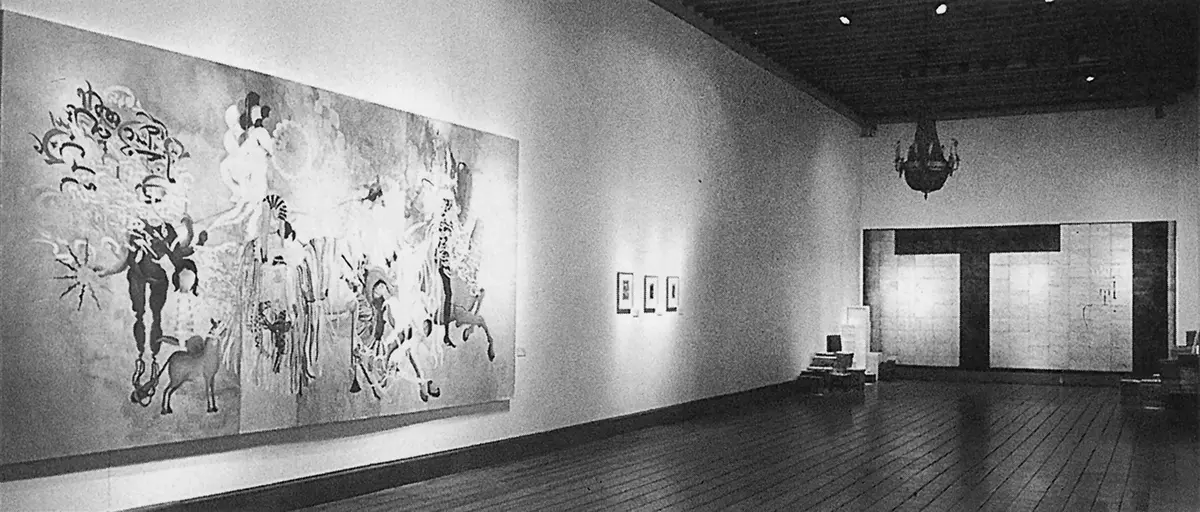
In the case of Mexico, Palau appointed Rita Eder and Sylvia Pandolfi, well-known researchers, and curators whose selection, nevertheless, caused a lot of debate, since the curious spectator wanted to know what theoretical framework had been used for selecting the works, as well as the criteria governing the eclectic curatorial process. Of the fifteen Mexican artists included —or artists resident in Mexico, as in the case of the Belgian Francis Alÿs and the Dutch artist Jan Hendrix— most used painting in its traditional sense. The most impressive example here was the immense canvas by Sergio Hernández (Oaxaca, 1957), titled Carnival, a monumental work measuring 342 x 600 cm., which revealed the magnificent technical quality which this artist has achieved in his pictorial language. Hernández is well-known for his richness of texture and excellent use of color in his work which refers to the magical-mythical universe of his native country. Because of the size and strength of expression of this piece, it was given a strategic location in the show, occupying an entire room to itself. In sharp contrast to Hernández, Boris Viskin (1960) and Miguel Castro Leñero (1956) participated with works reflecting the minimalist figuration which they have been using recently and which, in the context of this exhibition, revealed certain common characteristics. Jorge Rocha Linares (1963) paints rather sordid scenes which refer to the dehumanization and existential anguish of figures reminiscent of those of Edward Hopper and here given a post-modern kitsch-like tone. Gerardo Suter (1957) is well-known as one of the best Mexican photographers. This time he presented an aspect of his recent work, an installation, and a video in which he explores the interaction of various media and technical resources to produce a discourse involving both photography and painting. Francis Alÿs (1959), an artist of Belgian origin who has lived in Mexico for around ten years, is one of the most suggestive of our current conceptual artists. His intelligent irony concerning artistic process and the concepts of authorship and originality in a work of art has led him to undertake a variety of experiments in various fields. The animated video which he chose for this exhibition and which was also included in the last edition of ARCO in Madrid did not seem very suggestive and was somewhat sugary, in comparison with other works of greater sagacity and wit. Estrella Carmona (1962) surprised us a few years ago with her vigorous and expressionist painting, which is however a little too reminiscent of Orozco and the dynamism of Siqueiros. Her work has been focused on the subject of the dehumanization resulting from technology, industrialization, and the horrors of war. In this show, she presented four recent pieces which reflected her habitual qualities, although there was perhaps a certain formal stagnation. Magali Lara (1956), ever faithful to her organic metaphors exploring the subjective self, presented six large format paintings which revealed a heightening in the tone of voice: there is now a voluptuousness in her brilliant colors and gestual brush strokes, which are freer and more open, in contrast to the almost calligraphic subtlety of her earlier work.
Her delicate pictorial haikus have given way to fuller poems, where the impastos and resplendent lines reflect the exploration of unknown territories. I am fascinated by the work of Mónica Castillo (1961), which was recently presented at the Carrillo Gil Museum in a show titled I am another. From the beginning, Castillo has explored all the imaginable forms of the self-portrait in her profound meditation on her inner self. With sharp intelligence and irony, she depicts herself over and over again in all kinds of formats and techniques. In this show, there were two paintings on canvas done with impastos of oil applied directly from the tube, which created a surprising optical interplay. She also presented two kinds of crochet-woven masks in which she ironically fragments and disfigures her face in a process of both affirmation and negation of identity. Laura Anderson (1958) moves freely and interacts within various fields, including installation, sculpture, painting, and object art. A large part of her work is characterized by her use of organic materials which confirms her interest in proposing a dialogue between man and nature. The work included in this show offered a two-fold visual and conceptual interplay: it consisted of two series of portraits in which the artist incorporated a collage of orchid leaves covering the surface of the canvas, and left exposed, in one of the series, only the face of the figure, while in the other, the eye could see a bust painted in the style of a classical portrait, with the face, in this case, being hidden behind the same leaves. Both series, which were intensely poetic, functioned as a conceptual confrontation between the concepts of representation and suggestion, the configuration of codes, and the deconstruction of the image. To conclude with the selection of Mexican artists, I would like to mention the splendid work of Jan Hendrix (1946), a Mexican by adoption, who has made a very important contribution to the graphic arts field. His impressive polyptych was titled Script, a monumental mosaic made up of 574 fragments of oriental landscapes printed on Nepal paper and arranged in a harmonious sequence, but which allowed each piece to be viewed as an independent work. The simplicity and subtlety of the fine and elegant line work create a multiplicity of different evocations in each piece. The excellent finish and poetical essence of Hendrix's work reminded me of the very subtle images of the Franco-Chinese painter Zao-Wou Ki.
Turning to the international section, it was an excellent idea to invite four different curators for the four continents: the Cuban Gerardo Mosquera was responsible for the rest of the Americas, Rosa Olivares, from Spain, for Europe, the Korean Yu Yeon Kim for Asia and Oceania and the Nigerian Okwui Enwenzor for Africa (Enwenzor has also been appointed curator of the next edition of the Kassel Documenta).
The fifteen artists representing the five continents offered a mosaic of divergent and multi-disciplinary proposals which reflect the multiplicity of languages in the pictorial field. As noted earlier, although this was a Painting Salon, other genres converging on the pictorial but which were not purely plastic were also included, as in the case of the splendid video by the South African William Kentridge (1955), who presented a series of impressive drawings projected on a laser disk. Godfried Donkor (1964), who was born in Ghana, is also interested in drawing and the graphic arts and presented a series of serigraphic works with oil interventions focusing on his concern with identity, race, and the body, as well as the mechanism of perception through the relationship between the objectivized body and the gaze of the observer. Ellen Gallagher, who was born in the United States in 1965, also concentrates on the racial theme and on this occasion, made use of her customary iconography of the stereotyped negro face with two bulging eyes and colored thick lips. She presented two different works: a long wooden cane (4,5 m. long), with the abstraction of this black face being repeated successively on the surface. The tone of this work, Love Parade, was effectively ludic, while the painting Eleganza, which did honor its title, was a work of great quality in both finish and conceptualization. Gallagher apparently uses oilcloth, paper, and enamel in her large-format paintings, which give them a very unusual and attractive translucent quality that evokes a sense of mystery. Yinka Shonibare (1962), a Nigerian artist who works in England, can be placed at the intersection between African and European cultures, with her art explicitly proposing the possibility of asymbiosis of cultured and popular art. Halfway between ethnographic research and minimalist-conceptual- ist practice, Shonibare uses different lexicons taken from African popular iconography –in this case, the traditional batik fabrics used in traditional dress to create an ironic and allegorical metalanguage on cultural hybridization.
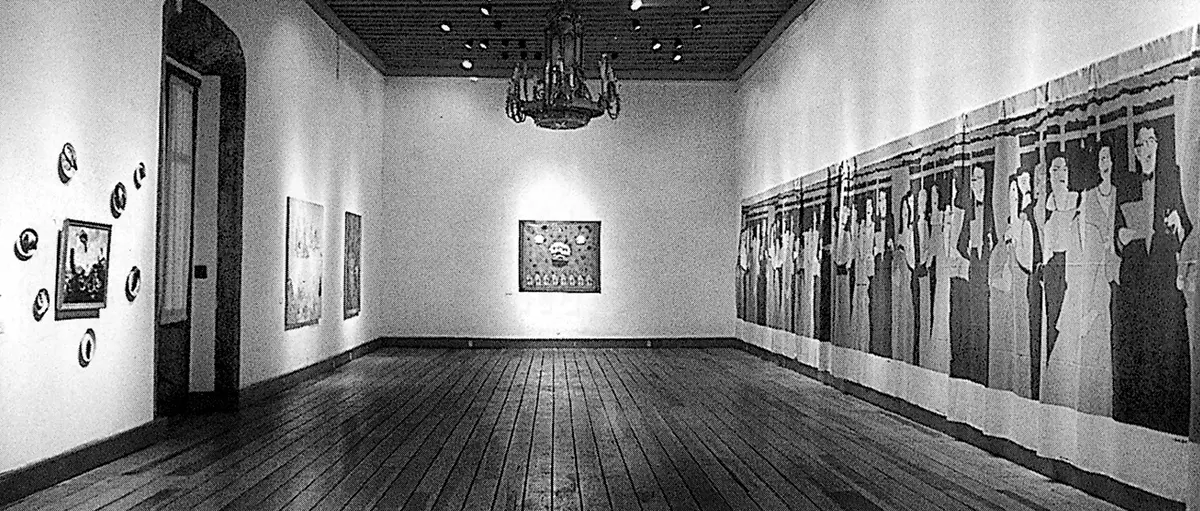
The Americas section chosen by Gerardo Mosquera included the Chilean Arturo Dudos (1959), the Colombian Beatriz González (1938), and the Brazilian Adriana Varejão (1964). Dudos' work can be seen as a configuration or compendium of religious, occult, ideological, and emblematic symbols which appear in his compositions like a taxonomical classification of decontextualized cryptical signs from various regions and traditions. Beatriz González presented two kinds of totally different works: the first was a post-pop scene based on a well-known photograph of a former president of her country flanked by his "heavenly court", in the form of an industrially printed serigraphy on an enormous curtain placed along the length of a wall, like a stage curtain. In contrast to this monumental piece, Mosquera also selected the series The Delights, consisting of ten portraits on canvas measuring 25 x 25 cm. each, which were skilfully placed in strategic places throughout the museum, outside the specific context of the exhibition. The Cuban curator decided to integrate the pieces into the museography of the permanent exhibition rooms where small pieces from the furniture collection of the city's museum were still being presented. This seemed to me to be an amusing and witty idea since these paintings in fact worked marvelously when set amongst colonial and nineteenth-century artifacts. Of the three artists from the Americas, the most audacious work in my opinion was that of Adriana Varejão. Influenced by the powerful tradition of the Brazilian baroque, Varejão transgresses the concept of painting by actually lacerating the canvas or even cutting it up and letting the blood run from the open wounds. In Meat à la Taunay, she presents an acidic allegory showing a conventional landscape painting violated by a thick layer of oil which looks like a stain of coagulated blood; around the picture, the artist hung on the wall porcelain plates containing pieces of artificial beef, also full of blood. The grotesque sensuality of these works, which were both suggestive and repulsive, attracts.
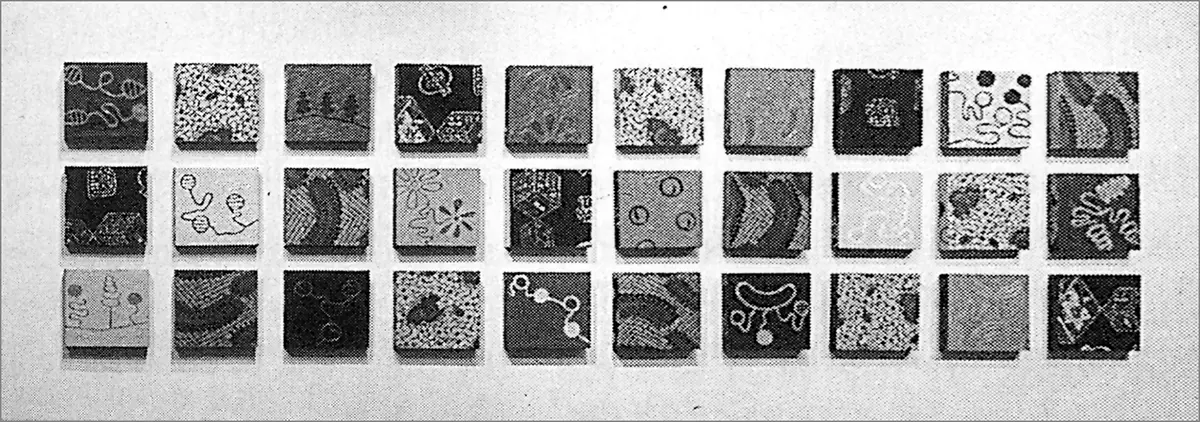
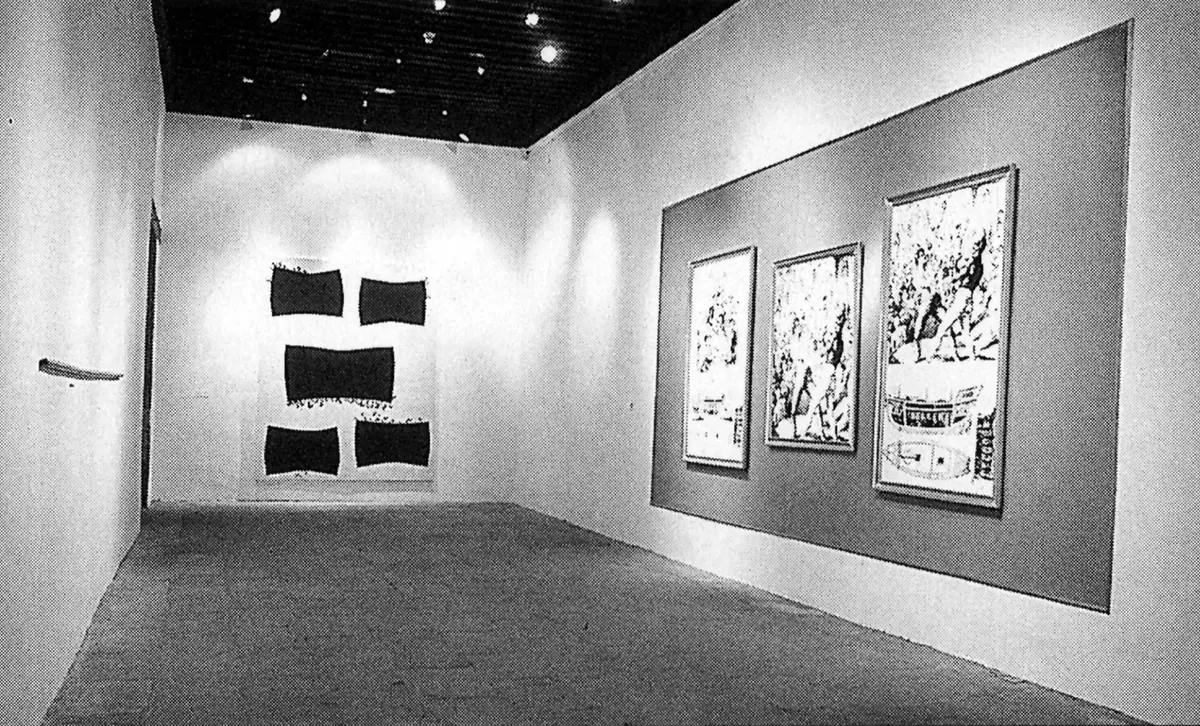
The selection of artists from Asia and Oceania was the most eclectic. Byron Kim (1961) and Cho Duck-Hyun (1957) are two Korean figures whose works, radically different in formal terms, have similarities in their conceptual intentions. Kim presented a piece that I found fascinating, titled Synecdoche (“a form of speech in which the part is made to represent the whole or vice versa"), an immense work made up of a mosaic of 304 little canvases measuring 25 x 20 cm., the surface of which was totally covered with a flat layer of uniformly applied paint. What was interesting was that each piece referred to the color of the skin of various individuals of different ethnic groups, who had posed for the artist. Abstract only in its appearance, the painting was based on a complex code of meanings concerning the colonial cultural context. For his part, Cho Duck-Hyun immediately caught the spectator's attention with his huge pictures of scenes of public protest in Korea (strikes, political demonstrations, social struggles, etc.), which proposed the re-reading of a changing reality that is relentlessly burying the immediate past. The quality of the line work (graphite and charcoal on canvas) and the search for realism made these paintings look like huge photographic prints. The Chinese artist, a genuine contemporary calligrapher, proposed a metaphor on interpretation, translation, and linguistics as a means of questioning the fusion of Western and Eastern cultures: using a computer, the visitor could translate his or her Western name into Chinese ideograms. Shahzia Sikander (1969) is an artist of Pakistani origin who produces a precious kind of painting based on the "miniature" tradition of Pakistan and India. The works combine the perfectionist and illusionist elements of the traditional style with modern concepts exploring the artist's inner thoughts. They are intimate paintings in which the female figure forms the center and focus of intricate compositions with imagery taken from Muslim, Hindu, Persian, European, Mexican, and Celtic sources. Alwin Viros Reamillo (Philippines, 1964) and Juliet Lea (England, 1966) work together and are known as Reamillo and Juliet. Their paintings provide a sharp criticism of the triad formed in the Philippines by the Government, the Church, and the military, with sarcastic metaphors of the nation as a corpse being devoured by the worms of oppression, corruption, and violence. The curator referred to "a bizarre mingling of icons" to describe the mélange resulting from the four centuries of Spanish domination, oppression by the United States, and Japanese control.
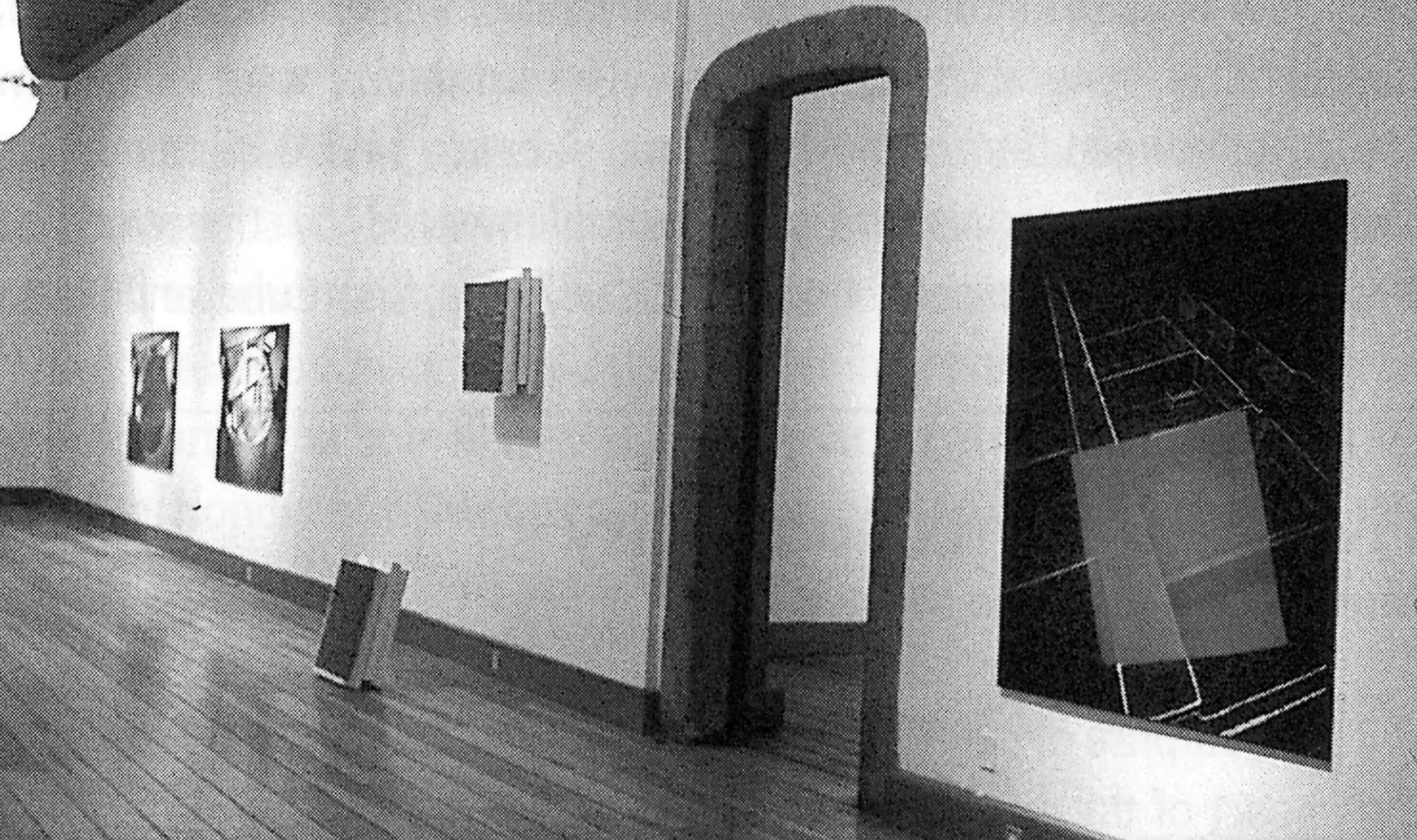
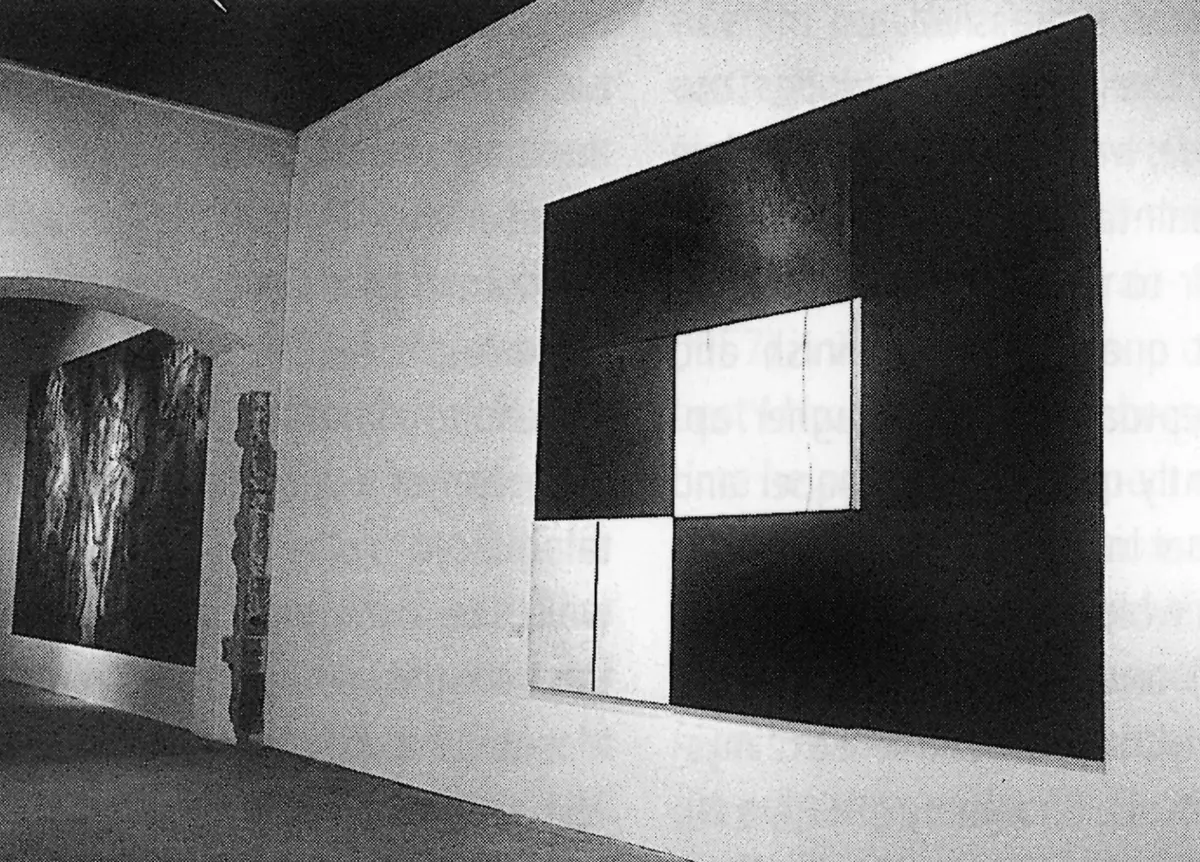
Before concluding, I should like to mention the European section, consisting of works selected by Rosa Olivares from Spain. This was particularly interesting because it was made up of three artists who work on the fringes of painting: although their production is intimately linked to the pictorial tradition, it is not exactly representative of that tradition. Rosa Brun, also from Spain (1955), creates postminimalist abstract compositions where the laconic discourse is the product of the materials used, in this case, wood and metal sheets. The most interesting of the artists in this section was Georges Rousse (1947), from France, who showed a series of intervened photographs that did nevertheless retain a certain pictorial quality. Rousse uses architectonic spaces which have been abandoned or evacuated, such as buildings undergoing demolition or uninhabited houses; he chooses one of the rooms the inside of which he photographs and then reworks through the superimposition of painted elements. The result is a series of enigmatic architectural landscapes of great visual effect.
Such an eclectic exhibition as this, of which we have just taken a bird's eye view, did confirm that, contrary to what is often said in Mexico, painting is not on the point of disappearing. As the title of the event clearly indicated, this Salon was designed to call attention mainly to the work of international artists who are still closely working with the pictorial tradition at a time marked by indifference to and disdain of conventional techniques. One of the constant features in the work of these 31 artists is the search for a re-semanticization of plastic language. What is worth asking is what remains to be painted and how. The themes are as broad as the human species: the challenge lies in the form. The only aspect which really worries me is the idea of a "global culture" if this means the homogenization of culture. As long as individuality prevails, there will be creativity and with it, originality.
GERMAINE GÓMEZ HARO