
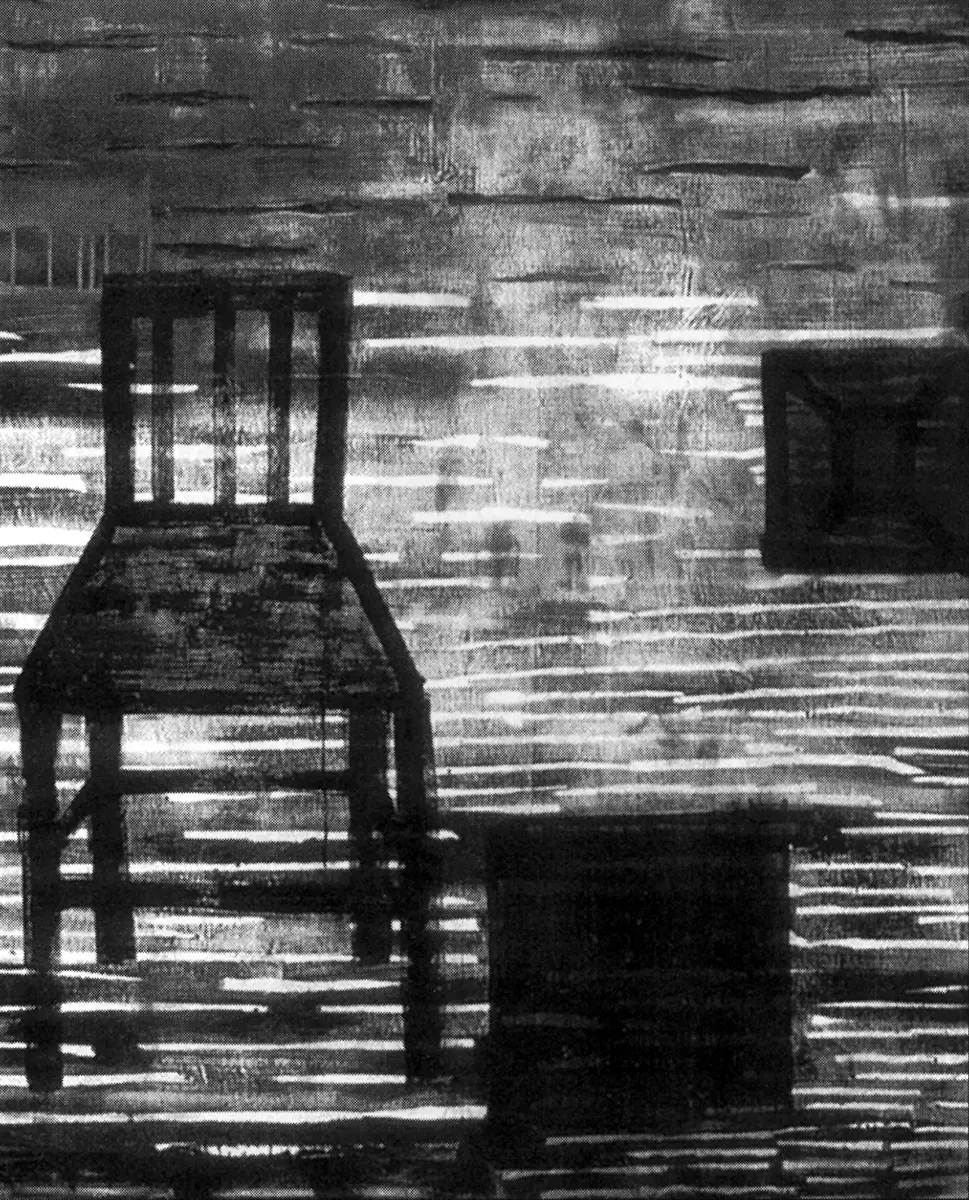
This exhibition recently presented by Héctor de Anda at the Pecanins Gallery combined pictorial work with the construction of assemblages which, as is frequent in the case of this artist, deal with interior space. In the first instance, it is an essentially domestic space: on two contiguous walls two large paintings of a table and a chair. Unlike de Anda's earlier transformations of doors and windows (Thresholds, 1995), however, these two representations were like shadows of the presence of these indispensable objects in any room. Both pictures were dominated by a black-a 180-degree turn from the artist's usual insistence on white-so that the chair and the table seemed like veiled presences.
This veiling was also evident in the installation Scalestrix, in which a number of miniature chairs were wrapped in the wire which had become rusted. They were placed one behind the other as if waiting for the miniature spectators to come and sit on them.
However, the patina of oxidation indicates clearly that no one will come to use them, and once again the chair functions as a sign of absence.
Significantly, the spectacle that no one will see is the subject of another installation, a piece titled Meeting my match, which is made up of three much smaller chairs whose legs have been lengthened to a person's height and rest on three pairs of shoemaker's molds. The first impression is a rather humorous one, as if the chairs could, against their immobile nature, suddenly begin to walk. However, we immediately realize that any movement would break the fragile balance of the chairs on which no one could actually sit. Ironically, adding false feet tends to make them even more immobile. Although the three chairs are extremely small, they are very stable and fixed and rise up above the rest like judges. Despite their size, they exert a silencing effect over the lines of the empty chairs "observing" them.
The paintings that accompanied the installation were all finished with an infinite number of circles of cotton soaked in pigment and stuck to the canvas. The painting is thus half-hidden by these pigment-based petrified objects, which constitute a kind of amplified textural network that takes the place of the representation and the collages they hide. The show in general consisted of a series of objects whose story has been half-concealed by the patina of time —for example, Confessionals— objects that are there without being there, absent because they are unable to reveal their history (this is especially clear in the case of the shoe molds and the chairs). They are like ruins frozen at a precise moment in their decomposition and became petrified. This reflection on the history of things, what remains of them and their fragmentary and ruined nature had its corollary in the installation environment titled Living in the Forest. This piece consisted of forty posts that formed an axis supporting a large number of clay pieces repainted in white, which were placed on one another to form petrified, static, and completely white trees which filled one of the rooms of the gallery.
The petrifications presented by De Anda restore the sense of beauty to the ruin. They are pieces that allow us to evoke what is not there, precisely because we can recreate it in our imagination. The patina and glazes used by the artist, already evident in such series as False Portraits (1997) and Thresholds, act as filters that allow us to perceive the beauty in the history of what belongs to the past, leaving only a mark which, when we look carefully, reveals the ways in which such traces inhabit our domestic and everyday space.
ISSA MARÍA BENÍTEZ DUEÑAS