A lecture by professor Robert Farris Thompson on the Kongo world in Africa and the Americas formally inaugurated the most recent exhibition of work by José Bedia at the Museum of Art of Florida International University. The talk, in which Professor Thompson distinguished himself by his charisma and expertise, was a perfect prelude to the show, which included more than forty works by Bedia from the artist's personal collection.
The canvas works on paper, and sketchbooks, and the installation is specially done for the event confirming the artist's great creative capacity. The retrospective nature of the show, combined with a series of talks, guided visits, and informal gatherings, made this an exceptional event.
The presentation of the show on the university campus was a wise decision made by the director of the Museum, Dalia Morgan. The academic environment meant that in addition to the simple viewing of the works, other communication processes could be developed that enriched and facilitated the analysis of Bedia's artistic work. Both the curatorial focus as well as the organization of parallel activities helped the reading of the work which, although simple in form, is fairly complex in its interpretation.
The possibility of generating multidisciplinary dialogues based on various academic interests provided the basis for a revaluation of the religious-aesthetic criteria generally used to evaluate the work of this artist. Carol Damian, director of the visual arts department, led a guided tour that emphasized the aesthetic aspect and religious themes of the work. Richard Sugg, professor of English and literature, gave a lecture on archetypes, culture, psychic symbols, and myth in the work of Bedia which provided a more literary focus. Ronnie Feinstein discussed the work within the context of the primitivist discourse of contemporary twentieth-century art.
All these approaches were equally valid. Bedia's work was seen as an artistic cultural product that allows multiple readings from various points of view, whether aesthetic, religious, anthropological, historical, literary and so on. Undoubtedly the exhibition enriched and confirmed the various interpretations that have been proposed by researchers interested in Bedia's work.
The show in itself was comprised of an excellent selection, that included the first room's seven acrylic works on canvas. The most important picture was without a doubt, Solitary Island (1997), a dark horizontal canvas where a human profile appeared facing a sinking boat, near which a man is swimming. Each of the symbols has multiple connotations. The profile symbolizes the human being in general, the cultural hero, and the subject of previous works (including a series of drawings from 1984 which was also in this show). The profile is also an island, a world apart, as indicated in the title of the work. A labyrinth that is laid out inside the profile is a forest whose center is at ear level. According to the Kongo myths, knowledge enters through the ear (since there is no written tradition in this culture, knowledge is transmitted orally). One of the main themes of the picture is the voyage, symbolized both in the labyrinth and in the boat. The little man who has survived the shipwreck sees the island as a twofold option: either he leaves the island, or uses it as a means of survival. The stag, inspired by the Indian tradition of the Americas, is in a sense the alter ego of the little man. Both are undertaking a journey. When the man's voyage is interrupted by the shipwreck, the solution is to return to himself.
A brief mention may be made of some of the other pictures. Nkunia Brava (1998), for example, shows a pink- earth colored landscape—an arid environment dominated by shrubs covered in thorns. Human and animal figures appear in the branches, whose meaning is to be found in the context of the tribal myths being used by the artist. For example, the only animal which is outside the forest is the centipede, which plays a special role in the Kongo myths. In the lower part of the canvas, a woman can be seen folding the leaves of the shrubs without pricking herself. This syncretic or Mpungo goddess has powers over nature.
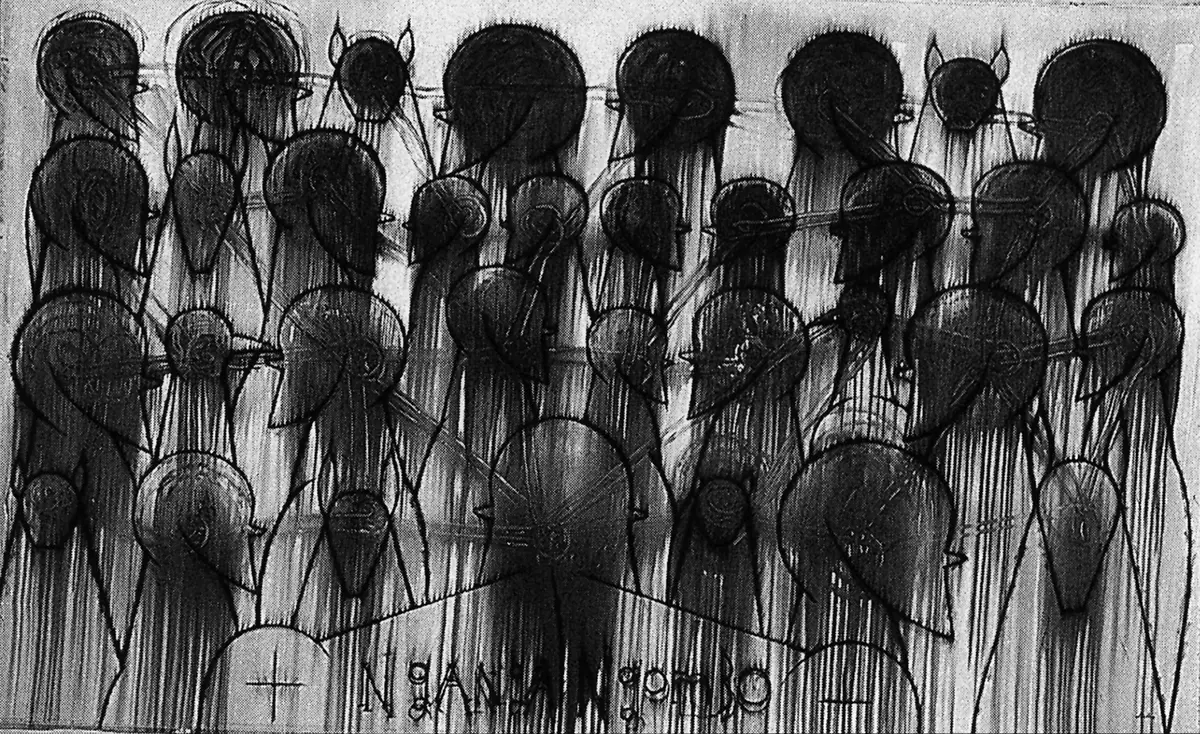
In another work, Nganga Ngombo (The Sorcerer, 1997), the central figure is a shaman with two heads, an initiate of the Palo monte tradition (he is carrying white crosses on his shoulders). The two profiles symbolize his ability to receive energy from other human beings or animals, according to the nahual tradition. In Bedia's picture, the heads are connected together with lines of fingers that are transformed into labyrinths. There are some animals, mainly dogs, and birds. The dogs, like the horses, represent the state of possession in the Palo monte tradition (in the moment of trance, the shaman is said to be "mounted"), while the birds represent the physical journey through the sky, the magical flight to the other world. Both the dogs and the birds are associated with the shaman, both in Palo monte and in several tribal traditions around the world.
El Pascola (1996) illustrates the Yaqui Indian ritual which is celebrated in Mexico during Holy Week. On Easter Sunday, the effigy announces the resurrection of Christ. It is dressed with flowers and with a mask attached to the head, as it appears in the image of the picture. The square pattern which forms the background is made with fingerprints and gives the picture a texture reminiscent of the mat-making work of Mexican peasants. The red color of the background makes reference to the strong colors of Mexican folklore and perhaps related to the theme of Easter and the death of Christ in the context of celebration.
Although the other works all have their merits and magic, without doubt, it was the installation titled Mi coballende (1999) that was the major work in the show. Inspired by St. Lázaro, the syncretic patron saint of sickness in Cuba, the work consists of a torso drawn on three consecutive walls which form a convex space. Within this space, and as a continuation of the figure, various elements made with natural materials can be seen.
The torso of the saint, painted in one corner (the crossing of lines is a spiritual space in the Kongo tradition), is marked with symbols of initiation or signatures. Its arms extend in zigzag form towards the nearby walls, and the figure is supported by three crutches which symbolize its difficulty in walking. The right hand is a dog's head, an animal generally associated with St. Lázaro and its only companion and guide. Around the dog's neck, there is a rope from which anisette liquor bottles hang, anisette being an alcoholic beverage associated with the cult of the deity.
Under the torso of St. Lázaro is a chair or throne with other objects related to the cult. The chair is furthermore the place from which the saint has symbolically risen, and is represented three-dimensionally by a pair of khaki trousers (a color associated with the deity) full of dried branches and fixed to the ground by a pair of shoes.
St. Lázaro, who is generally depicted as a solitary, indigent, and wounded figure barely able to walk, appears in this context as a powerful and absorbing being. By playing with the different dimensions of the installation and using the Asiatic perspective, which places the vanishing point behind the spectator (the vanishing lines are suggested by the crutches), Bedia inverts the proportions and makes the spectator feel completely absorbed by the deity. The concave torso of St. Lázaro physically surrounds the spectator, who feels overcome not only by the impressive presence of the image but by the atmosphere of spirituality in the air.
Mi coballende is one of the most powerful installations done to date by José Bedia. It is not necessarily an altar or a religious object, as he himself has said, although it clearly has a strong religious feel. What Bedia is most interested in is the content. The essence of the deity, the actual elements of the ritual (the anisette bottles, the water, the throne, and the tobacco), and the rich symbolism associated with the saint must be interpreted as the formal elements of a cultural product where aesthetic language is paramount.
FRANCINE BIRBRAGHER