The show
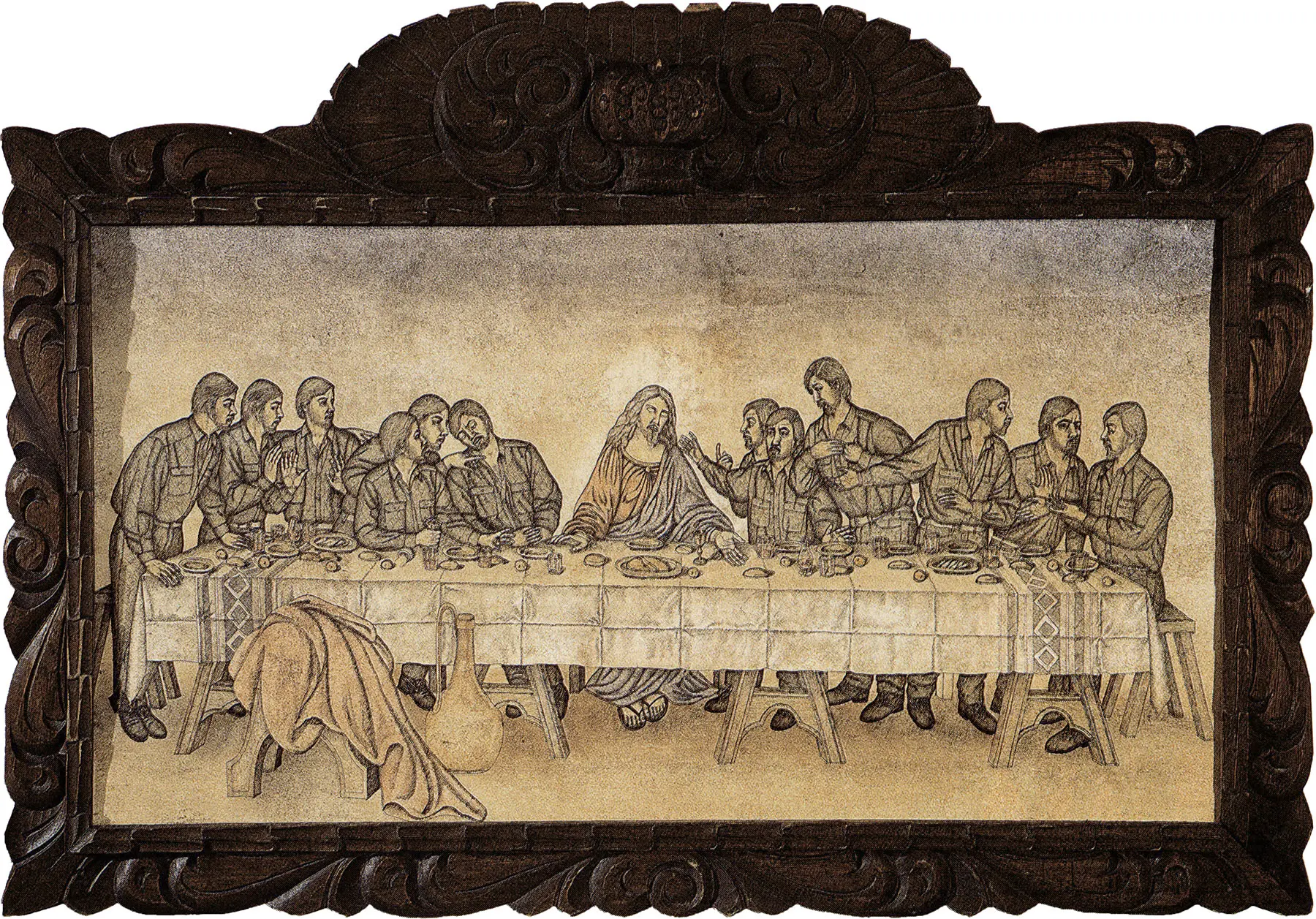
By way of introduction, let us look at the first of several of Zenil's installations. It is entitled The Last Supper and consists of a table and thirteen rustic seats. Only one chair, the main one, has armrests. On the table, there are sheaves of wheat, and resting on them is a three-dimensional head of Zenil. Nearby, is a picture that evokes the other, very well-known Last Supper by Leonardo da Vinci. In this version, only the image of Jesus has remained virtually intact. The apostles, on the other hand, have lost their individual faces and they all look the same, or rather, they all look like Zenil.
He is the central figure of his painting, a figure that is simultaneously unique and multiple, an individual entity and a mass, couple and lover, son and mother, master and pupil, painter and model. The focus is on his repeated and multiple identities. This illustrated biography also includes the presence of those persons who are dearest to him. Gerardo, his lover for a number of years, is one of the most recurrent figures in his work. We can also see his mother, especially in the pictures done after her illness and up to her death on December 31, 1987. "After she died, I never tried to do another picture of her. I limit myself to including references to the maternal figure in my pictures," the artist confessed to Cristina Pacheco in a recent interview.1
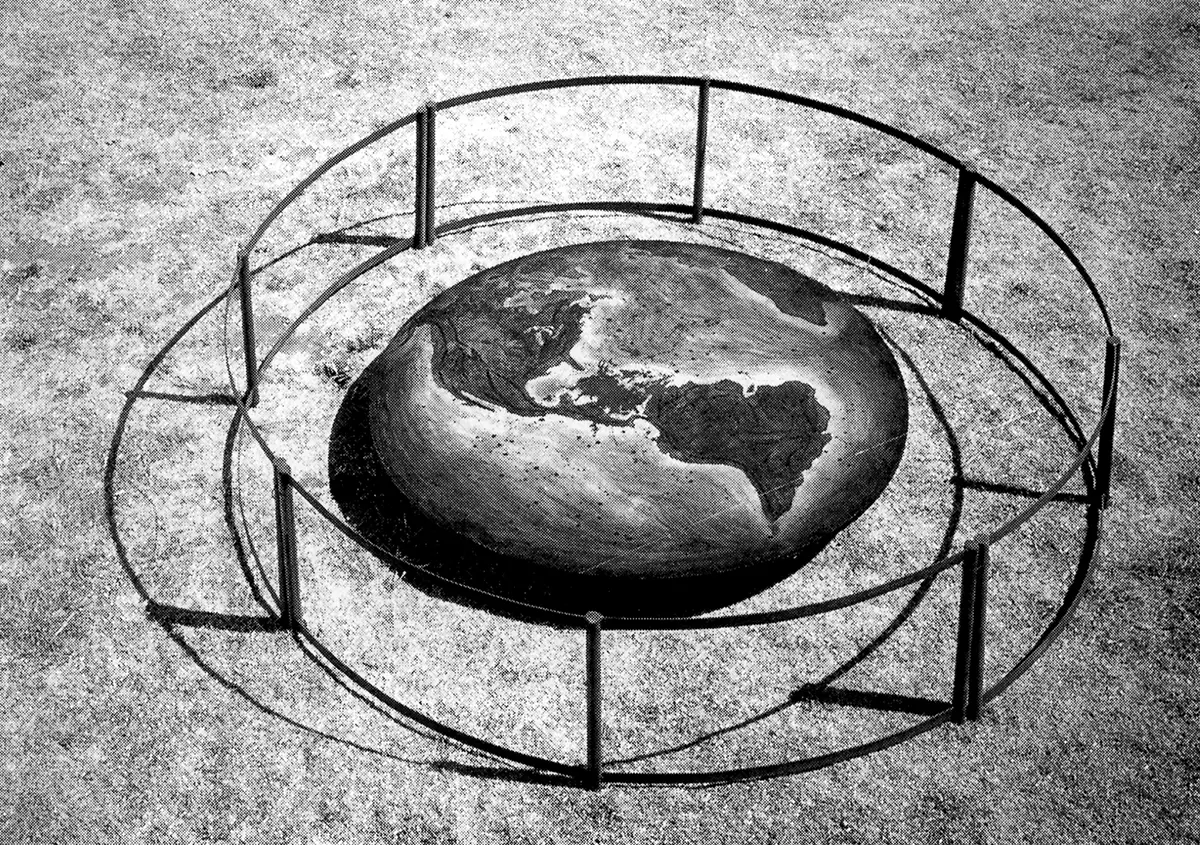
In The Great World Circus, hazard and chance are present. While we are actors in it, we can also play the lottery or admire the "Snake Man", meet the "Smiling Monster" or marvel at the "Contortionist II", who can not only bend his neck, legs, and arms in an incredible manner but (and this is his great merit) make his penis stiffen and rise up like a mast. Zenil renounces intimate secrets. He opens them up and shares them, and in so doing, he turns them into our own secrets so that we become a kind of public that enters, by invitation, into his private world. In a real circus, the acrobat who slips off the tight rope falls into a net. In Zenil's circus, however, the fall is fatal, since the acrobat falls onto an enormous planisphere on the ground.
The circus spectacle marks the frontier between our real-time and our festive time: the latter transgresses the former and invades it on its own territory. We suddenly find ourselves living in a comedy on a day on which pleasure and surprise were not on the agenda.
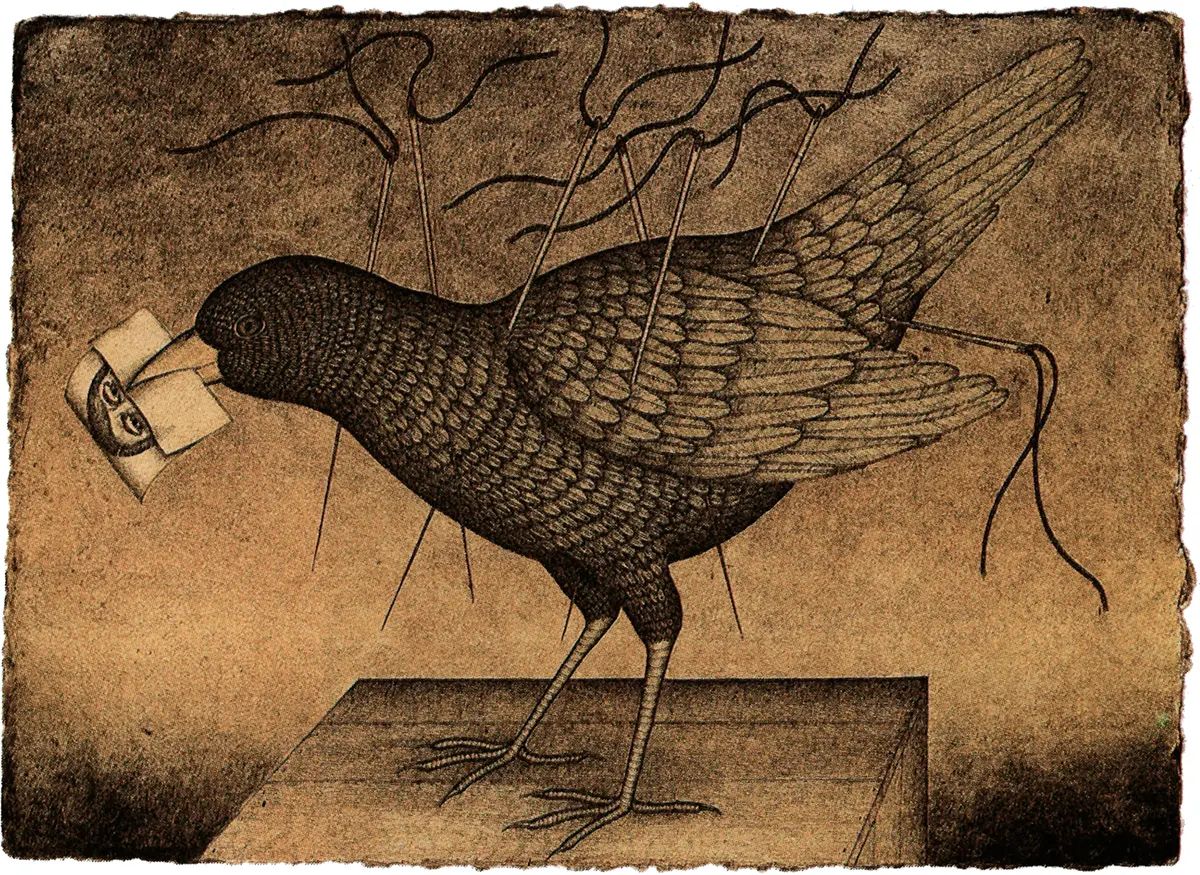
Thus the games unfold freely, with their meaning changing in the development of Zenil's work. The Bird of Good Luck contains one of the most terrible images of what fortune may mean. A bird is holding in its beak a piece of paper, like the trained birds at a fair which, in exchange for a few seeds to satisfy their hunger, come out of their cage and nervously select a folded piece of paper from hundreds contained in a small box. After dropping the paper, they immediately return to their prison. This typical fortune-telling tradition has been changed in Zenil's work: the bird holds in its beak a piece of paper in the fold of which we can see part of Nahúm's face. He is the piece of news, the prediction, the fortune—whatever it may be, that is being told.
The bird, about to deliver up the piece of paper, has been mortally stabbed by seven long sharp sewing needles at the ends of which we can still see the traces of thread which now only serves to finish off the bird's life. This is an important aspect in Zenil's work-the double (or multiple) meaning of elements that are repeated from picture to picture. Just as in the past it was angels that gave the news of life, now it is a fatally wounded bird that is predicting the future.
The name of the filmmaker Luis Buñuel, who constantly showed women in the act of sewing, springs to mind here. The final scene of That Obscure Object of Desire (and also the final scene directed by Bunuel in his long film career) shows hands skilfully embroidering a piece of lace and repairing a tear in the material. Bunuel used in his films actresses like Catherine Deneuve, Simone Signoret, and Jeanne Moreau, amongst others who, under his direction, performed the task traditionally carried out almost exclusively by women of knitting or embroidering. The act has a similar meaning in Zenil's work, where it evokes the idea of the female presence and, in some cases, the maternal influence.
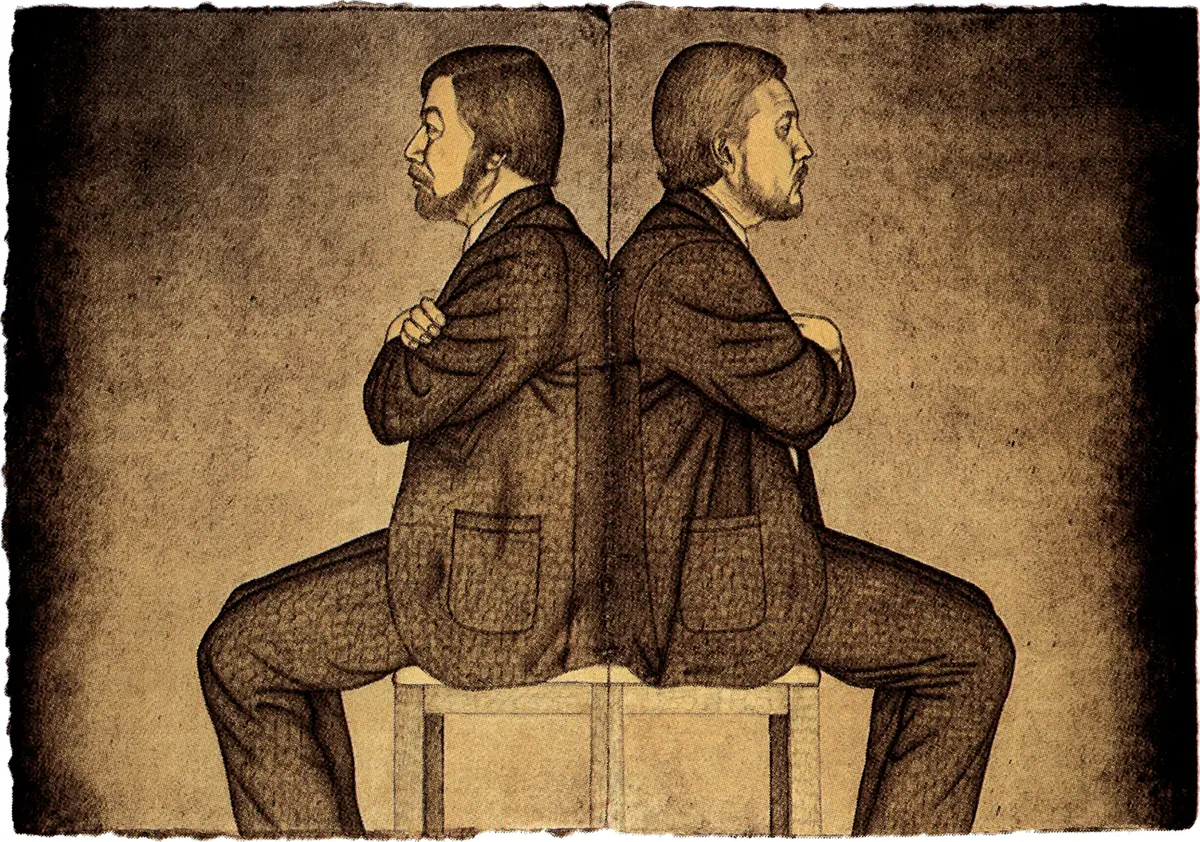
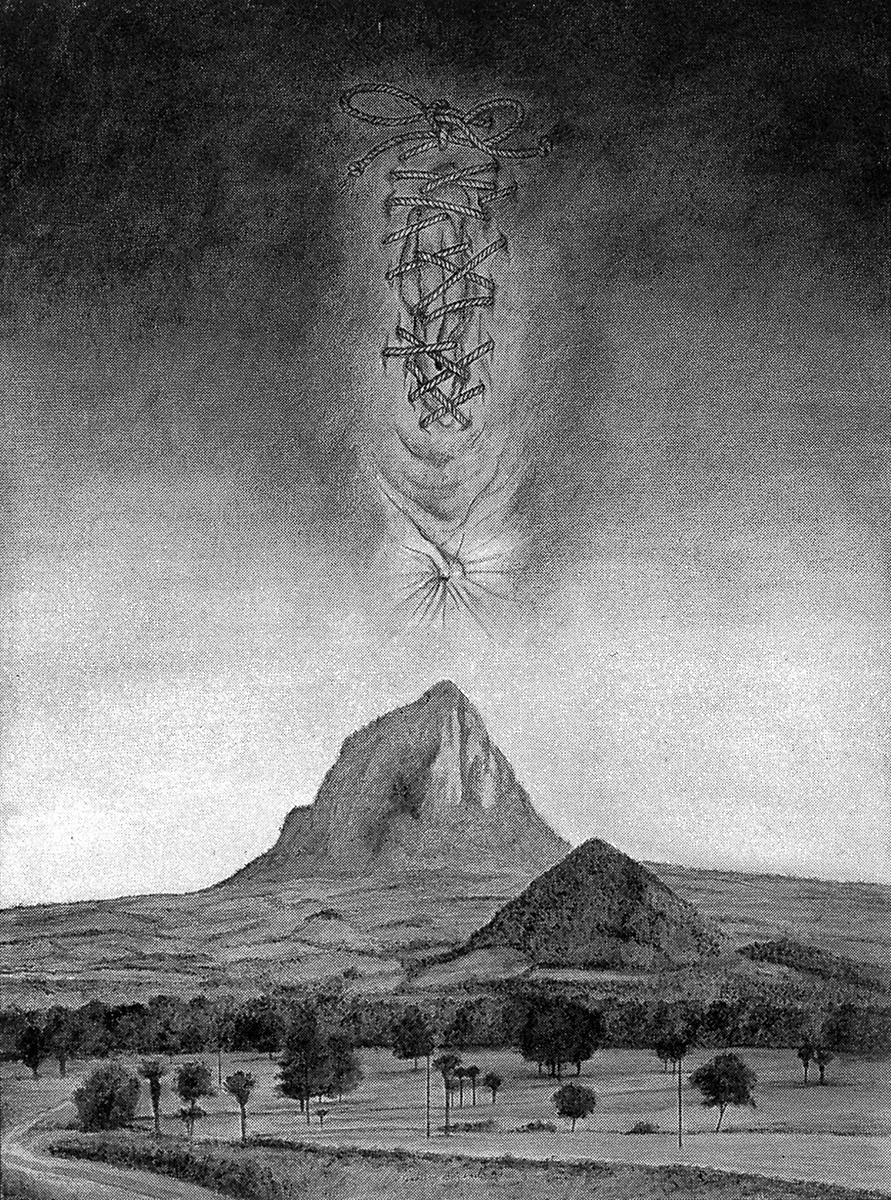
Figures linked by a thread evoke the idea of this task of sewing which remains a reality today through a linkage, as in Siamese by force, which joins together Nahúm and Gerardo back to back, or through a negation, as in Prohibition Zone. This picture which is unlike Zenil's other work in composition and finish, shows El Tecomate, an idyllic landscape from his childhood featuring a sharply pointed mountain. Like an enormous apparition in the sky, a sewn-up vagina is suspended in space. In front of the picture, Zenil has placed a cord that physically separates the work from the spectator. "This is my prohibition zone —he explains— because these are things which I cannot have and therefore I also want the public to keep their distance from the picture."2
The decisive presence of Zenil within his own work is characteristic of his production. If we look back over his long career, we can see that he has in fact patiently and meticulously painted his own life. At the opposite extreme of Zenil's work are the portraits of Aziz-Cucher.3 In these works, all the facial orifices (eyes, nostrils, mouth) have been eliminated by the computer, so that the subjects appear as sceptic, inexpressive beings on the point of dying within themselves, without any possibility of exteriorizing their words or gazes, but at the same time making it impossible for the air, light, smell, and sound to penetrate them. Another feature of the work of Aziz-Cucher is the inability of the figures to release their biological waste (faeces, urine, menstrual blood) or to reproduce themselves since they . have lost their vaginas, penises, nipples, and such vital parts as their facial features which participate in and are actively expressed through the interplay of human relationships.
In contrast to Aziz-Cucher, Nahúm Zenil lives, breathes, enjoys, and participates in life through his orifices, through his features which are always similar in their appearance, and through his living body which is connected to the world.
Another work that reconstructs identity is Portrait. It consists of a glass box containing hundreds of pieces of the dung of various colors and shapes. Eschatology is used here as a metaphor for the human representation, of the body as something transformable and finite. Through this reduced temporality, the artist emphasizes his need to exist and that note should be taken of his passage, although such an act might reveal his status as a waste product. "This is what we are in the end,"4 the artist explained to me, indicating the glass box full of excrement. And so, after agreeing to enter the circus (into the imaginary evocation of the inside of his body), through the mouth of Nahúm disguised as a clown (Entrance-Exit), we necessarily have to come out at the other end through an enormous anus (Exit-Entrance), transformed into waste material.
This is a symbol that, like any symbol, is multi-faceted. As Alfredo López Austin has pointed out, "shit is an expression of nausea, scorn, mockery, laughter, complicity, fear, anguish, aggression, thousands of messages in asymmetrical and never complete reciprocity; messages which are contradictory, conflicting, complementary, parallel, unrepeatable, unique. There it is, far from its nature. It is like any other symbol. A symbol like corn, sex, fire, cold, rain, the Sun, a house, a mat, and a walking stick. Like a clenched fist, which might be a threat, an expression of determination, or a fraternal greeting..."5
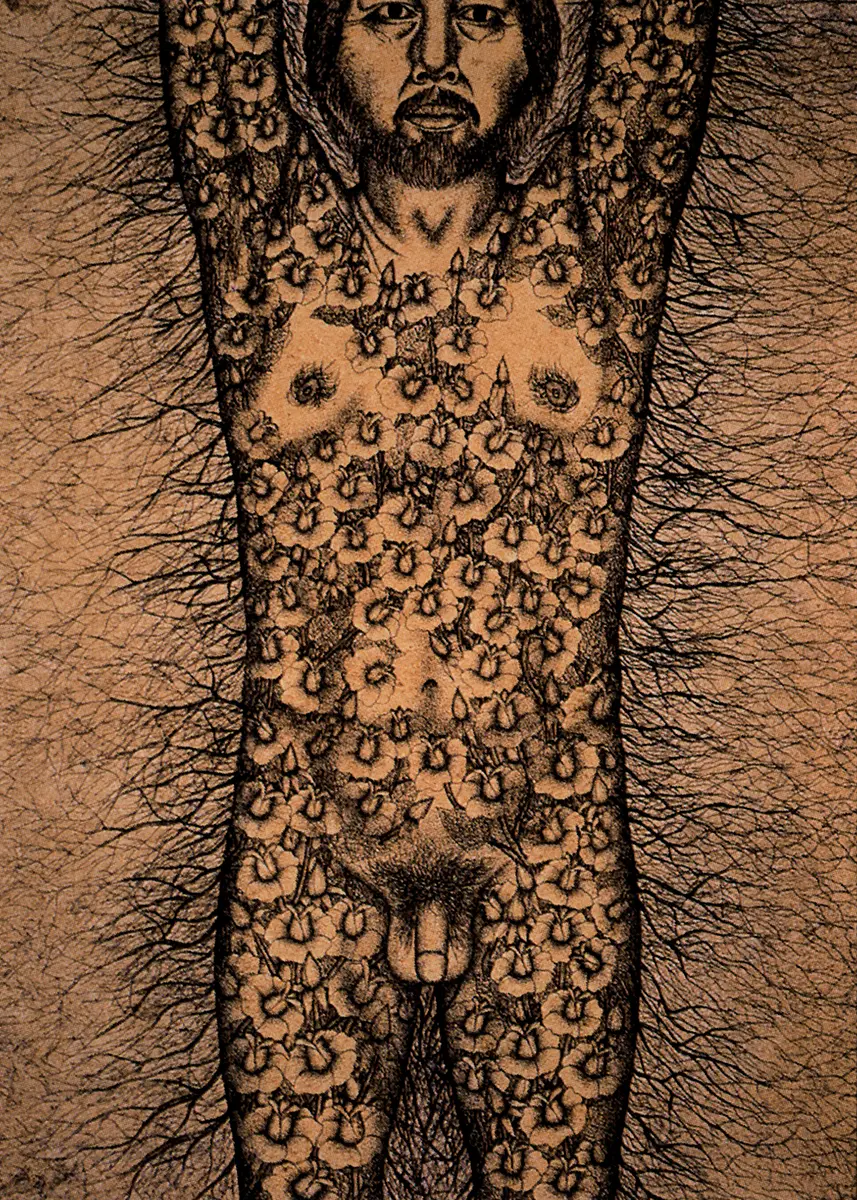
And identity? To show and exhibit oneself is to show and exhibit through one's body the feelings and beliefs (whether as regards religion or patriotism) which are part of the constant construction of a very personal identity. There is no sexual innuendo in the work of Zenil, except in the eyes of those who obstinately refuse to see his work as a message of brutal love, a love that gives no more license than that required for its full accomplishment. For this, Zenil uses his face, his body, and the body of Gerardo, his mother, and the saints, their robes, and iconography and which, without being venerated, inhabit his hours of ritualism and fervor.
The most important identity is his own, which he has defended and fought for tenaciously. Zenil seems to disorder the world rather than re-invent it; yet in reality, what he does is open up new paths for a deep river that will soon flood the branches of this new stream in a spectacle that is both handsome and hallucinating. The essence of the work of Nahúm B. Zenil does not lie in the iconographic collection of patriotic or religious elements, nor is it to be found in the artist's sexuality or even in himself.
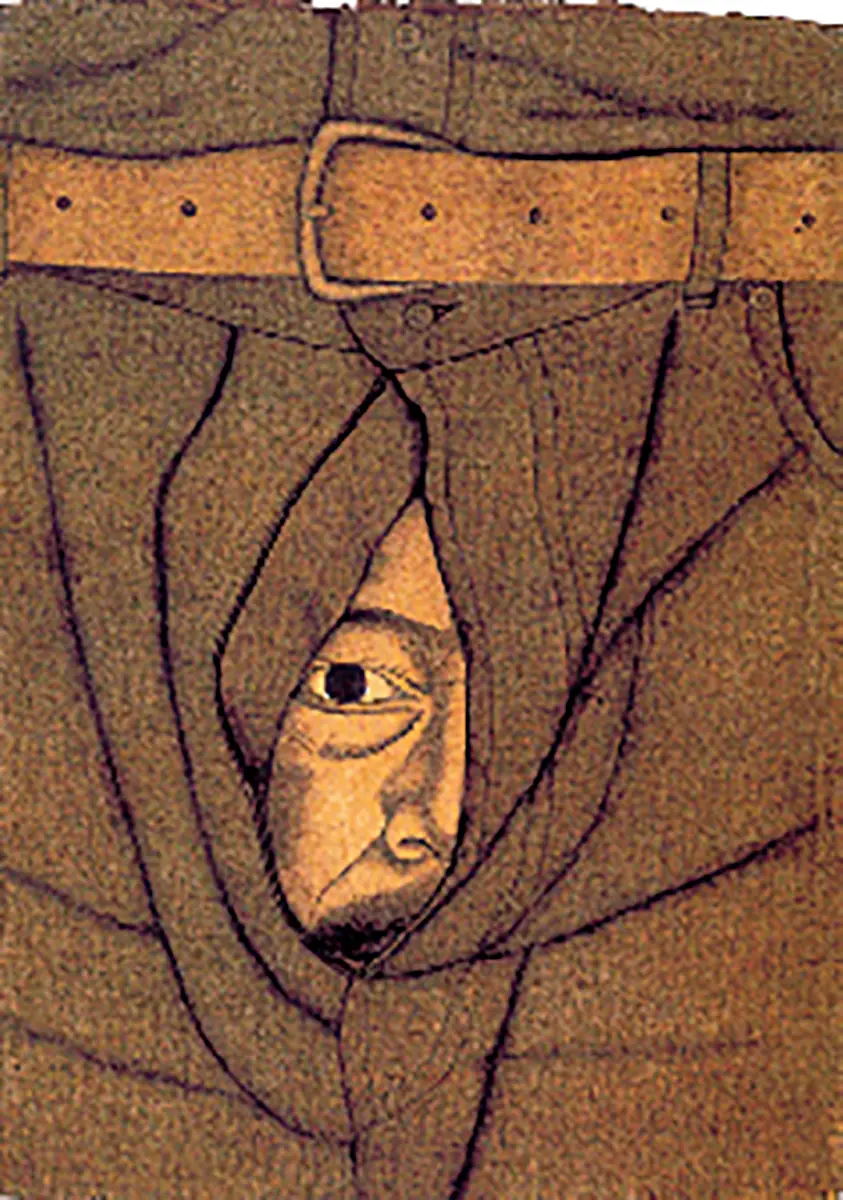
The heart of his work is his profound sensibility to any event that may occur before his eyes, and the transformation it undergoes on entering his world.
Sexual preference does not shape the essence of identity in Zenil's work. His vision of the world has more to do with the matter of human desire which, through himself, has been the driving force of much of his work. It is not possible to ignore the considerable irony (and even cutting humor) in his references to themes that in the past were considered sacred, such as the fatherland, religion, Mexican-ness, sexuality, etc.
As Luis Carlos Emerich6 has written: "His humorous confrontation with contemporary morality (i.e. with no specific morality) allows him to create forbidden sexual desires and incorporate them in a new concept of realistic normality in which the couple is the result of natural law rather than nature defined by regulations." Zenil clearly makes a statement about the condition of his desire.
Faith is also implicit in desire, where religious belief is both deep and full. There is here a personalization and re-iconification of prototypical religious icons, which concern not only the world of faith in Zenil's work; the mythical iconography (Mother, Serpent, Devil, La Guadalupana, Blood, Excrement, Thorns, Wings, etc.) acquires considerable presence and renewed meaning in his hands.
It is for this reason that even in the most obvious cases the treatment of religious beliefs in Zenil's work goes well beyond the mere representation of the figure in question. The case of the Virgin of Guadalupe is one of the iconographic substitutions which best illustrates this process. The facial features of La Guadalupan are replaced by those of another figure whose personality and importance in the intimate affections of Zenil play a key role-i.e., his mother. He retains the well-known garments and the prototypical elements. She becomes therefore, without the artist insinuating himself as God, as he presents himself as a cherub holding up the crescent, his own personal Virgin ("Thank you Little Virgin of Guadalupe"). The semantic relationship is direct since the Virgin has been called the Mother of all Mexicans; she is therefore Zenil's mother. But she is not only not remembered and thought about. Beyond her actual portrait, the mother can be venerated by her son Nahúm in the identifying garments of the Guadalupana figure. Is this profanation? No. It is rather a transubstantiation that makes these works highly respectful expressions, an intimate tribute to the prototypical figures of religious iconography.
The work of Nahúm B. Zenil is at this stage of his important career a metaphor for his relationship with his lover, with religion, and the fatherland expressed through his iconography. He reworks the visual elements of these three major themes in his painting to create an important way of re-reading, by means of this new writing, the surroundings in which he finds himself, along with Gerardo, his beliefs, and his ways of keeping his feet on the ground. The spiritual realm is now the concrete world. Zenil's self-portrait is not the image of something inside, but rather intimacy transformed into something corporeal-although the real Nahúm may appear less and less like the painted Nahúm, with the two-dimensional Nahúm becoming increasingly like an idealization of the real Zenil.
Today we know that the figures of a circus are not always people who travel from town to town and whose lives take place under the big top. We also know that circuses have rings that we have agreed to call streets, houses, and countries, whose inhabitants prepare themselves energetically each day in an attempt to outshine one another. The great world circus consists of a lottery ticket and an injured bird telling us our fortune. None of the performers works with a net to protect themselves in the event of an accident. You come out of one circus and enter another. But this circus will be presenting its performances for an indefinite period, without any specific times for the shows, and it is suitable for all kinds of public.
NOTES
1. Interview with Nahúm Zenil by Cristina Pachecho, titled “Entre la sexualidad y la culpa,” published originally in La Jornada Semanal (January 15, 1995) and subsequently in the exhibition catalog Nahúm B. Zenil: Witness to the Self (March 16 - September 1, 1996), curated by Edward J. Sullivan and Clayton C. Kirking, The Mexican Museum, San Francisco, California.
2. Conversation with Nahúm B. Zenil at his home in Tenango del Aire, March 1999.
3. Aziz-Cucher are Anthony Aziz (United States, born in Lunenberg, Massachusetts, 1961) and Sammy Cucher (Venezuelan, born in Lima, Peru, 1958). They met while studying at the San Francisco Art Institute, where they began to work together in 1990. They have received various awards, including the Ruttenberg Award from the Friends of Photography at the Ansel Adams Center in San Francisco, as well as support from Art Matters, Inc. and the Western States Art Federation.
4. Conversation with Nahúm B. Zenil at his home in Colonia Condesa, March 1999.
5. Alfredo López Austin, Una vieja historia de la mierda (Ediciones Toledo, Mexico) 95 pp., first edition 1988.
6. Luis Carlos Emerich, "Nahúm B. Zenil: El morbo y la lira," in Figuraciones y desfiguros de los 80s, (Mexico City, Editorial Diana, 1989) pp.151-154.
*All illustrations are photos by José Ignacio González Manterola. Courtesy: Museo de Arte Moderno, Mexico City.
SANTIAGO ESPINOSA DE LOS MONTEROS
Mexican curator and art critic. Correspondent for La Jornada journal and curator of the National Fund of Culture and Arts of Mexico.