
In its desire to eliminate barriers and transgress conventional limitations, contemporary art is undergoing a kind search for new foundations and innovative media. It was in this context that Nela Ochoa produced a video installation titled Lejana, the structure of which was the result of a combination of various disciplines.
A story by Julio Cortázar provided the axis around which the artist created her video, where images and verbal phrases alternated with expressions taken from music, dance, and theater. To further increase the persuasive resonance of these elements, the artist organized the space on the basis of plastic criteria which enveloped the spectator in a tense, challenging, and moving atmosphere. The projection was done on two screens separated by a large central mirror that enabled the reaction and presence of the public to be reproduced. This mirror also reflected a figure with the ragged dress of Alina Reyes, the central character in Cortázar's story, and a role played by Nela Ochoa in both the video and the performance that inaugurated the work at the Alejandro Otero Museum.
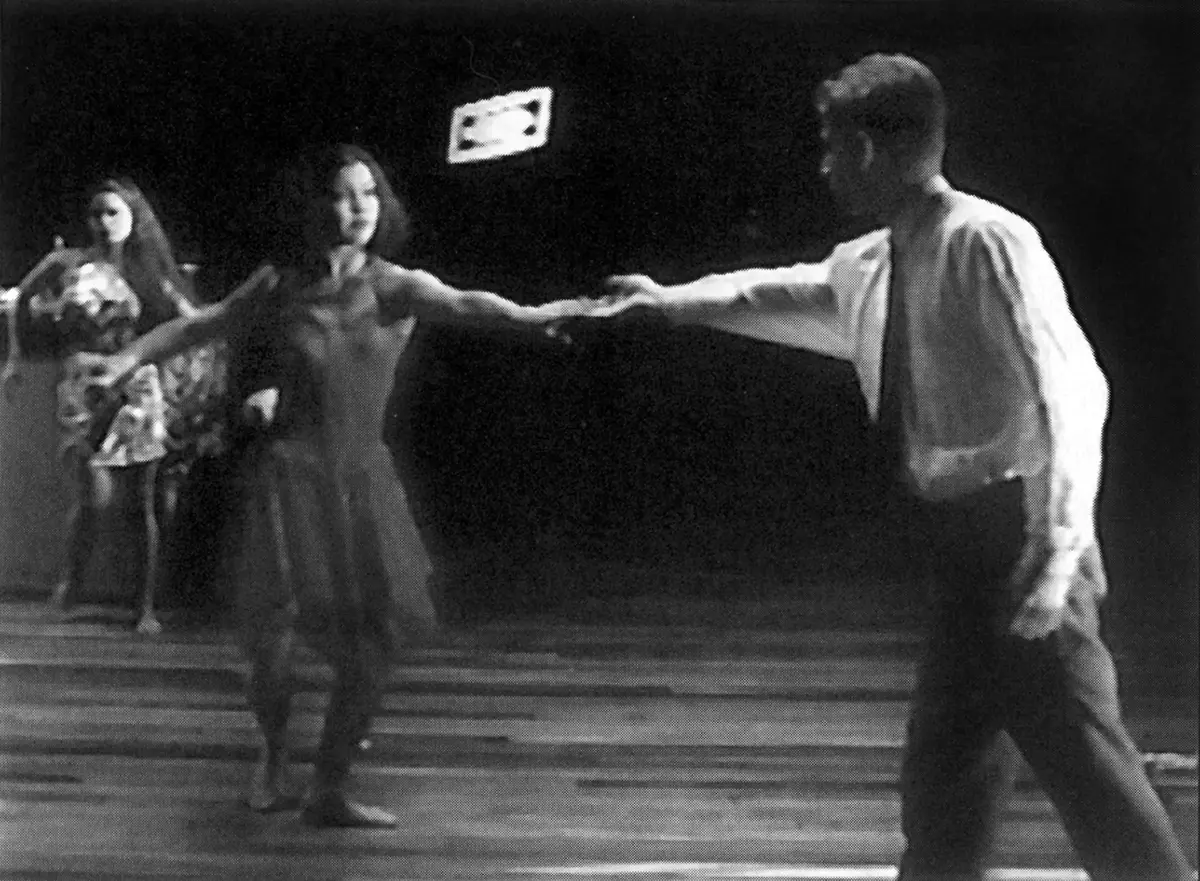
The relationship established between the literary, visual, auditory, scenographic, and plastic media avoided any kind of subordination criteria and led to the emergence of an extraordinary spatial and environmental synergy. Sensations flowed and accompanied the story of Reyes, who records in a diary her dramatic journey towards extreme poverty and destitution. In this context, the artist also makes use of autobiographical accounts by incorporating phrases taken from old diaries which further increase the sense of alterity and otherness, lived experience, and the simultaneous sense of identity and ambiguity which are at the heart of the concepts through which the work is developed.
The interpretations and incorporations made by the artist on the basis of Cortázar's text, as well as the environmental resolutions and multi-media integrations are magnificently combined to produce various emotional effects and powerful resonances at the reflective and intuitive levels. In the midst of these feelings, thoughts, and intuitions, a symbolic texture emerges which is impossible to separate into its constituent parts. The contrast between a happy youth and subsequent destitution produces a tension of superlative amphibological connotations. To use the words of Mario Trevi, we might say that the insistence on bringing together opposites, without negating their opposition, is the hallmark of symbolism. In this case, the artist brought together various kinds of contrasts that resulted in a kind of schizophrenic delirium: we are what we are not or we are not what we are but what we have become through our contrary condition. Or to put it another way: we are what we are because we know what others are and what we have of others, and to avoid what others are.
Perhaps the main question the artist wanted to raise was precisely the question of identity. The self in terms of solitude, the self plus the other as plurality, or the self as equal to the other as alterity. The "I" is a grammatical illusion (Nietzsche)and the "I" is a metaphor, a parasite.. . and a mirage. At this point, we should recall that it was not by chance that on the face of the dummy with its back to the public was a mirror in which the spectators were tempted to look in order to internalize the appearance of physical precariousness and psychological despair. It is possible that Ochoa took something from Christian Boltanski's aphorism that the artist is someone who holds up a mirror in which those who look can recognize themselves, but with each seeing a different image.
Identity can never be imprisoned without knowledge of otherness and alterity. Neither can it be conceived independently of simultaneity and ambivalence, because as Pascal said, human nature is a mixture of many natures. Identity is the consequence of looking at ourselves after seeing the other from the other, with the other, opposite the other, through the other, and for the other. Furthermore, to be ourselves, we need to detach ourselves from ourselves and be there where we are not yet ourselves (Massimo Desiatto). As Jaspers said, "I am not alone."
Cortazar's text is thus a pretext for developing the context and intertext of identity. For this reason, the video installation might be sub-titled "The symbol of the self" or "The self as a symbol." This intention is further strengthened by the experiential input from the artist herself during the production of the video. She played the part of Alina Reyes and incorporated her feelings as if they were her own. Dressed in rags as if she were a beggar she went around public places and experienced firsthand the life of disdain, underestimation, and abandonment of such people. Life is not made up of what is heard or said: we live life only through the events that affect the flesh of our body and the essence of our spirit. This experience is complemented by self-referential elements, which, as Zuleiva Vivas points out, allow the artist "to reveal herself before us, to open up her diaries, to eliminate the pressures of time and space and to broaden the vision of her inner feelings... leading us towards certain dark territories of reality and fiction." In this audacious discarding of inhibitions, Nela Ochoa shows that her work is not an attempt to tell a descriptive story or present an aseptic account of an event. Her interest is more symbolic and conceptual. The symbolic strength lies in the process of revealing and masking, concealing and showing, simulating and dissimulating. She knows, along with Jung, that a symbol is alive only if it is pregnant with meaning; but when a symbol has given birth to its meaning, it dies. To this must be added the conceptual profundity which results from intense and secret questioning. As Collingwood has said, a text or a work can only be really understood when one has understood the question to which it is a response. The problem is that in the world of aesthetics, the art of asking questions is the art of continuing to ask questions.
VÍCTOR GUÉDEZ