
The presentation by Noemí Márquez in the mid-1980s of her sculptures with ceramic bases was a major artistic event. The artist thus introduced an element that changed the dimension of art in Venezuela through her very simple, large format vertical sculptures, with their very rich textures, which exalted the ceramic-based process as a major art form.
Since then, Márquez has investigated the expressive and formal possibilities generated by her work. Her main forms are columns or walls, presented individually or grouped together like an installation. They are between one and four meters high. The bodies are markedly cylindrical or square, straight or semi-inclined, topped with a sphere, an arabesque, a horizontal tubular line, a kind of wedged piece, or a volume that seems to challenge gravity itself. The colors of these sculptures include chestnut, ochre, red, black, and sometimes white, the marks of fire, and a variety of damp earthy tones.
On the columns the artist inscribed written signs, a grammatical texture made up of an interminable ascendant and enveloping graphism. Then there is her particular relationship with her materials, her explorations of small cavities, lacerations, corrosion, and an exuberant and at the same time discreet addition of little stones and seashells that heighten the cosmic quality of the pieces.
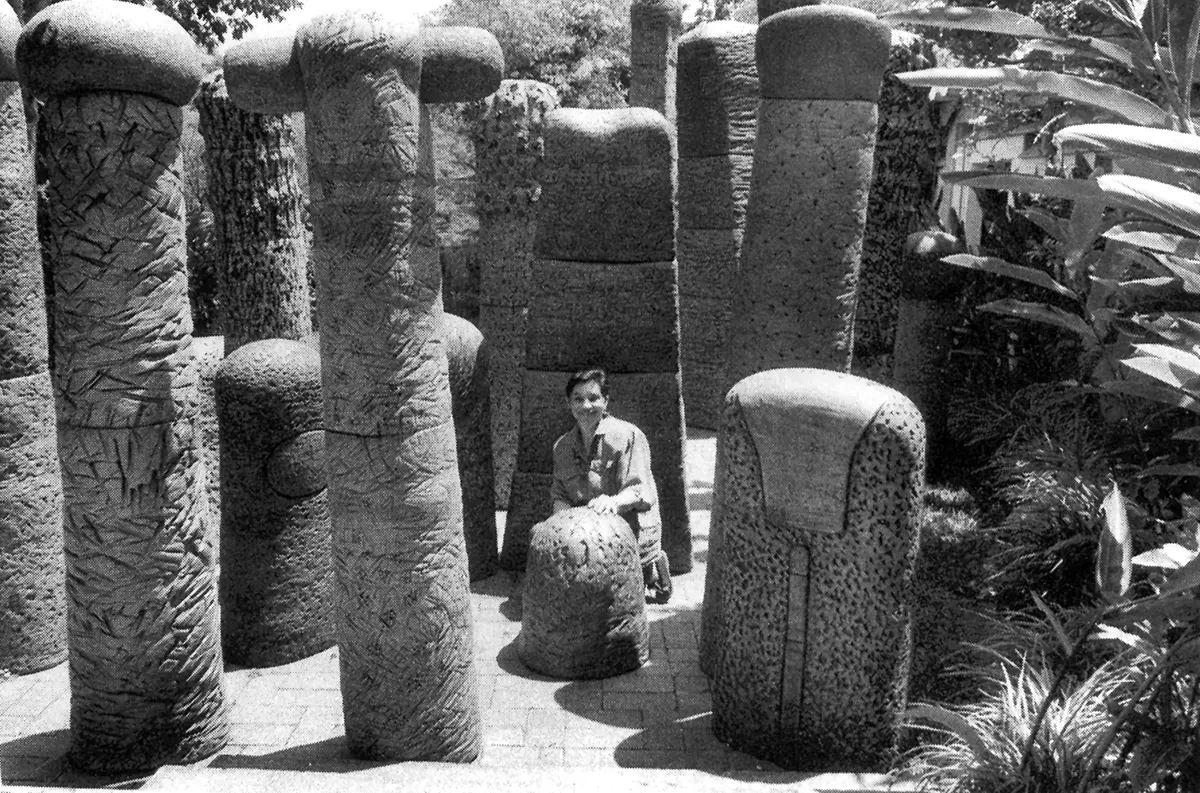
All this work has provided a new opening onto space and the sculptural body. Noemí Márquez seems to reinvent new possibilities for sculpture, like Miró, who used the arts of fire to propose impressive volumes in space. Márquez's work, too, is the result of a contemporary approach to an archaic conception of man's aesthetic legacy.
Undoubtedly one of the characteristics of contemporary art is its close relationship to primary forms of expression, reworked in light of the ever-present expectations and existentialist doubts. Noemí Márquez reveals to us, in her many pilasters, columns, and walls, the commemorative qualities of art, the sacred dialogue that it implies, and that useful space that fuses the real with the imaginary.
A book on the artist with texts by Roberto Guevara and Juan Calzadilla is titled Tributo a la Tierra (Tribute to the earth, 150 pages, 1995). This exhibition was titled Clay idols in search of an altar, a title that reaffirms Márquez's artistic origins in earth and clay. Fortunately, these two aspects of her work-the primitive and the sacred—are spontaneous, that is, there is nothing resembling a formal pose here, none of the opportunism of a trend, but rather work which is the consequence of a process and a conviction. Her work is seen as a process of cultural dialogue, the result of cosmic and conceptual encounters.
There is another feature worth noting in these sculptures: their texture and exteriority. There is no single center here, but rather an infinite variety of forms making up volumetric and ascendant calligraphy. A texture that is both visual and tactile, encompassing the object and stirring the feelings of the spectator.
JUAN CARLOS PALENZUELA