
The language of Olga de Amaral has remained virtually unchanged in recent years, but so has the interest and pleasure evoked by the exquisite finish of her pieces. Our experience of her textiles continues to be both gratifying and powerful. One of the most persistent characteristics of her work lies in the dialogue which she establishes with architecture, a feature that certainly is due to the character itself of the tapestry which is designed to be hung on a wall. In this respect, a comment once made by the architect Rogelio Salmona is pertinent: "Architecture is present in all of Olga de Amaral's work. An architecture built on the ancestral gesture of a repeated, insistent and obsessive craft. An architecture enriched by communion with the Andean landscape through the subtlety and depth of the color of the earth-meticulous, compressed, and agile. It is a work done with materials that can be recognized in the environment, a work that communicates emotion through the subtlety of its preparation, and which is imagined in space, which it illuminates and divides. An architecture that is complemented by architecture."
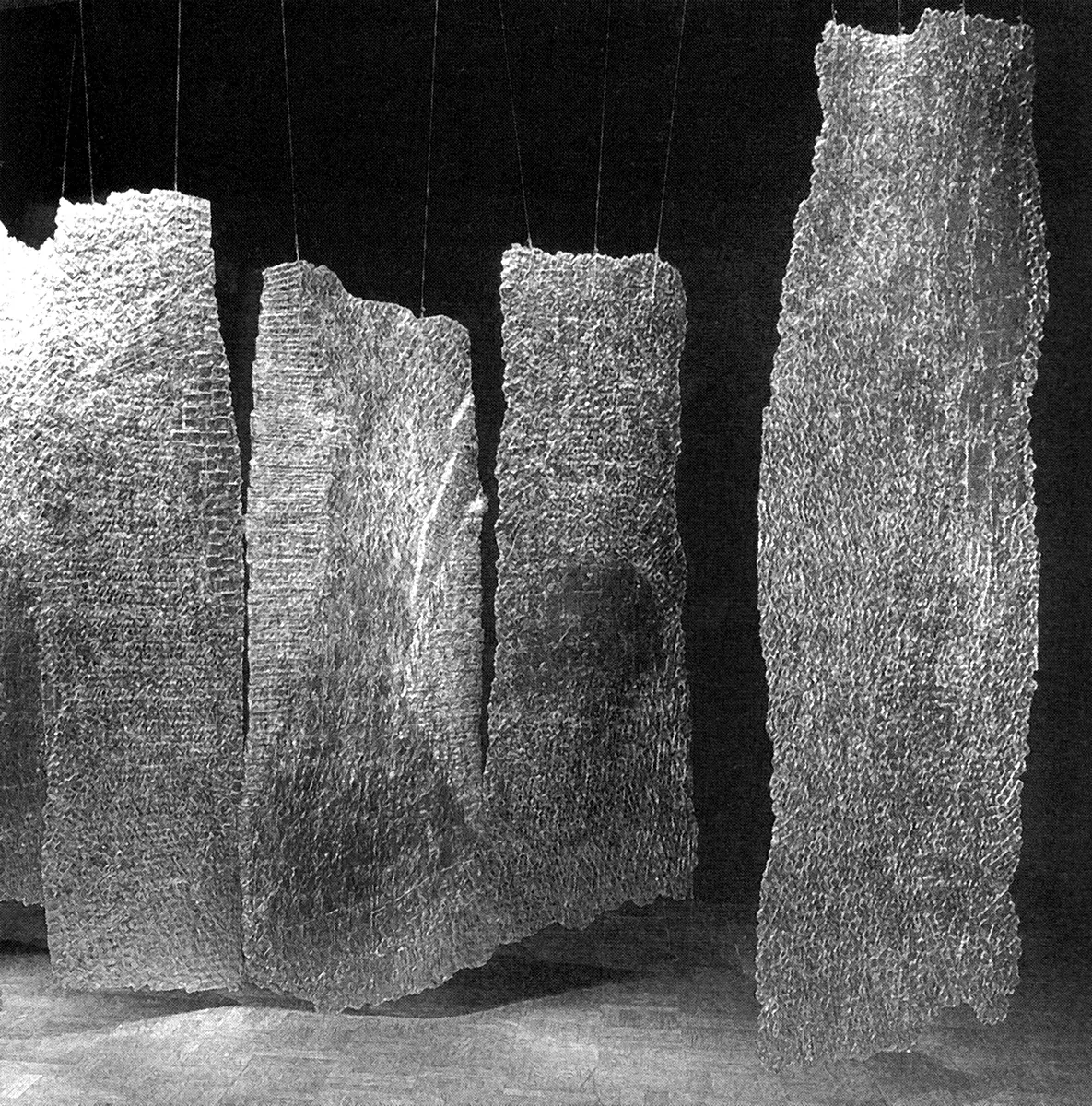
It is precisely the relationship her work establishes with the wall and architectural space that was in evidence in the installation which was part of her most recent show at the Diners Gallery in February and March. Under the title of Steles, Forests, and Umbras, a series of pieces of different formats dramatically affirmed the sacred and ceremonial dimension that has characterized her work throughout this decade.
The exhibition, which combined pieces full of rich and refined chromatism with others done in gold tones, culminated in a longitudinal room that was partially darkened. In it, a dozen or so pieces had been hung in accordance with the structure of the space; some were woven with golden materials that gave them a luminous and radiant presence, while others were made with dark fibers evocative of shadows, or absences. The visitor to the room was greeted with a powerful and austere image where time itself seemed to have stopped. Because of the penumbra, the tactile nature of the work was camouflaged, revealing only the presence of the fabric, the primitive and ancestral nature of which was in many cases powerfully evoked. The staggered arrangement of the pieces with their absolutely irregular edges invited the spectator to enter and move through the space, in a direct experience with these presences. The works were done on a scale equal to the spectator who, on approaching the pieces, could appreciate the very subtle and flawless quality of the weaving. The Andean music accompanying the show was perfectly in keeping with the quality of the works which, as in Amaral's other production, evinced a minimalist rigor that further heightened their effect.
This new kind of arrangement in space, which was rather theatrical in the positive sense of the term, signals a new reflection on her own work which has already been widely recognized both in Colombia and outside the country.
MARTA RODRÍGUEZ