
With this Nerudian-sounding title, an Argentine art show was organized at the Jack S. Blanton Museum at the University of Texas, Austin. The Blanton Museum is nothing more than the famous Archer M. Huntington Gallery with a new necklace. For decades this was perhaps the only university institution in the USA that was seriously focused on contemporary Latin American art, and it definitely had the most important collection. It was reborn as the Blanton in order to honor its namesake who donated money for a new building that will open its doors in 2003. Besides speculating about whether the Latin American focus will be maintained in the future, the obvious temptation is to worry about the destiny of Mr. Huntington, who gave this institution its first name. These are interesting issues indeed, but they are not the motive for this note. Here it is more fitting to talk about the show of the nine Argentine artists grouped under the title.
Actually, the show's poetic title shares the sarcasm that saturates the majority of the pieces in the exhibition. Chosen to express that sarcasm precisely, the new artists formed a group that is both suggestive and evasive at the same time. The show does not embrace the art of the last thirty years (thirty-six to be exact, 1961-1997) covered by the works on display. Going beyond that, the selection of artists captures a transparent spirit that characterized the period. In a country with the size and artistic ambitions of Argentina, an artistic novena, in general, would represent nothing more than a small courtesy. In spite of that, the exhibition succeeds in pointing out something very close to national identity. The absence of several artists in this strange configuration (Antonio Seguí, Felipe Noé, and Norberto Gómez, to mention just a few), does not seem indispensable to achieving the show's purpose.
This said it would seem that the purpose of the exhibition is clear. But what is it? It is evident that here there is no attempt, nor could it be attempted, to define an essential regional specificity. However, that is one of the consequences: at least it does not seem to be a show that could be attributed to any other country. It also does not seem to try to illustrate the work of a coherent group: they are all individual or individualist artists who, except for some incidental friendships, never worked in mutual agreement. All in all, it is undeniable that there is a union —a common denominator— that expresses itself in a carnivalesque, and often vulgar, cynicism, in an almost totemic common use that antecedes the (innocent) illustrations of Molina Campos (even when only Benedit alludes directly to his work), in a will not lose itself in the tower of elitist speculations.1 Nor can we speak of a generational presence, except for the work of Antonio Berni, a sort of father to all of them, and ungraspable in a stature that seems to grow continuously. What age does not separate, the diversity of origins and careers of each one does (from Berni's Latin Americanized social realism to Benedit's folkloric conceptualism, from Ferrari's political conceptualism to de la Vega's comic Cobra, etc.).
The nine artists exhibited are Luis Fernando Benedit, Antonio Berni, Juan Carlos Distéfano, León Ferrari, Víctor Grippo, Alberto Heredia, Rubén Santantonín, Pablo Suárez, and Jorge de la Vega. For Mari Carmen Ramírez —curator of this show—, the aforementioned sarcasm is irreverence and parody. She bases the notion of parallelism on these two concepts: the observation from outside and a critical reconstruction of reality where contamination is avoided, ''counterhistory in response to the official history." But although irreverence and parody are key ingredients of this attitude, the words never fully translate that "excess poison" that characterizes those of us from the Southern Cone. It is the particular attribute of the urban cultures of Argentina and Uruguay that generates that rare blend of dislike and admiration in the rest of the continent, often concentrated in the tropical jokes about Argentines. The title Cantos paralelos (Parallel songs) fits perfectly here because it shares that poison (could it be contagious?), and it is certainly applicable to the exhibition.
Although the dislike of the Southern Cone partially responds to a certain intellectualist pedantry of Buenos Aires, it is also due to the shock produced by the lack of courtesy that is part of the package. The "poison" goes directly to the point, there are no adornments or apologies, and, by confiding in the third element, humor, the message is softened. But that gentleness is generally absent. The humor is cynical and only succeeds in sharpening the point of the poison, not sweetening it. That talent for straightforwardness, and directness, is what (sometimes) succeeds in producing admiration. The admiration in this case is the convalescence experienced after suffering or perceiving the effrontery.
In the case of the artists chosen, there is no pedantry. Yes, there is a sarcasm of the wounded, of the survivor. It is the expression of the individual aware of the fact that there is no possible recovery after decades of broken promises. It is the response from someone who confided in democracies either false or cut short, from someone who lost relatives in the struggle, who created art as if he were committing a crime. It is the voice of the person trapped between authentic emotion and foolish sentimentalism, of the person lost in the labyrinth, who no longer merely mistakes the exit, but doubts that it exists. There is no place for pedantry because insecurity itself defines the security of what has been done. None of the artists are interested, beyond some flourish of technical virtuosity, in flaunting knowledge or martyrdom.
It is interesting that, within this commonality, a shared style or aesthetic is not outlined. The answer could just as easily be expressionist and baroque, or cold and contained. Benedit and Grippo are the most cerebral, educated by conceptualism. Ferrari (who precedes conceptualism) is the most conceptualist of all and could, to a certain extent, be branded a conceptualist-expressionist. But whatever the formal resource is chosen or the category used to classify them, the artistic response of all these artists is always biting and bitter. In this sense, the word "song" in the title is ambiguous. It could also be interpreted as the blunt side of the knife, the one that causes even more painful cuts.
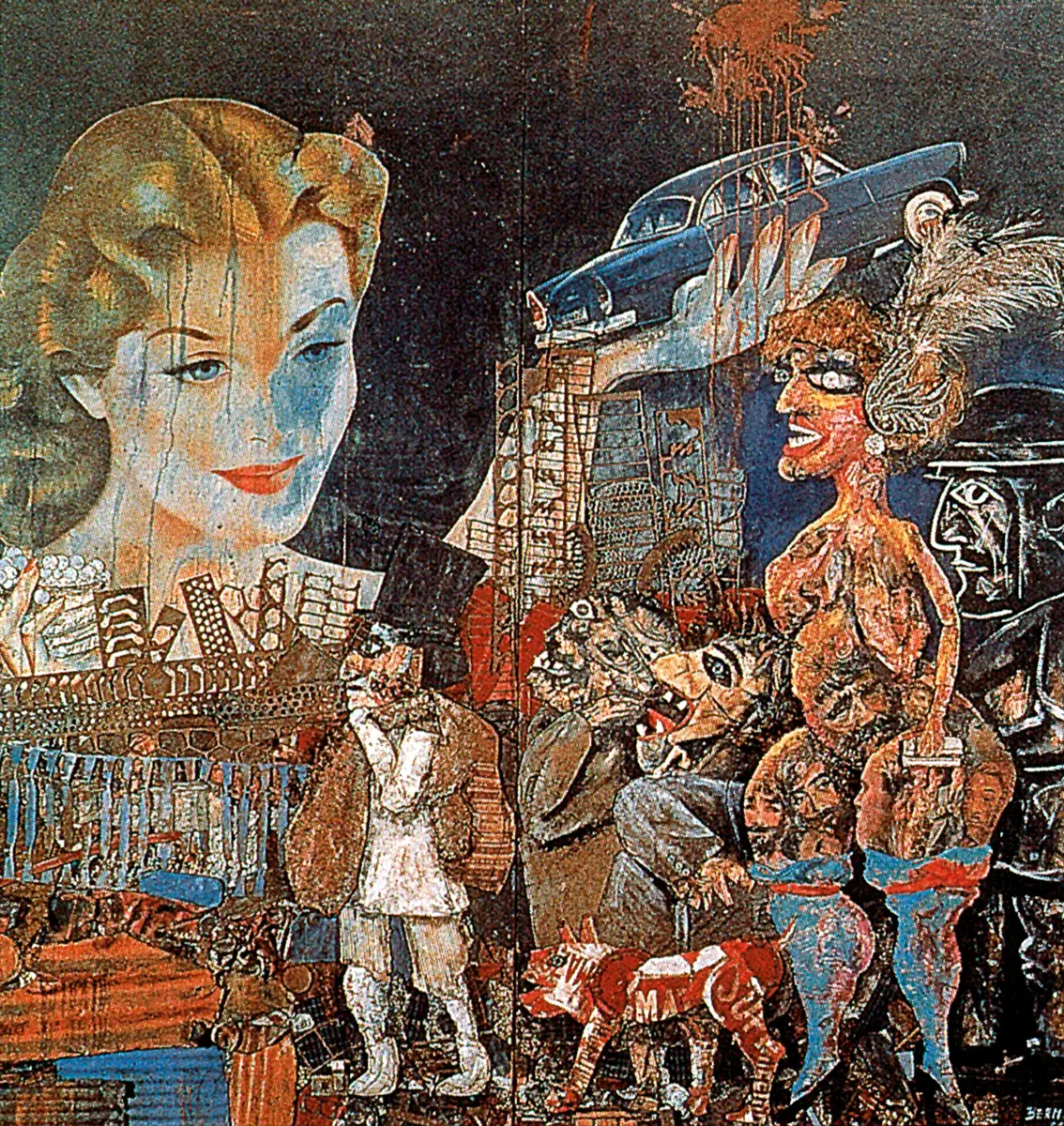
Berni's presence in this show is not only one of a colleague among artists, but he is also the one who outlines the tendencies that are happening in the other rooms. He obviously points out the importance of figuration as a reference, but he also gives a series of aesthetic guides that are interwoven throughout the rest of the pieces. La gran tentación (The great temptation, 1962), his most important piece here, is an excellent example of Argentine Otra figuración (Other figuration) by sharing stylistic elements used by Noé and foreshadowing later solutions by Seguí- His etchings, especially El amigo marino de Ramona (The sailor friend from Ramona, 1964), lay the groundwork for de la Vega's Good Health (1965). La pesadilla (The nightmare, 1965), a huge sculpture in which Berni explores elements of popular baroque culture, is associated with La copa melba (The Melba Cup), produced five years later by Heredia.
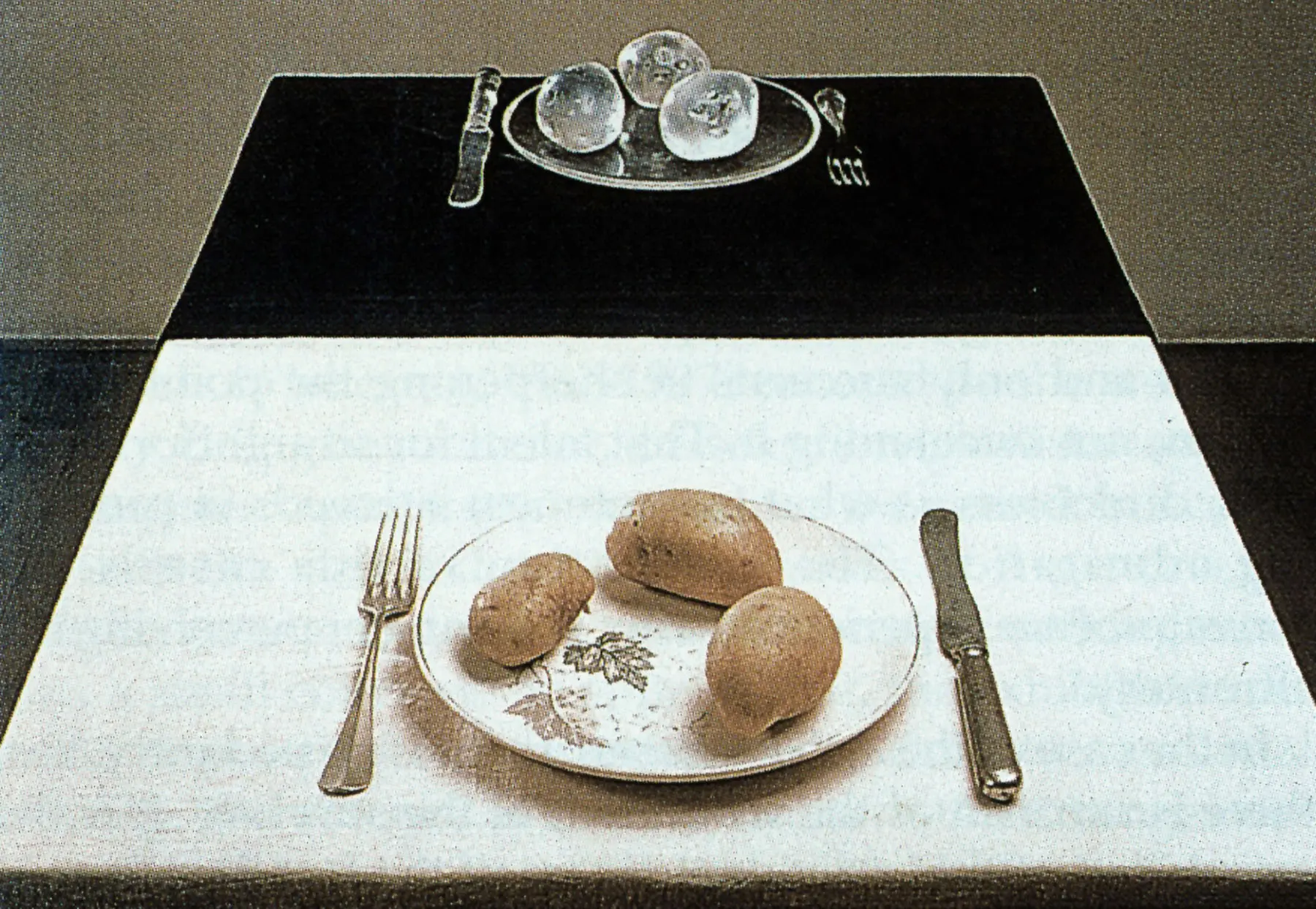
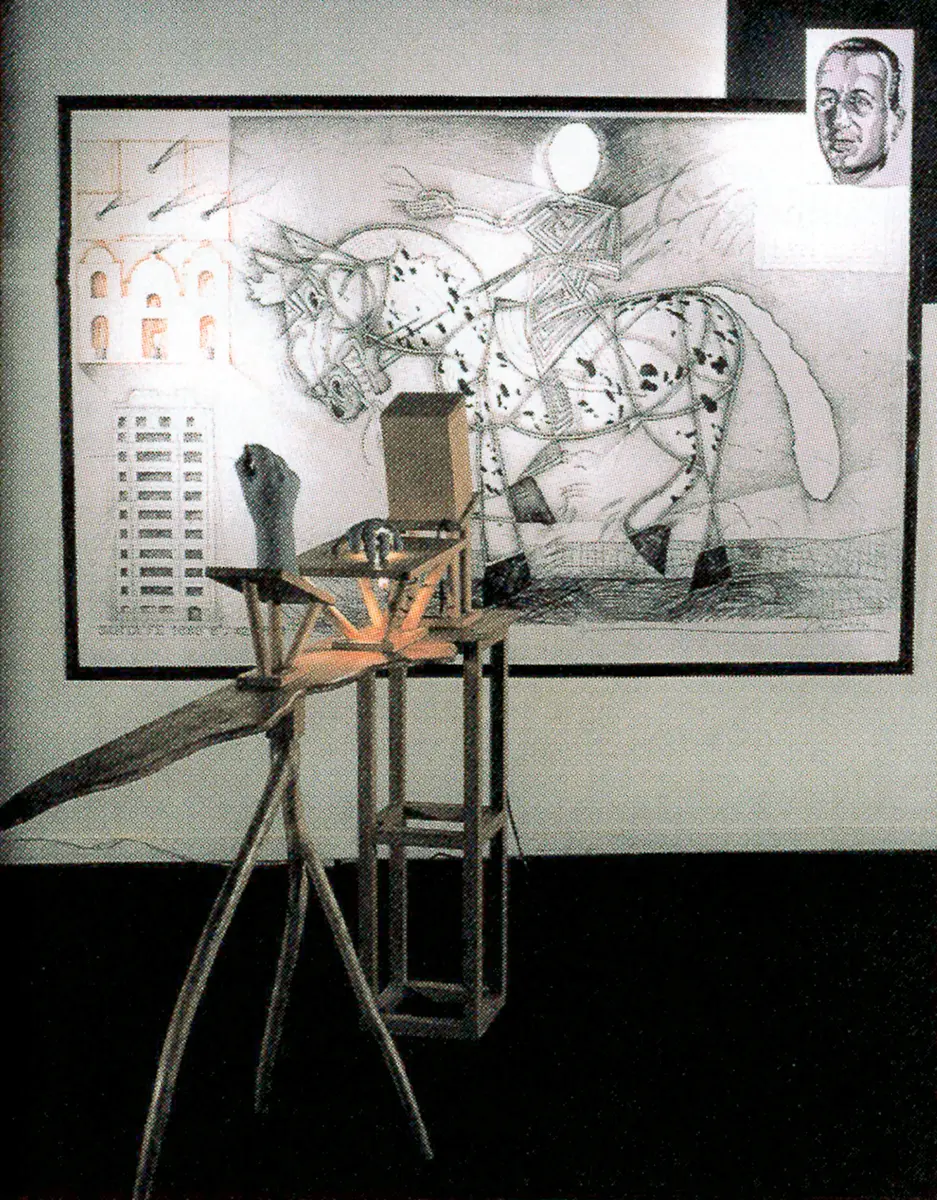
The connections among the artists —formal, intentional, atmospheric— were subtly exploited in the curatorial montage. The discreet personalities —or rather, circumscribed personalities, since the pieces generally tend to be indiscreet— are interconnected in an almost musical way, thanks to connections that facilitate a visit that seems to have been subliminally directed. The Gag, one of Heredia's typical elements, is reflected in Santantonín's work La mordaza (The gag, 1961). Other pieces of his, the “things," based on the use of little balls and small spheres, echo both in the potatoes used by Grippo (Analogía IV [Analogy #4], 1972), one of the classic pieces of Latin American conceptualism) and in the bolas of Benedit's works. Benedit's most common images seem to have been taken up again in the pieces by Pablo Suárez who, in his own way, resounds (more in form than in intention) in Distéfano's sculptures. It all looks like a good soccer game that has been carefully choreographed.
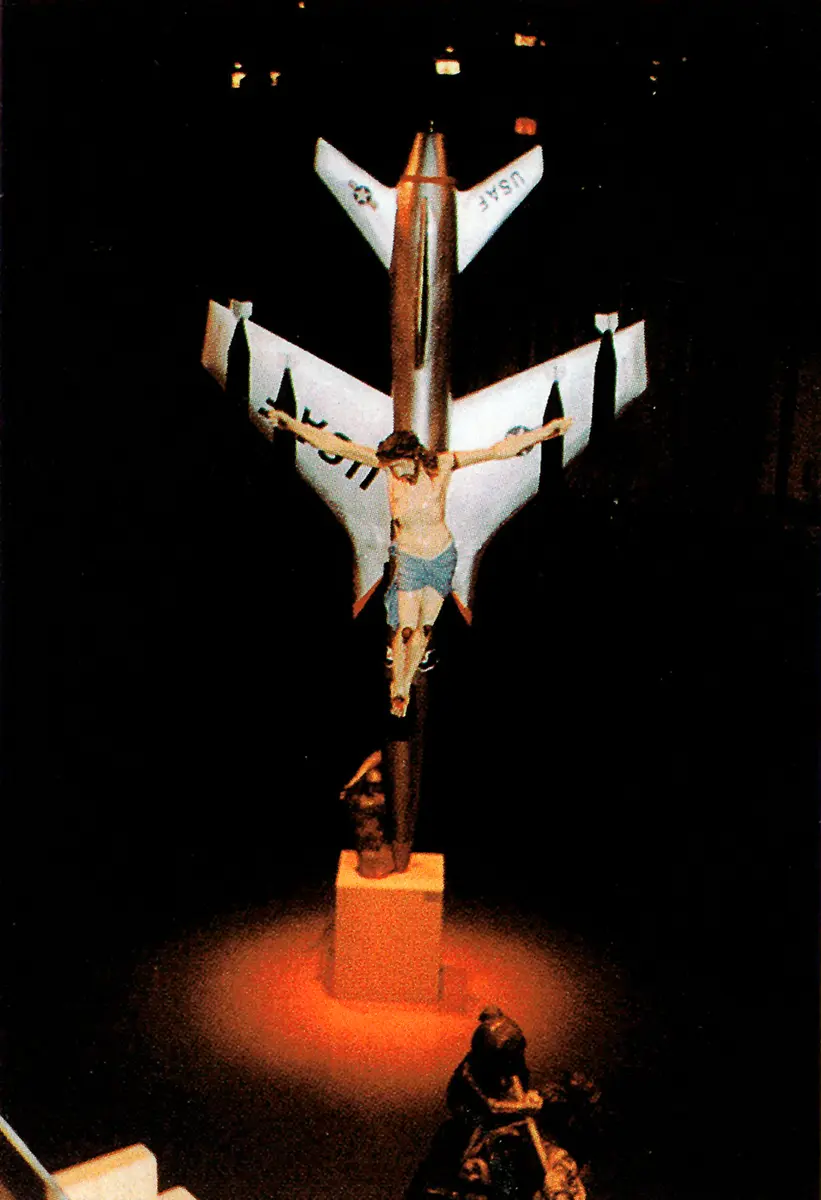
The show takes place in its entirety under the protective sign of León Ferrari's La civilization occidental y cristiana (Western and Christian civilization, 1965). A classic of this incorrigibly blasphemous artist, this piece was the scandal of its time when it was removed from a show at the Instituto Di Tella a few days after its opening because it was considered too offensive. It consists of a large sculpture of Christ crucified and nailed to a model of an American FH-107 airplane, the bomber used for the making of lunar landscapes in Vietnam. Here it is hung from a two-story ceiling and promises to plummet into one of Distéfano's sculptures.
The general unity of the show with which Ramírez so perceptively succeeds in capturing the local flavor of Argentina, hampers and almost invalidates the analyses of particular pieces. There are, however, works that stand out. Ferrari's Carta a un crítico (Letter to a critic, 1965), a message inserted into a bottle, is connected to the artist's series in which he explores his Cuadros escritos (Written pictures, 1963-1965). This series is the one that —preceding Joseph Kosuth's work— served as a guide for many works within the Latin American version of conceptualism. The letter is not completely legible, written in an "anti-cool" and crazy hand, ready to be thrown to sea and thus assure the improbability of its reading; this illustrates the alienated life both of the critic and the artist. Ferrari is also represented by his most recent series of anti-religious works, reproductions of religious and anticlerical pictures with quotes from the New Testament written in Braille. The most illustrative of the series is Amaos (Love one another, 1997), a painting by Clovis Trouille (1899-1975),2 showing two nuns in a torrid embrace with the sentence: "A new commandment I give unto you, That ye love one another" (John 13:34) in relief for the blind.3 Ferrari himself wrote in 1968, in what was a sort of creed: "Art will be neither beauty nor novelty, art will be efficiency and disruption."4 That definition of propagandist art is related to Santantonín's chronologically earlier work.
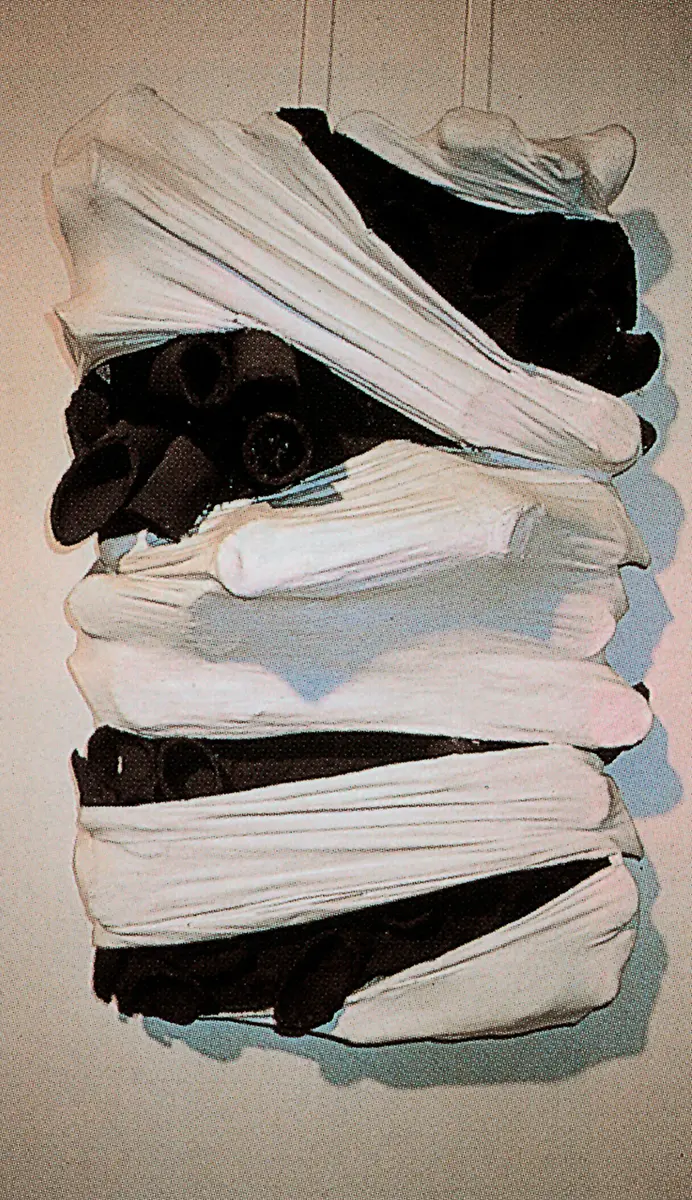
The presence of Rubén Santantonín (1919-1969) constitutes, to a certain degree, a form of unexpected revelation. The artist burned the majority of his works shortly before his death. However, the show succeeds in giving a distressing and representative profile of his work. Famous for having co-authored La Menesunda (The embarrassing situation), a work generally attributed to Marta Minujin (the catalog affirms that the true intellectual author was Santantonín), his objects are the most hermetic of the show, and apparently the most distanced from the propaganda that one could imagine. Called "things," they are objects reminiscent of the pictures of Manolo Millares, anti-contemplative objects that try to achieve "immersion," "to touch that no man's land that everyone has." Santanonin distinguishes (clearly and almost tragically) between the traditional art "of things" and his "thing art": "the 'thing' understood as an expression.5 But he also calls them panflecosas (propaganthings) and, with his intention, Santantonín is perhaps the most politicized artist of the group. Visually the least accessible, he is the one who wishes to penetrate most insidiously into the viewer (in 1961 he wrote: "the thing gets in through your eyes, it invades you through the skin, through all the pores, by virtue of its material urgency without transcriptions"). In 1963, when defining his panflecosa, he said: "The panflecosa is: propagandist; proletariat; solitary; unsellable; it is the unbribable image that is given away—IT IS GIVEN. It is: unsellable art, door-to-door art..."6
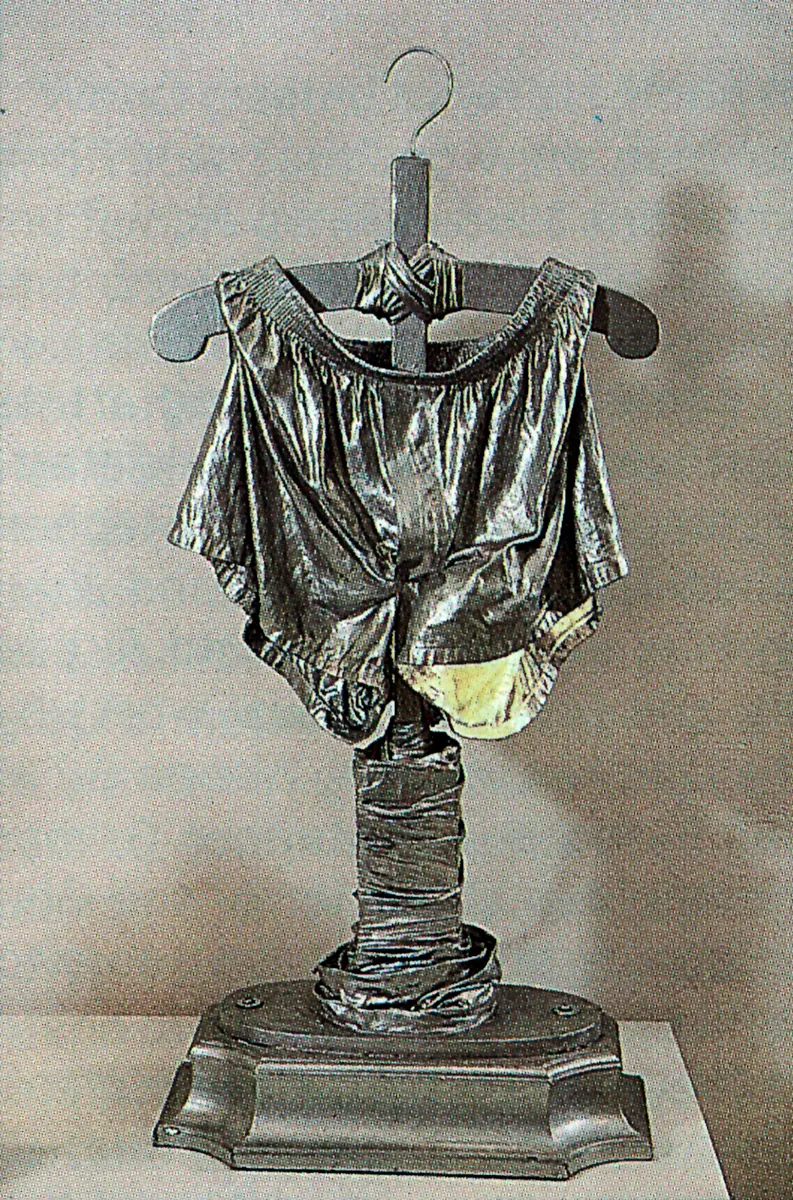
One of Alberto Heredia's pieces, Cruz con calzoncillo (Cross with underwear, 1980), stands out as an icon set in opposition to Ferrari's work. The crucifix is here made with a hanger that holds up a pair of men's briefs. Inside, there is an illuminated light bulb that consecrates with its aura the do-it-yourself work with found objects. It is carefully placed in the position of a testicle. Metalized with silver paint, the piece is a translation of Ferrari's La civilización... (the combination and ridicule of the great "causes") into daily life in its most banal form. But it is also the cynicism aimed at the political sermon that we inevitably read in Ferrari's work. Consciously or subconsciously, the "poison" of the show, in this sense, also has its cannibal aspects.
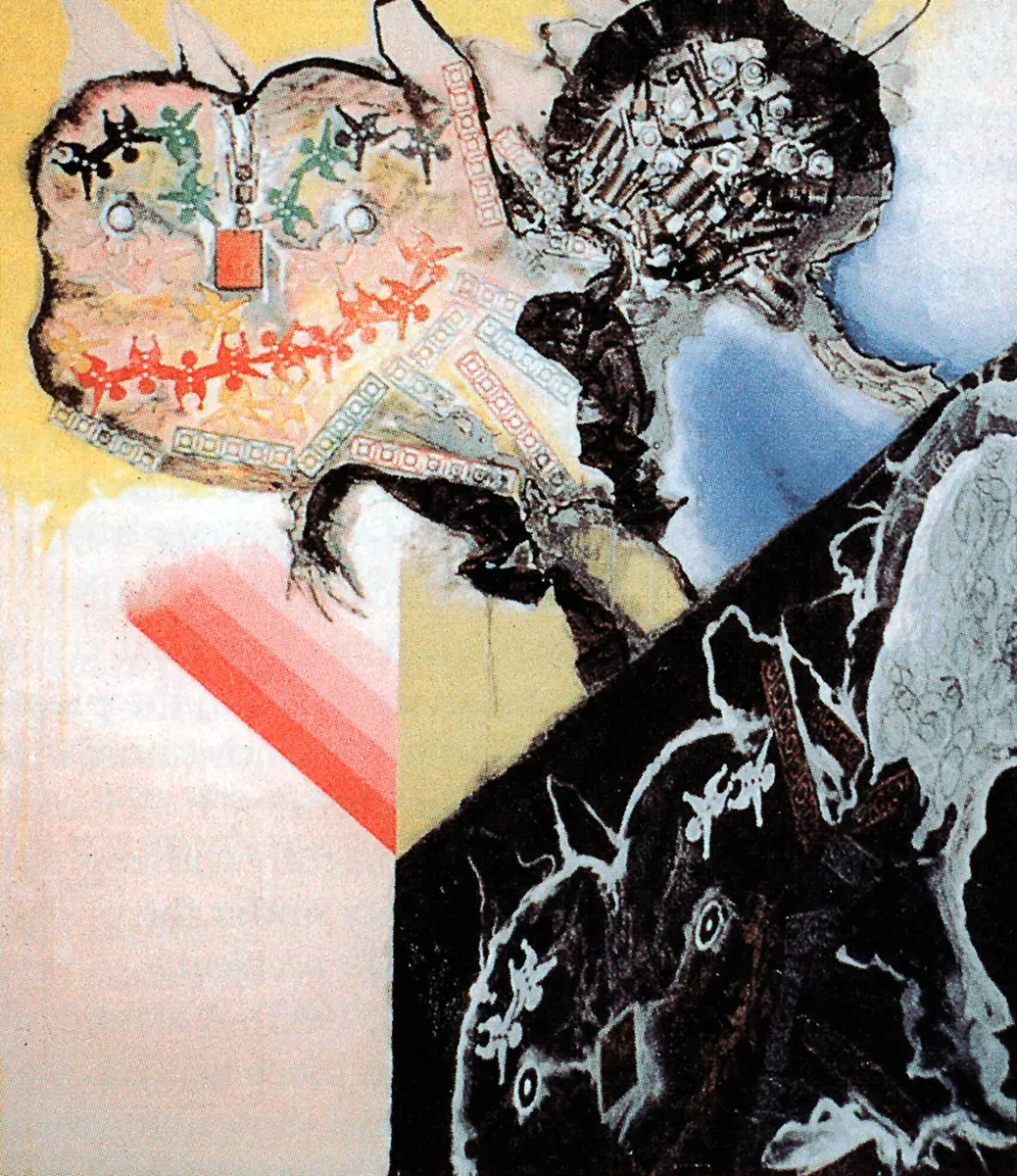
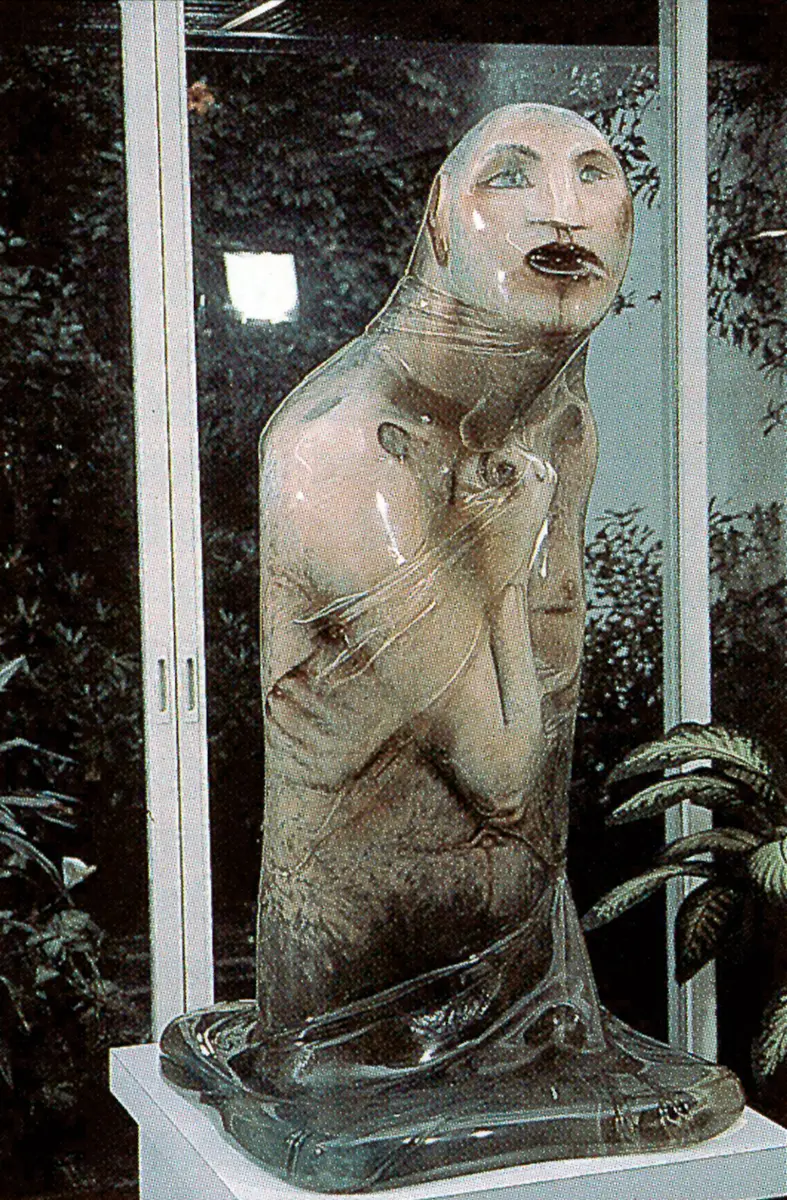
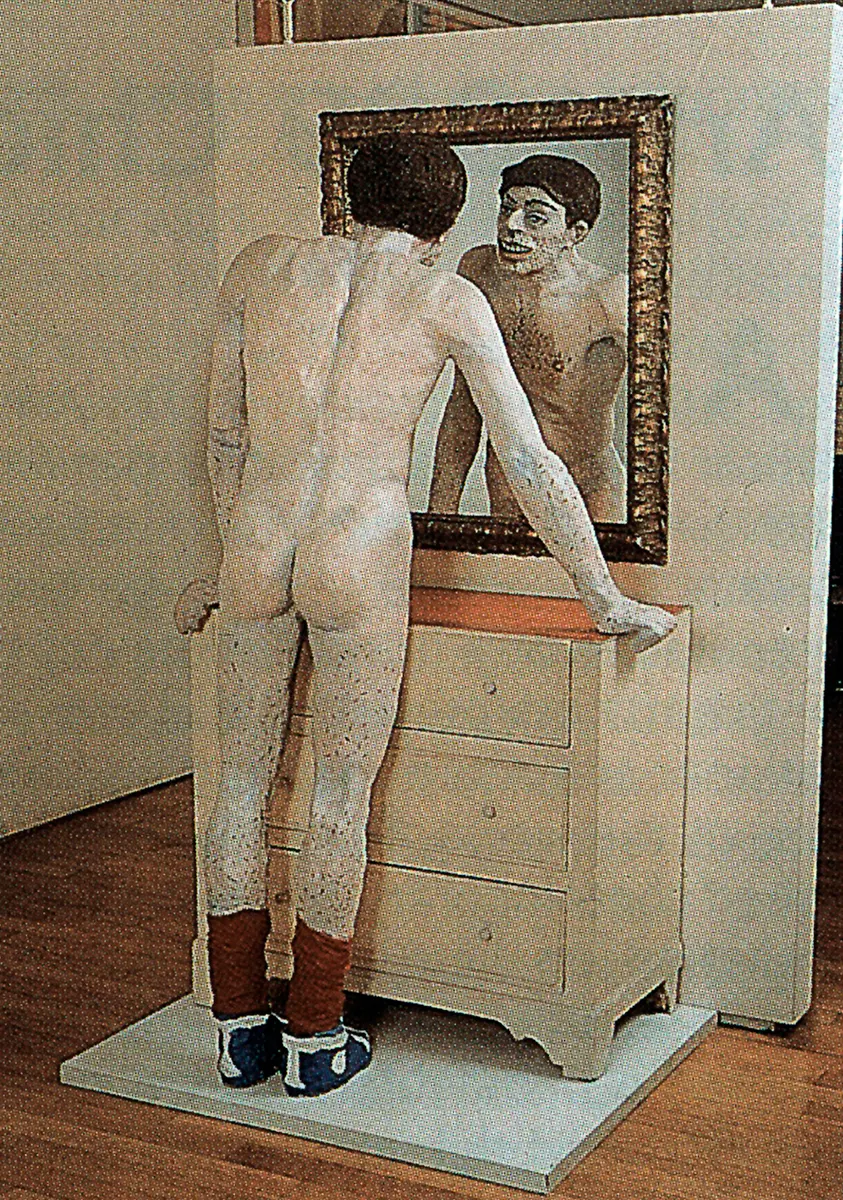
Finally, Distéfano's disturbing work worthy of mention, Telaraña II (Spider web II, 1974-1975). With formal references to the indigenous Mexicans, to the old expressionist sculptor Ernst Barlach, to certain kitsch stylistic, with the use of unpleasant colors and a candied surface, Distéfano achieves an image that synthesizes, in an apparently cold way, a drama and a pain of claustrophobic intensity. The garish irony in Suárez's work, especially in Narciso de mataderos o el espejo (Narcissus of slaughterhouses or the mirror, 1984-1985), to cite another sculpture with reference to a certain traditionalist figuration, is silent in Distéfano. Benedit, Grippo, de la Vega, and the rest of the artists in the show also offer no impediment to this reading. Distéfano, in a sort of Borgean climax of irony, opens the almost fatal doubt: is this guy serious or is he pulling my leg? Fortunately, it is a doubt that increases the mystery of the work and that, paradoxically, brings the work closer to the spirit of Santantonín than to the rest of the team. But it is precisely the diversity of the group, within that unity perceived by Ramírez, which makes this show so strong.
This exhibition will travel to the Phoenix Art Museum, Arizona; Biblioteca Luis Ángel Arango, Bogotá, Colombia; Museo Nacional de Bellas Artes, Buenos Aires, Argentina.
NOTES
1. Simultaneous to Parallel Songs there is a small show of Molina Campos’s work from a collection that belongs to the university. Molina Campos worked during the ‘40s for Walt Disney as the adviser for "Argentine affairs."
2. Clovis Trouille was a painter of anticlerical erotic pictures, especially known for having made the poster for Oh Calcutta.
3. Ferrari is currently busy collecting signatures in order to convince the Pope to postpone the Final Judgment.
4. "El arte de los significados" (The art of meanings), written in 1968 for the preparatory meeting of Tucuman Arde, cited in Cantos paralelos, catalog of the show, Jack S. Blanton Museum of Art, Texas, and the National Art Fund, Buenos Aires, 1999, p. 206. The catalog, with excellent essays by Ramírez, Andrea Giunta, and Marcelo Pacheco, is, in spite of an overdesign that hampers the reading, an invaluable source of information.
5. Cantos paralelos, 237.
6. Cantos paralelos, 239.
LUIS CAMNITZER
Uruguayan artist, Professor in the Department of Visual Arts, State University of New York, College at Old Westbury.