The magnificent Jackson Pollock retrospective opened in New York with a great song and dance.1 The background music gave greater importance to Pollock's "Americana" than to the quality of his painting. The artist fulfills two myths that still seem to have a certain (at least nostalgic) attraction. One is that of the male artist, just as he was conceived in the United States, with motorcycles, women, and alcohol. The other is that of the ingenious inventor who creates things from scratch and with minimal resources. Consequently, the show generated a good deal of chauvinistic literature, underscoring Pollock's role in the placement of the center of global art in the United States.
The character conjured up by all this is the product of a strange blend of Van Gogh, Thomas Alva Edison, and James Dean. As an example of the national quintessence, Pollock continues to guide the national-globalizing art from an American Olympus, doubtless located on the peak of Mount Rushmore. It is worth noting, however, that inside this epiphany there is no lack of critical notes. Kirk Varnedoe's introductory essay in the catalog, for example, stands out for some of its demythologizing efforts.2 This doesn't take away from the fact that Varnedoe also believes that Pollock produced "some of the most inexhaustible artworks of the century."3
I should point out here that, although I have only a fragmentary knowledge of Pollock's work, this artist never excited me very much. A series of reasons made me respect him and even accept him as a factor of crucial breakage in the art history of this century. But I was not impressed by the dance show generated by his painting, an antecedent, for many, of performing art and the happenings that would come later.4 Nor was I seduced, to put it in more traditional terms, by the presumed unfolding of a multiplicity of dimensions, nor by the possible presence of a multifocal which is said to have destroyed—forever—the Renaissance perspective. Yes, I saw the dripped canvases and the occasional and fascinating success of a reconstruction of the plane of the canvas that maintains a lightness—without ever reaching a saturation point. In this, however, it is unknown if there is anything more than a vision imposed by the theory of Clement Greenberg, friend, and quasi-collaborator of Pollock.
The intellectualization that led me to respect has to do with something else. It is the separation of the painter from his work, a position that leads to an image opposed to the traditional one held by Pollock. Instead of a character consumed passionately and animally in the excretion of pigment on the floor, I saw the critique of the work itself. Pollock, according to this theory, had armed himself with an entire automated paraphernalia that allowed him to distance himself from the process, instead of entering into a mystic trance. That distance allowed him to decide on the final point of the work that he was "self-executing." It was almost like the person who stops the projection of a film on the perfect image that sums it all up. This outline raised Pollock to a level of supercritical. He was the artist who had succeeded in formalizing the "stop" into a work of art.
Within this theory, all the anecdotes about his relationship with urine—that the drips were a consequence of having seen his father urinate,5 or his own micturition on Peggy Guggenheim's chimney—lost their importance. Pollock had become a conceptual artist. He was in line with Duchamp, not because of the public toilet, but because both celebrated the moment of choice, even when Duchamp tried to defetishize his work, and Pollock fetishized his.
It was with this baggage that I went to see the show, really out of professional duty and not for pleasure. You can only see this type of retrospective once in a lifetime, a perception shared by many people, judging from the line that was waiting in the rain. The result was informative, but it never attained a level of pleasure. And my theory didn't entirely hold up, at least not in that simplistic version.
In 1930, at 18 years of age, Pollock began to study with Thomas Hart Benton; in 1932 he met Siqueiros in Los Angeles, and the following year he observed Rivera painting the mural at Rockefeller Center. In 1936 he studied with Siqueiros in New York and saw exhibitions of cubist, abstract, and dadaist painting. In 1940 he saw Orozco working on a mural commissioned by the MoMA. This was his decade of studies (and his introduction to alcoholism, which forced him to admit himself into a clinic in 1939). He began young, confused, and reflecting his masters in an impoverished way.
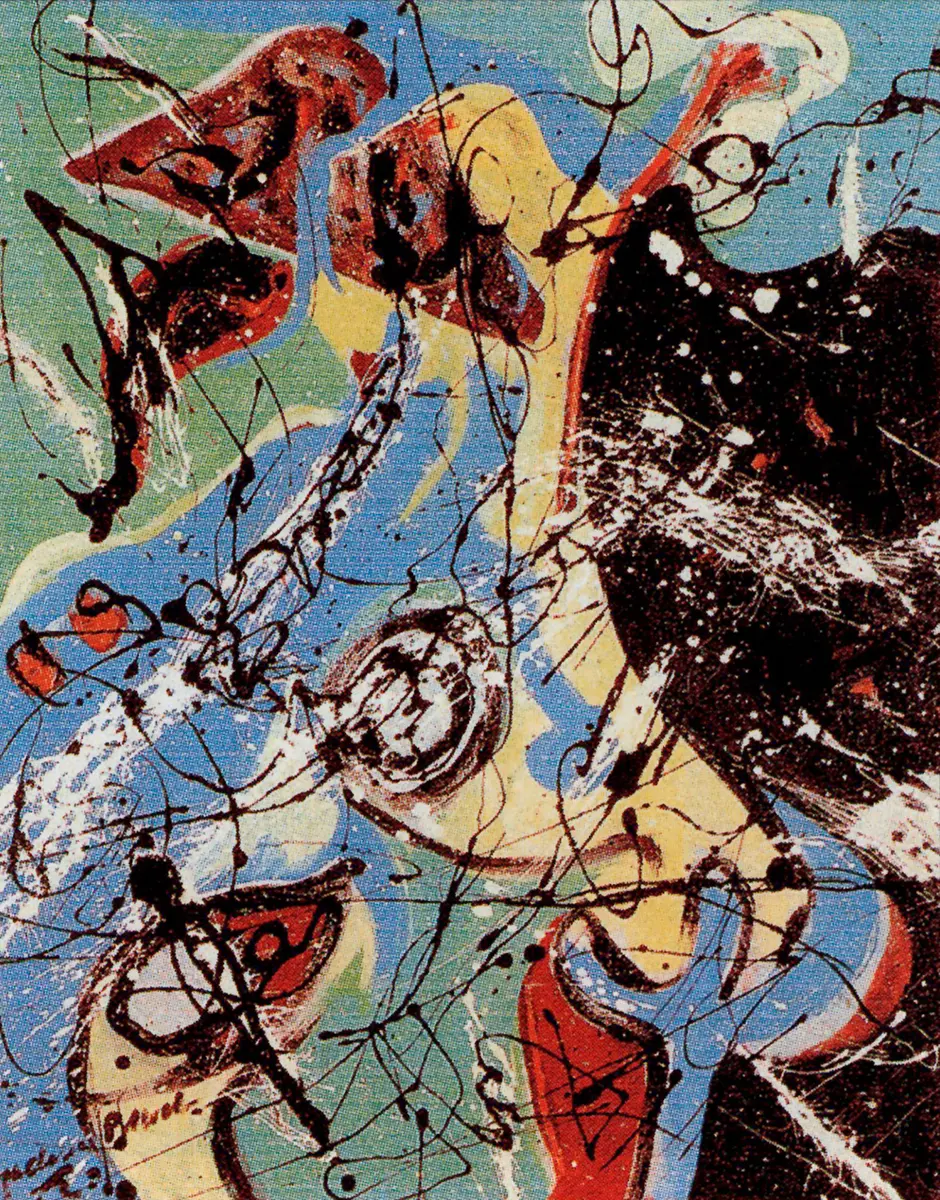
Shy, theosophical, and a communist—that is, with no clear ideology to back him up—his works reveal from an early stage, more than anything, a terror of space and a heavy hand. The show presents an informative selection of works from this initial period. In spite of the influence of figurative painters that he knew and admired during that period, some isolated abstractions from around 1934 are pointed out. With no compositions based on figures, but which end in relatively abstract plain rhythms of disagreeable taste. In 1939, Pollock saw a Picasso retrospective as well as the Guernica, something that increased his confusion even more.
It was in 1943 when Pollock first used the drip technique. However, it was not something that he adopted with firmness. They were doodles used only to highlight an underlying structure, but which doubtless contributed to lighten the heaviness that characterized his painting. It would seem that he became aware of his slowness and the lack of elegance of his brush strokes, and he balanced them with an almost capillary net of dripped paint. But, by and large, they are works that do not radically speculate with the formal aspect of painting. They are always based, even when remotely so, on literature that distracts. And this resource continued as a secondary accessory for some years.
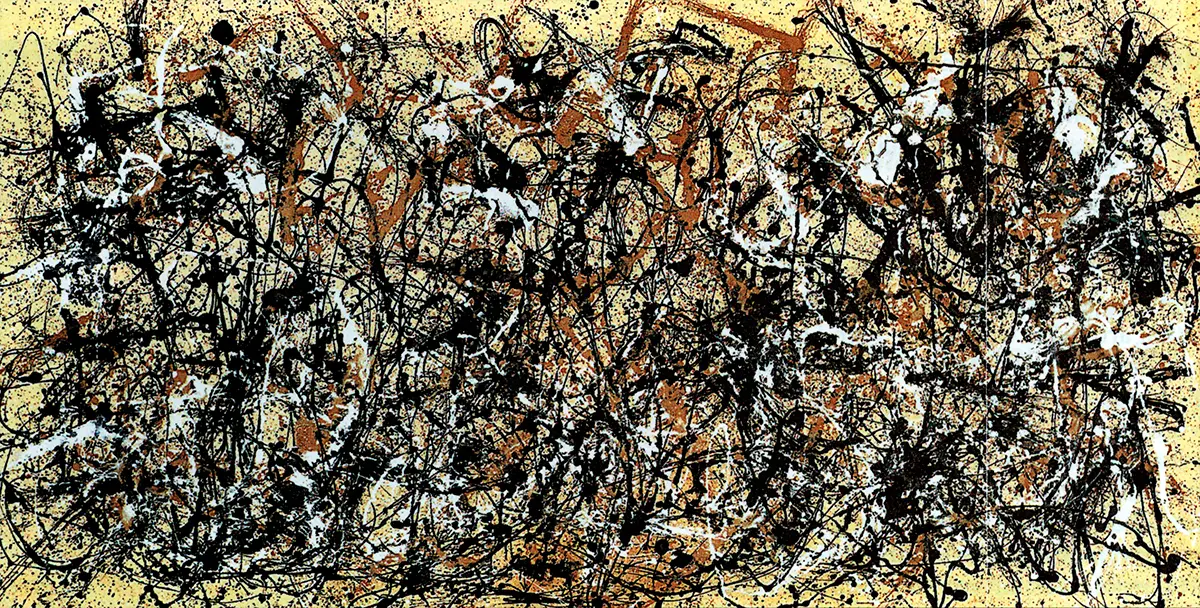
The most famous pieces, now under the tutelage of Peggy Guggenheim (whom he met in 1942) and Clement Greenberg, continue to be amalgams of influences. He plays with Picasso, Miró, and Masson, and he continues to support himself with figurative references and poetic allusions. It was in 1946 when the situation cleared up a little with his Sounds in the Grass series, where he announced (although without dripping paint) his most typical formal language.
The three pictures of this series presented in this exhibition coherently eliminate the references and seem to be dedicated to exploring the plane of the canvas in its possible infinity. With the exception of the rupture caused by his own signature (visually unnecessary), these pieces seem to carry to the extremes the formal search that Pollock had, if not avoided, missed. But what happened between 1947 and 1950, the period considered Pollock's most excellent, is also not as clear as one would like. The pathetic decadence of his final years already appears revealed here at length. The critical freedom that technical distancing offers him is limited by literary decisions that contradict the process. The white line that interrupts the fabric in order to turn the picture into a comet (Comet, 1947) leaves us with a bitter taste of the banal illustration. The reopening of the weft in order to accommodate colored forms (White Cockatoo: Number 24A, 1948) lays the foundation for the disastrous Portrait and Dream from 1953. It is interesting to note that 1953 is also the year in which Rauschenberg symbolically annihilated abstract expressionism when he created his work erasing one of De Kooning's drawings.
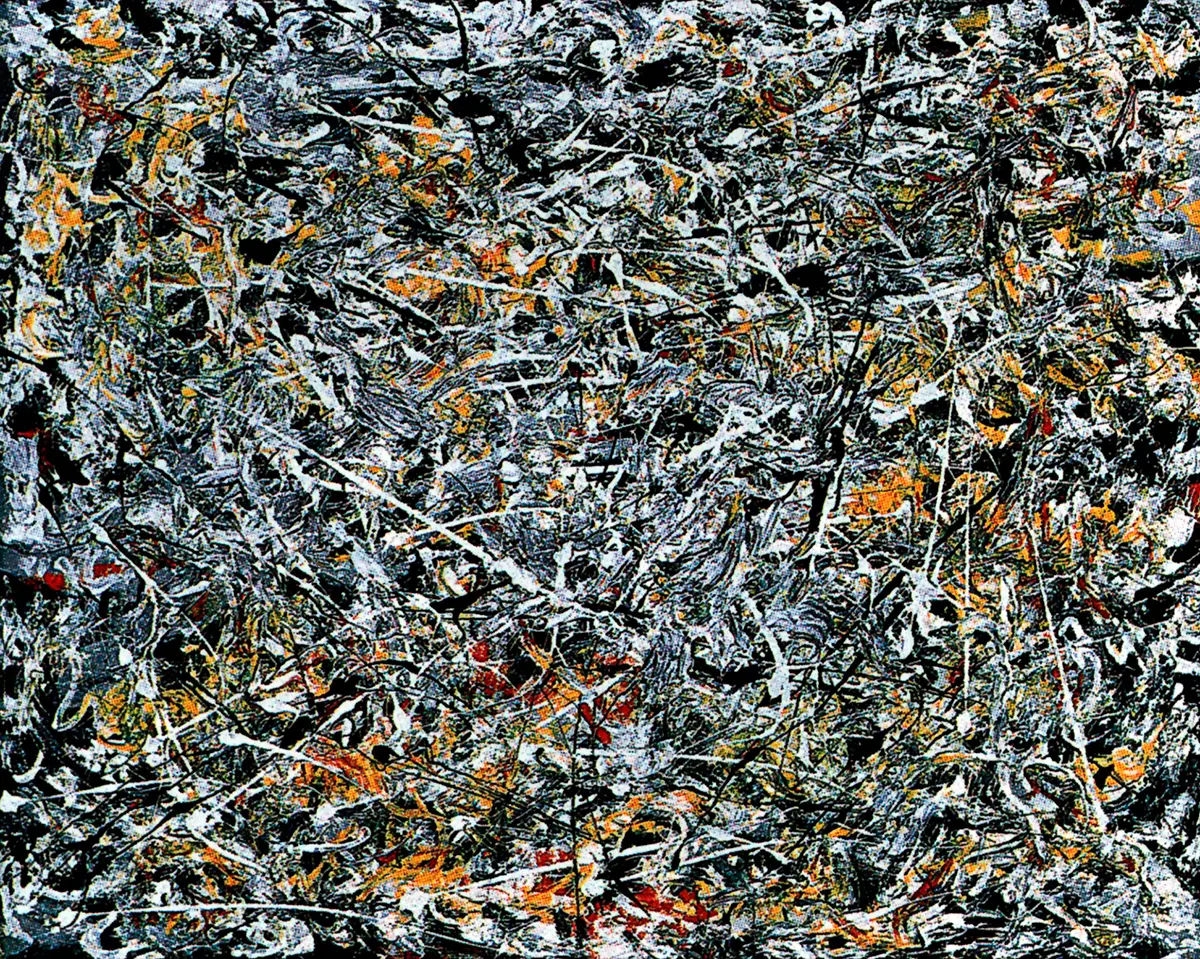
Throughout this entire show, Pollock emerges as an extremely insecure artist. The continuity given first by fragmentation and later by drip painting surges through a superficial stylistic appearance and not through a visionary, philosophical, or perceptual grounding. Pollock's problem seems to lie in the fact that he never confided in the random aspect of his painting. In the notes that he prepared for a radio interview in 1951, Pollock mentions that "technique is tire result of need," and he underscores the "total control," "the denial of the accident," and the "states of order."6
That fear of accidents becomes evident in the famous film by Hans Namuth which shows Pollock painting on glass (the camera films from behind). Pollock deposits objects and splashes, making decisions that are quick, but never arbitrary. Control is also expressed in the fact that, in many pieces, Pollock begins with a recognizable figuration to later conceal it with successive layers of dripped paint. His technique is dedicated to hiding, not revealing.
Paradoxically, it was the intended random and accidental aspect of his work that seduced many later avant-garde generations. The myth of the physical and excremental quality of Pollock's painting, the consequence of a certain animality connected to his movement in space, conferred enormous importance upon the studio in which Pollock painted. This importance was illustrated in the MoMA show with the recreation of the shed in which Pollock made his canvases. The museum reserved a room in order that the public might enter the old barn. The experience of space, presumably, allows the viewer to better experience the paintings.
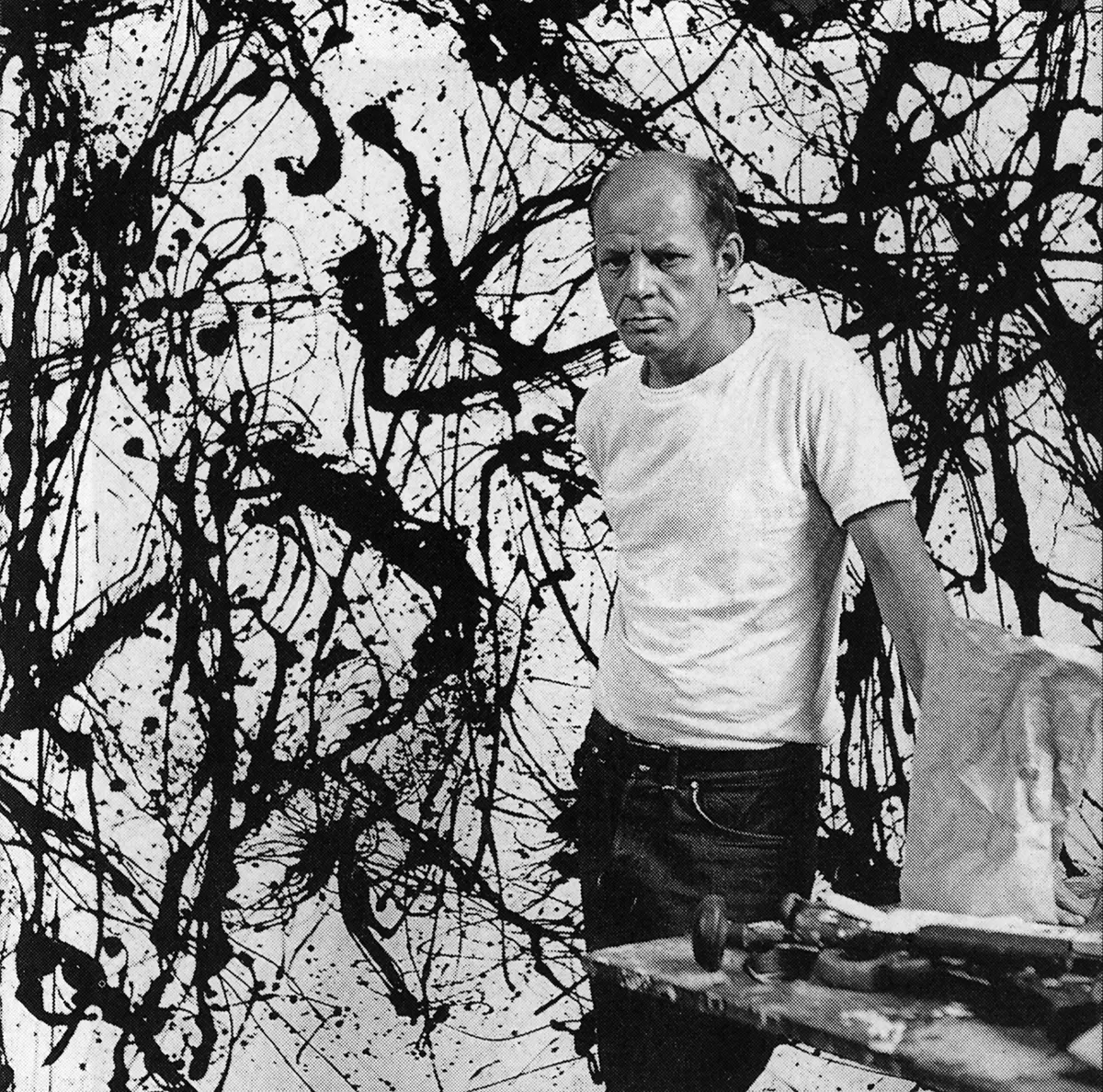
The effort is limited to a tourist experience and nothing more. On the walls, there is a sequence of photos of Pollock painting, but the floor is empty and the totality looks more like a chapel in honor of the master than of an electrifying studio that could "explain" the scale and movements of his canvases. Moreover, the show itself forgets the importance of scale. Pictures that were enormous in their day and context appear diminished by the proportion of the rooms. The large pieces, which oscillate between 2.5 and 5 meters (and which in the act of this presumed physical action-reaction would almost turn into pools for Pollock), acquire a strange objectual coldness. The arrangement allows (and the explicatory placards invite) an analytical comparison between the works, but they hamper the contemplative immersion that this supposedly requires.
Historically, Pollock's work could have been one shared with that of Mondrian.7 In the superficial outline that one makes without recalling all the works, the drip painting could have the same systematic effect as a system of perpendicular lines. Both are sufficiently simple resources—invested with the correct rhetoric and corresponding obsession—so as to serve to explain the universe. Mondrian developed his points of view with coherence and rigor and created a plausible discourse. Pollock, on the other hand, without learning from the spider, became entangled in his own weft.
Today, now that Pollock's paintings have been relativized, it is possible to affirm that he just may in fact be a quintessentially American artist. But that essence is not a consequence of problems with ethnicity, race, or traditions. Rather, it is the result of a marketing symbiosis. With the help of Greenberg, a famous article in Life, and a film by Hans Namuth, a superstar in visual arts was created in a way only known at that time in Hollywood. He is, in this sense, a new essence and a purely cultural product, to the extent that the importance of commercial stardom is a component of culture. The rupture that Pollock introduced in art history is due in part to that contribution.
It could be said that it was the lack of coherence and rigor that allowed the creation of Pollock's stardom. He was a recipient of interpretations that shaped his public image, an outdated image with regard to his own identity, against which he did not know how to measure himself. At his time, the idea that someone could make pictures with no preconception, based purely on an arbitrary and chance drip, was extremely daring. It was an idea that generated respect and admiration, even among the Philistines. But it did not encapsulate Pollock's true interest. This point of view was combined, contradictorily, with another romantically attractive image: that of the shaman in a trance, guided by external spiritual forces (something more interesting for Pollock). And, similarly, even a third quality was added that did not have much to do with the other two: that of the uncontaminated (i.e, unguided) instinctive and primordial animal reaction.
In spite of the impossibility of real coexistence among the three conditions, it was that mix-up that had a tremendous influence on his later art. Today, Pollock's artistic extensions include practically all art based on disarranged formal accumulations (Twombly, Arman, Kusama), art made with poured liquids (Serra, Smithson), and art that uses physical contacts with pictorial support (Klein, Mendieta). They are effects of the attribution to that image manufactured around—but not within—Pollock.
During the visit through his work (and his opinions), we see how those images contradict themselves or force their opinion upon themselves. The painter becomes an actor, the actor becomes a painter, but not entirely out of his own need. It was an intuition that led Pollock to scream at Namuth—it was during a dinner (after a film session) in which, among other things, Pollock overturned the table on which the meal was served—"I am not a phony."8
Only here does this character begin to fascinate us. Pollock lived the drama of wanting to do two things: to create an important oeuvre and to be important in art history. The visit to this show demonstrates how very difficult was the first, and that he achieved the second. What he did not satisfactorily attain was the integration of both proposals. We always hear that the premature end of his career in 1956—in which a suicide car accident is assumed—was a consequence of his depression before the decadence of his works. But perhaps it was something much deeper: confronting his inability to unify his two proposals into one coherent unit, feeling that his feet were planted on two paths that were separating more and more. The act of walking down both roads led him to collapse.
NOTES
1. The MoMA show ran from 1 November 1998 through 12 February 1999. It will run at London’s Tate Gallery from 11 March through 6 June 1999.
2. Kirk Varnedoe, “Comet: Jackson Pollock’s Life and Work,” Jackson Pollock (New York: MoMA, 1998).
3. Varnedoe, p. 62.
4. Kaprow cites him as a direct precursor of his work. His happenings translate the relationship between drips and canvas into one of persons, objects, and space.
5. The anecdote is that his father taught him how to draw on the rocks while he urinated.
6. Varnedoe, p. 56.
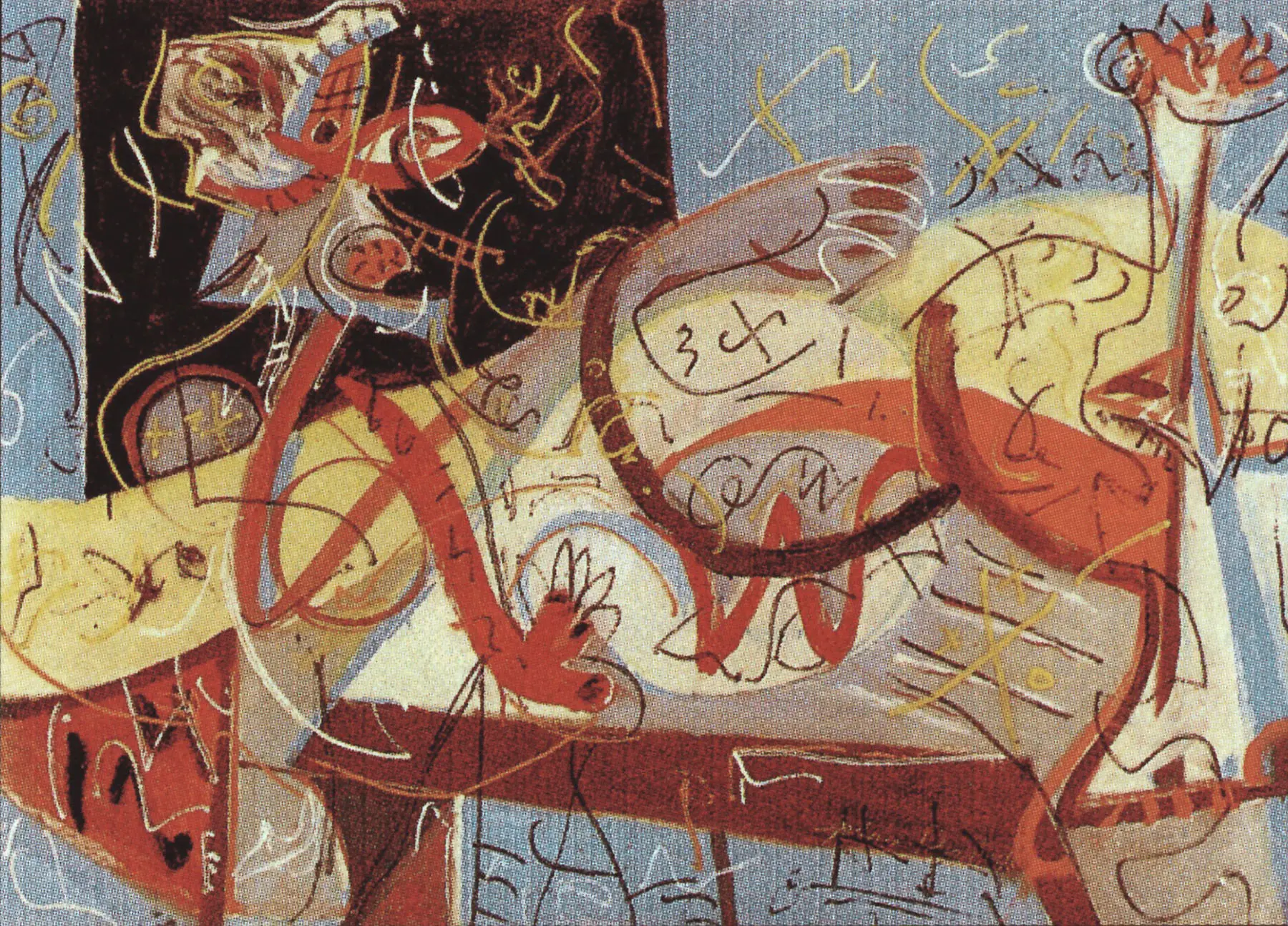
7. Coincidentally, Mondrian recommended one of Pollock's works for a show by Peggy Guggenheim in 1943, but the piece was Stenographic Figure (1942), a rather post-cubist composition with no relation to Pollock’s future work. Varnedoe, p. 36.
8. Varnedoe, p. 62.
LUIS CAMNITZER
Uruguayan artist, Professor in the Department of Visual Arts at State University of New York, College at Old Westbury.