
The first one-man show of the young Cuban artist Renelio Marín (Havana, 1964) included paintings, drawings, and sculptures. His pictures show him as an artist who knows the time in which he is living, as someone looking for his own way based on his solid drawing and devotion to work. His drawings are the key vector. They are important strategies for the author and the collector because these works of conceptual transparency are directed towards and resolve situations of rigor. This solo show by Marín was preceded by his recent participation in the group exhibition of eleven individual artists at the same gallery: Randi Chaplín, Luis Miguel Suro, Pablo Helguera, Scherezade García, Buzz Spector, Eduardo Kac, Stephanie Brooks, Gue Schmidt, Iliana Emilia, Vivían Pastouvich, and Renelio Marín. In that exhibition, Marín's installation Metamorphosis marked an important opening in the context of Cuban artists in New York. 5..., 10..., 15 heads structured in a wire frame, modeled in unfired clay and painted in white and red acrylic; and 30...50... 150 caterpillars in papier maché done with molding paste, painted in acrylic. The "caterpillar" emigrants understood the work literally. The other spectators interpreted it aesthetically. Another version of the installation was included in the solo show.
Over the course of history, strategy has been used —primarily— by members of the military and politicians. In the second half of the twentieth century, however, most people had to learn how to be strategists in order to survive. This apprenticeship was the result of centuries of abuse. It was acquired in praxis and emphatically localized in Latin America and other "developing countries". In Latin America, strategy has become something natural and indispensable. Each child has it in their genes and develops it according to their personality and environment.
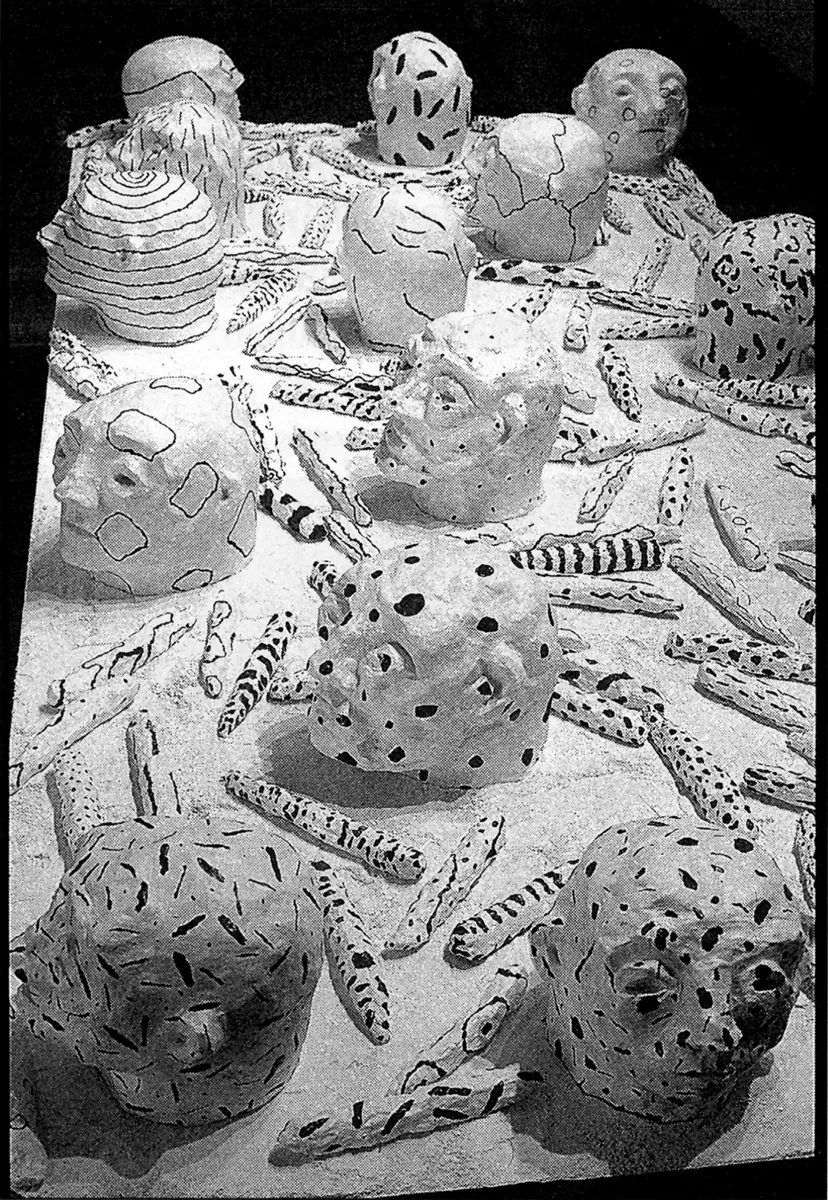
Marín has studied, experimented, and asked questions. When he arrived in New York, he found himself at various crossroads: he had left his place of origin; his native country was going through unknown situations; he came to the center of the art world from the opposite end of the political world; he arrived shortly before the end of 1998 and plans to come back when there are three zeros on the calendar.
"I don't want to take advantage of the frequent situation of saying 'I come from Cuba' and I don't want to repeat the same story about coming from an island," the artist explains, "I am here to work and I want to do it transparently." Those who have experience in Latin America will understand these words of Renelio Marín as part of a rich artistic spectrum with social limitations. For those who are not conversant with this broad and powerful magma, a certain reference point must be provided.
It can be said briefly that strategy here does not mean the artificial manipulation of artistic experience, but is rather a means of defending oneself against the abuse that countries —through their governments— inflict on thinking persons and the population in general. The people of Latin America, whether artists or workers in any sphere, have learned to survive in conditions of the greatest instability. As for Marín, we have to look at what he has to show as an artist; what he has developed, and what he wants to create.
Heads, eyes, circles, receptacles, and graphisms —rounded forms, almost always closed— exist side by side with the signs "x" and "+," with rectangles, triangles, and rebuses. The very fine line is descriptive, and the fuller, more pictorial line is fluid and more saturated with color. As he paints, he establishes three color stains-"islands," that can be classified according to the respective form and concept developed by the artist. They refer to the outline of recognizable forms or figures: the house, a reclining person, a fish, a face, or a bird. Occasionally, they serve to group together a number of small lines and delicate drawings with a free range of meanings. Thirdly, the stains act as a shadow placed on the land inhabited by animals, vegetables, and human beings.
Just as the artist finds himself at his own crossroads, so he places us before the same and other crossroads.
GRACIELA KARTOFEL