The works presented in the recent exhibition by Silvia Rivas (1957) at the National Museum of Fine Arts speak of time and, in the process, borrow the image of the sea. In this way, Rivas helps to give form to one of our least communicable kinds of experience.
If nothing is more alive than our experience of time, there is nothing more difficult than its representation. "What is time?" asked St. Augustine. "If no one asks me the question, I know the answer, but if someone does ask me the question, then I do not know," he replied in perplexity.
Every day we are confronted with the experience of finding ourselves in space and of living in a time that passes by. But depicting this space —one of the obsessions of Rivas' earlier periods— and capturing the flow of time is not easy.
To give form to the flow of time is to halt it and therefore to de-naturalize it, making it lose its essential qualities. Where then can we find images that at least bring us closer to the representation of our experience of time?
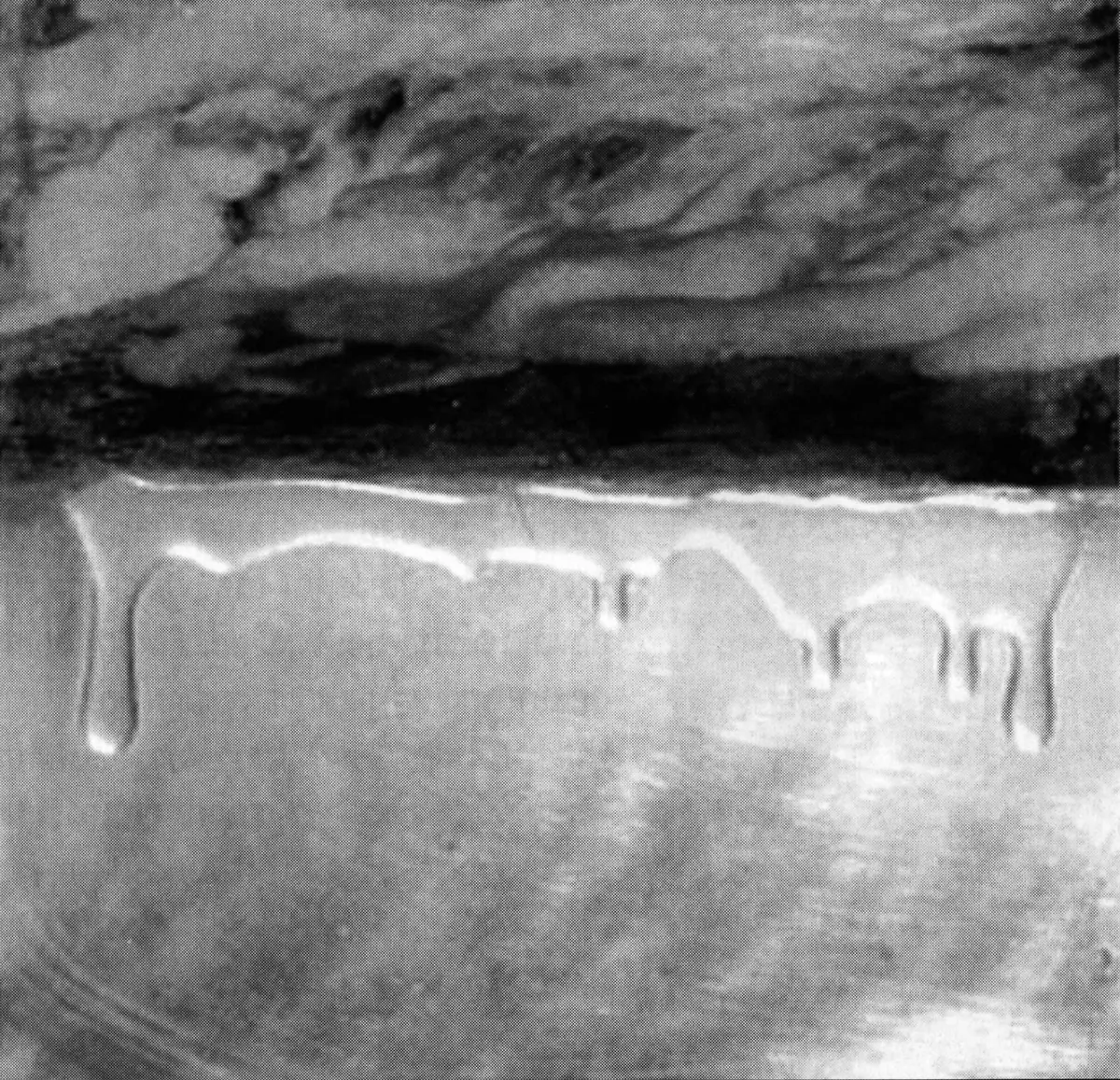
One of the privileged sites throughout history has been that of art; precisely its possibility of speaking to us about our shapeless and sometimes confused experiences is one of its strengths. The works of Silvia Rivas from the series Marks of Time, Image and Likeness, Absurd Objects and Semi-irreversible Objects, reveal to us this rare possibility that art has for giving an image to something which in itself has none. For this reason, they are eminently symbolic.
Rich in associations, the image of the sea encompasses two opposed elements: life and death. Because although the sea contains many forms of life, it is also undeniable that its movement instills fear and reminds us of death that is lurking. Water is also synonymous with life and is a powerful agent of destruction. As such, it entered the work of Rivas at the beginning of the 1990s. The series, which she presented at the Banco Patricios Foundation (1992) and in Santiago de Compostela (1993), was her first public expression of this personal mythology.
While Rivas had opted for painting in the 1980s, the I990s saw her emphatic incursion into the field of photography. "Photography as a medium has always interested me," she says, "although I had not directly used it in my paintings. I had sometimes used it as a starting point; then it seemed unnecessary to reproduce the photographic image and I decided it was sufficiently expressive in itself. This led me towards other supports different from the canvas on stretchers." On the basis of this photography, Rivas is now engaged in a metaphorical interplay with many elements related to the sea. She merges it with the sand or with the drivel of an animal, linking it respectively to the wind and the body.
To this notion of the sea as the protagonist must be added, in her most recent work, the role played by the silkworm cocoon (represented or sometimes directly presented). It resembles a maternal uterus or an egg from which life is born. But this soft white container is, like the sea, a receptacle of both life and death. At other moments of the evolution process, it could become a shroud. The silk threads which, when taut, attempt to demarcate areas of the land and sea, also bring to the forefront of our perception the increasingly uncertain question about the limits between things.
In no way can we say that Rivas' work is feminist. However, it is based on a sensation of fluidity that we associate with the feminine, and which is different from the solidity traditionally identified with the masculine. In this way, it constantly refers to the body, which is evoked through its liquid elements: saliva, drivel, flow, and flux.
The careful and comprehensive selection of works that were recently presented at the National Museum of Fine Arts included translucent objects and works in mixed media on paper, canvas, iron, and steel. All in all, they confirmed the enriching experience of photography in the work of this artist.
Printed on emulsion-based supports, Rivas' photography has been subjected to various kinds of glazings and opaque treatment. It helps reinforce the ambiguity and poetry that are the hallmarks of all her work features that help make her one of the most attractive figures of the 1990s.
ELENA OLIVERAS