By using the landscape which is common to us and which is at the same time totally personal, private, and unique —the lines of the hand— the artist Teresa Gazitúa (Santiago, 1941) develops work that generates printed images, in both two and three dimensions.
The palms of the hands, of her hands, the hundreds of lines, ridges, and marks, this evocative network of dimensions that escape reality and which, some people think, form a map of human life, contain the morphological origins of the work in this show. The investigation goes back a number of years and has already produced concrete results, such as her fine artist's book. Her palms are revealed in two drawings with a number of lines, from 1998. The current work is a fuller development of the same theme, a sophisticated version of the first exploration undertaken some time ago.
Everything began with a print of an ink-stained hand, used like a mold. Then the print was recorded photographically and enlarged. Treated in this way the volumetric configuration of the hands disappears and the attention is focused on one or more little crossings of lines —white on black in the printed image— i.e. inverted with respect to the original living form. The inversion is two-fold, both directional and in terms of tone and light. It is a first step toward the radical abstraction which provides the basis of the printmaker's language, the change of register from the organic to the aesthetic proper, from the world of biology to the world of plastic expression, from physical reality to the conceptualization of signs. The self-referential starting point is diluted in the treatment given to it. In its essence, this meticulous analysis of ontological reality, of this particular being that is Teresa Gazitúa, or the part of her made up of the palms of her hands, is a process of the deconstruction of the same reality— a process in pursuit of the elusive reality of art.
On the image printed by means of the photographic register, the artist makes a selection of certain areas, which are indicated with crossings, confluences, and knots, as it were, which interest her in particular. From these minimal nuclei, reworked with an extraordinary degree of synthesis, the complete compositions of the prints emerge. Two or three tiny lines contain enough dynamism to generate powerful configurations that can easily be seen to have been inspired by superhuman landscapes. These prints on paper or wood, despite their modest sizes, seem to concentrate forces that evoke a world much bigger than that of their physical reality. Can we not perhaps detect a hidden and perhaps involuntary evocation of the Chilean cordillera? Throughout her career, she has referred to landscape very often in a more or less explicit manner.
In the works which made up this show, there are few forms. I say forms and not planes because, particularly in the works on paper, the capacity for spatial suggestion goes well beyond the tenuous reliefs due to the pressure from the press. The intaglios of the matrices appear not only as flat images but as real reliefs. The space —not the surface— is the fundamental plastic element in these prints.
Gazitúa does not follow any of the orthodox printing practices, in part because she is interested in carrying out research that allows more novel technical possibilities, and because she considers the traditional methods of biting into the plate with acid solutions as very aggressive. This contrasts with the centuries-old process of engraving, the production of a permanent mark on a specific surface by means of a hard instrument that alters the very quality of that surface. In her prints on paper, the final imprints are the result of real collages of different matrices, and even of different materials, such as acrylics printed directly with the burin or the punch, or a photopolymer worked with water and light. Strictly speaking, there are no unique plates or matrices of the compositions which are the final stage of the work. The configurations gradually take shape, and only the printing process unifies them. The artist prints her own work, and each work passes through the press once.
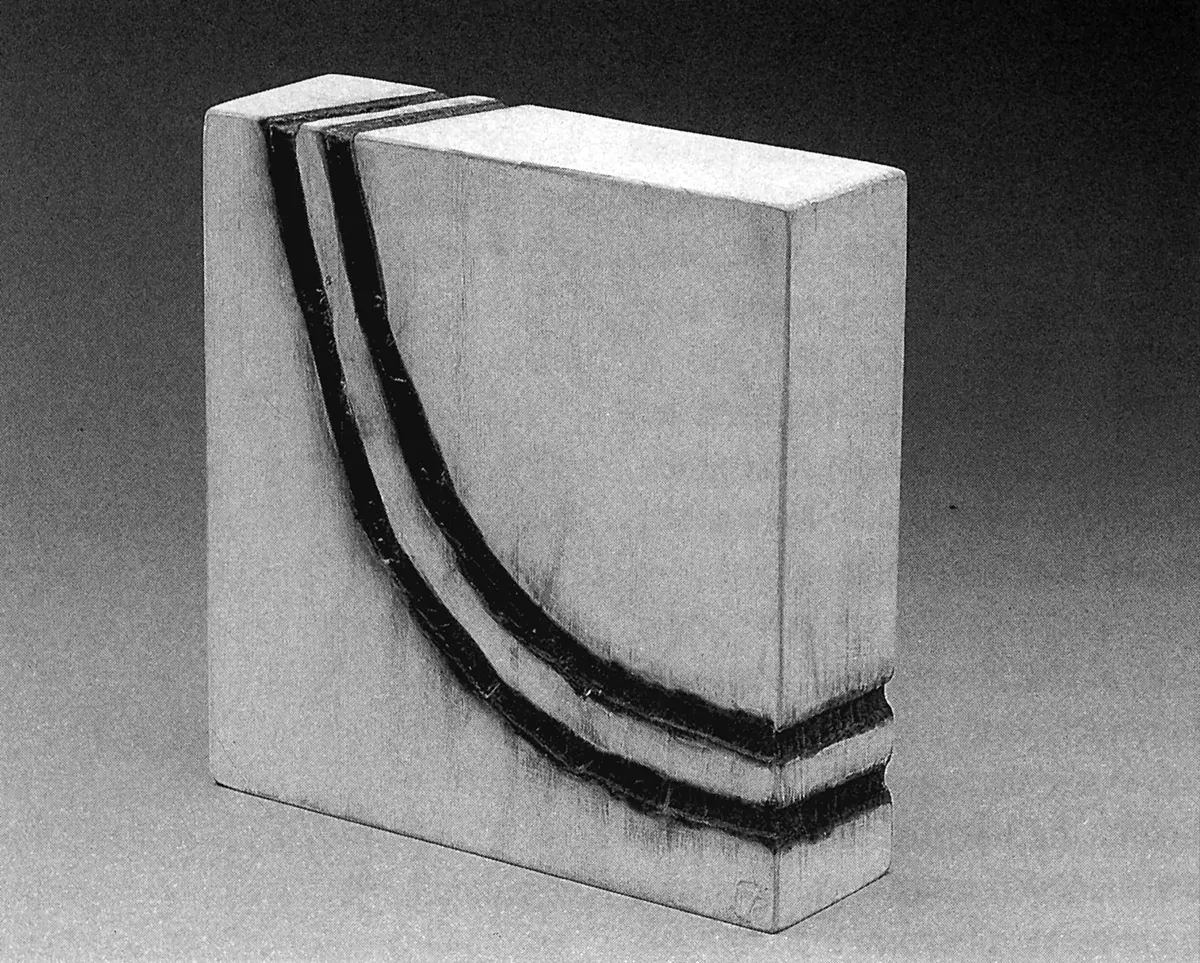
The three-dimensional prints call into question, first of all, the meaning of a printed work of art. The general way in which the term "print" is used very often disguises the actual origin of this expressive technique. Prints were done on volumetric objects, stones, eggs, clay, or pieces of gold or silver long before being produced on a flat surface by means of impression. Perhaps this is the meaning that Gazitúa is trying to recuperate by using supports that are three-dimensional, volumes made up of blocks of finger-joint pine wood. The form chosen is that of a parallelepiped of two straight sides and four rectangles, in half cubes. As in the prints on paper, the artist has worked in three sizes. The blocks are supports, not matrices. And the print is made by means of the imprint of metallic matrices in bright red. Linear matrices, forged in rods of construction iron. First, the artist used copper, but it proved too soft for her purposes. Heated iron prints and leaves its mark in the soft wood. In the process, it burns part of the immediate surrounding area, giving a certain coloring to the support. The gesture is definitive and irrevocable. As the support hardens, the mark will harden, as in the case of branded cattle.
Theoretically, the action can be repeated to create editions of various numbers. But this is not what most interests Gazitúa; therefore, the pieces become-unique prints, rather than multiple copies.
The ridges which are left deep and burned in the blocks of wood contain, retain, and attract space, calling it towards them. They are centripetal, i.e., they function in the opposite way to that of prints on paper, where the forms appear to emerge from the little squares which are their physical continent. The hot rods are applied to various sides of the block, suggesting the crossing of space and the hypothetical manipulation of each piece. Each surface, perpendicular to the surrounding planes, results in a visual displacement, a break such as a bend in a path which we gradually discover.
Apart from the essentially linear language, the common denominator of these works on paper and wood is their extraordinary capacity for synthesis, their economy of means, and the endowing of each stroke with significant content. Teresa Gazitúa is in search of essences, a virtue that goes well beyond the undeniable plastic beauty of her creations.
MARÍA ELVIRA IRIARTE