
In less than a decade Williams Carmona, a passionate cerebral (and, yes, extremely controversial) Cuban artist who has lived in Puerto Rico since 1992, has established himself as one of the most poignant voices among the young visual chroniclers who are interpreting the "games" that define the Caribbean (and all its exiles) at the end of our 20th century.
Carmona's exhibition of his recent paintings, Tírate que das pie, is a surrealist celebration where the artists borrow freely from the Middle Ages, Hieronymus Bosh, Bruegel the Elder, Goya, Dalí, Remedios Varo, Leonora Carrington, and the Caribbean's present postmodern labyrinths in order to construct alluring scenarios where the constant and brutal quarrel between Survival, Eros, Death, and Resurrection is intelligently presented.
Coming from Cuba, a land marked by intense aesthetic dialogues —from Lam and Portocarrero to Jose Marti and Benny Moré; from Lezama Lima and La Lupe to Ponce and Amelia Peláez, Mariano Rodríguez, Carreño; from Lopez Dirube, Cundo Bermúdez, Zilia Sánchez to Ana Mendieta, Tomás Sánchez, Bedia, Mendive, Torres Llorca, Julio Larraz and Kcho— Carmona is now seen as a marvelous storyteller for whom Surrealism, with its immense possibilities, has been a means to convey the generous spirit and the sensual mysteries of the Caribbean.
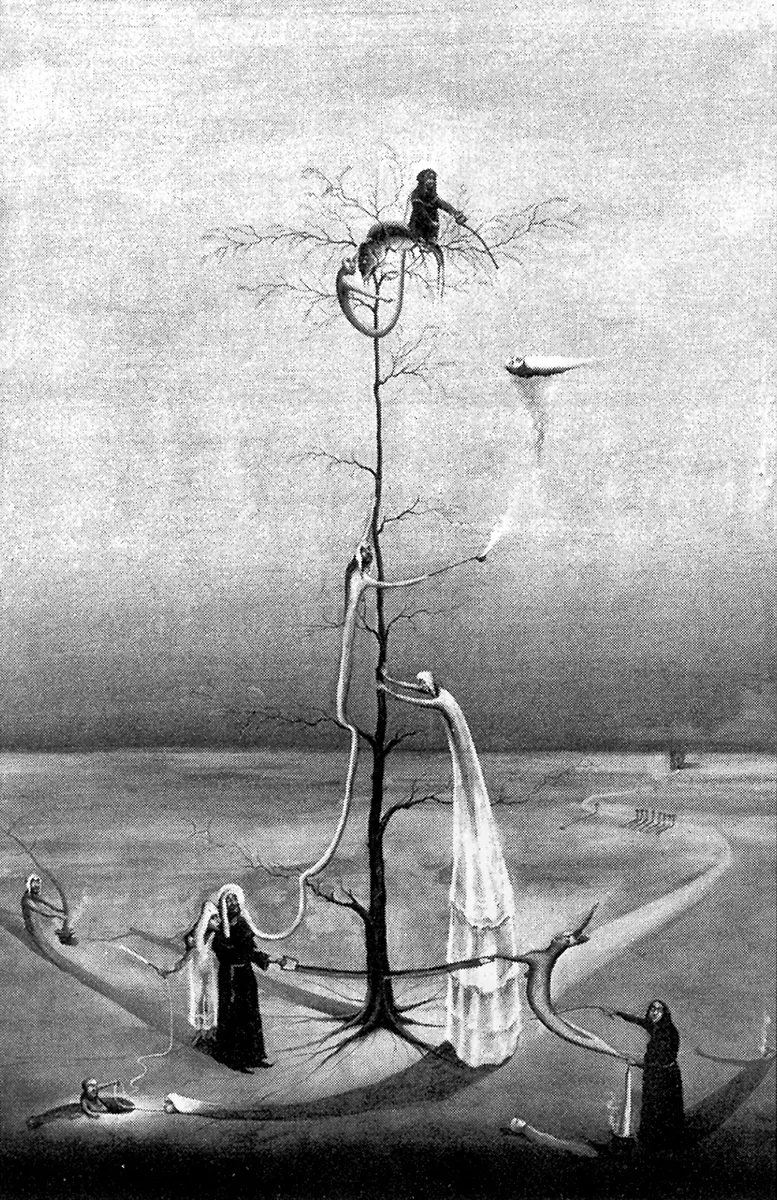
Ruled by premeditated chance and endowed with a pair of imaginary wings, Carmona has decided to fly over the abyss of nothingness and create enchantment, creating magical mirrors that will triumph against all kinds of erosions and continue seducing us as we change and remain the same.
Known for his refined use of color and effective sense of composition, Carmona's aesthetic universe harmonizes a generous understanding of the human race and a deep belief that both, pain and suffering, awe and beauty, sensuality and love are the forces that give meaning to Life.
His recent paintings are poetically constructed scenarios where tragedy, lust, and hope are admirably balanced creating secret mirrors of ourselves. His timeless personages —always full of luminous peace, full of enigmatic desires always— invite us to embark on splendid journeys that can take us to the essence of humanity.
These new "stories"— and each one of Carmona's paintings is a difficult but seductive story that has been conceived from the exile we have all experienced in the Caribbean throughout our history—reveal that this incisive but compassionate artist has been able to understand and translate into the canvas the essence of the brutal games of exclusion we play, and the suffering caused by the continuous diaspora we have been forced to live in that in many ways defines this secret Circle of ours.
In fact, Carmona's paintings—so full of lyricism, irony, sadness, and joy; so full of mystery and magic; so surreal yet so close to our daily lives— are awesome mirrors that reflect the topographies of our memories and our desires. His scenarios are precious poems about an extraordinary past and the unimaginable possibilities of our confusing but generous present. But above all, they are original metaphors about ourselves within the history of mankind the history of art, and ultimately, the history of love.
In his forceful and enigmatic "maps" Carmona juxtaposes spirit and matter, freedom and oppression, passion and emptiness, and ultimately, life and death, in order to let us see that our short journey on this planet should be lived as an honest love poem.
MANUEL ÁLVAREZ LEZAMA