
The Carrillo Gil Museum in Mexico City recently presented Sumo and Under Treatment, two interesting series from a project which the Mexican artist Yishai Jusidman has titled Pictorial Investigations.
Since the late 1980s, Jusidman has undertaken research that has resulted in the splendid series titled Astronomer (1987-1990), Spheres-Clown (1990-1991), Clowns (1991-1992), and Geishas (1993-1995), the main theme of which is painting itself.
To find an artist like Jusidman in the contemporary Mexican art scene is an enormous surprise. While most young artists influenced by the visual media and television speak of the imminent demise of painting and try to complement their art with alternative materials, Jusidman prefers to return to the essence and with a considerable sense of craft, shows the spectator that painting is not only alive and well, but that it is fully part of the contemporary world.
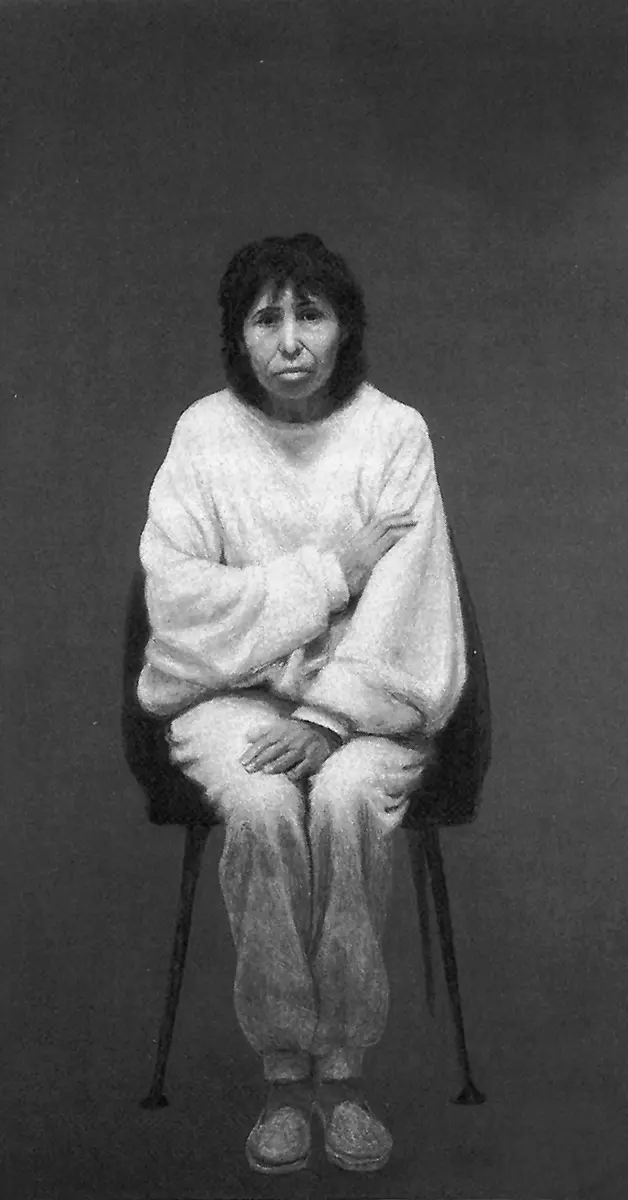
It has been said that retrospective shows are more necessary for the artist than the spectator since they allow him or her to look back and analyze past work and decide which path to follow. On this occasion, however, it was the spectator who ended up the winner. Jusidman's work reveals the development of his gaze. Looking and discovering that the work is done in such a way that the spectator not only interprets it but, on looking, actually completes it.
In the Sumo series, Jusidman uses the Japanese wrestlers merely as a pretext for carrying out formal exercises. The two human figures engaged in combat, in reality, face each other in Jusidman's work like the different pictorial elements of a picture: figuration vs. abstraction, surface vs. figure, movement vs. immobility, etc. The backgrounds and different planes give the pieces a sense of displacement and elasticity, resulting in a visual sequence in which what is seen in one picture necessarily takes us on to the next until the end of the series. In these works, Jusidman sets out the formal problems of true painting and places them before the spectator, without any tricks or disguises. In Under Treatment, the artist's most recent project, Jusidman went to a psychiatric hospital in Mexico City, where he photographed various patients holding an art book in their hands. Each patient chose a reproduction with which they wanted to be photographed: thus de Kooning, José de Ribera, Mondrian, and Velázquez, among others, formed part of the instantaneous universe which the artist created for these patients. Initial visual contact is thus established with the model; the creation comes from investigation and the development of the concept.
The identity cards appearing with each picture completed the work. They showed the initials of the patient, the nature of the illness, and the name of the picture which appears in the book held by each patient. A network of associations is thus created which form a dialectic of the gaze —as the spectator looks at the person in the portrait, he also looks at the plate in the book held by the model, who in returning the spectator's gaze completes the work initiated when the spectator first looks at and reads the information about each patient. So where does this leave the artist?
In this case, the artist disappears when the work is finished and remains only as a constructor of emotive situations and instantaneous images whose memory is captured in oil on canvas. In Under Treatment, the work of art acquires total autonomy. This is Jusidman's real achievement: the triumph of painting through the artist's concept, his pure technique, and his excellent craft as a painter.
ANA ELENA MALLET