
The young Mexican artist Yolanda Gutiérrez (1970) recently exhibited for the first time in Paris with around twenty works at two different venues: the Musée du Jeu de Paume, as the third invited artist in the Americana cycle (which consists of presenting a young Latin American artist in conjunction with an important retrospective, in this case, Yolanda Gutiérrez and the Pompidou collection, and at the Espace d'Art Yvonamor Palix, as part of the Under the greyness of Mexico cycle, which will be presenting young artists from Mexico throughout 1999.
There is in the art of Yolanda Gutiérrez both a relationship with the body and a relationship with nature, that is, two forms of relationship with the world in which time and culture separate or fuse to enable art to provide a sensitive response to questions of a philosophical or existential kind —involving identity and the meaning of life— posed by artists. At the "formal" level and in terms of sources, it should be noted that this young Mexican artist is, whether consciously or not, part of the tradition of relationship with natural material which another Mexican, the painter Francisco Toledo, has constantly experimented with in his multifaceted and prolific work. However, Toledo has never deliberately referred to any kind of ecological posture, despite the inclusion in his work (or the fabrication) of objects based on fishbones, tortoise shells, and other shells, and branches, as well as the use of natural products such as cochineal and amate paper (natural bark). While the common denominator between these two artists who belong to very different generations is their awareness of fleeting and poetical materiality and the threatened aesthetics of nature, the difference resides in their individual plastic proposal (Toledo is a painter, printmaker, sculptor, and ceramic artist) and their manner of "transforming” a natural object and giving it an ontological status as a work of art.
But the purpose of this review is not to compare the work of these two artists, who are certainly close, but rather to understand the links which might explain the genesis of the precociously mature work of Yolanda Gutiérrez. The most important aspect here is her involvement in a "soft" (non-violent) ecological militant movement with the creation in 1995 at the Autonomous National University of Mexico of an interdisciplinary group which was to give a scientific structure to her interventions on the landscape. In Mexico, women artists of her generation, such as Sylvia Gruner, or older figures such as Helen Escobedo, also share this ecological concern. The latter has made several in-site interventions to denounce acid rain (Germany, 1992), the extinction of giant sea turtles (Costa Rica, 1993) or urban waste (Mexico, 1990), to mention only a few examples, and which combine in a single event several discourses highlighting the ideological, humoristic, aesthetic and poetic dimensions of her work.
What distinguishes Yolanda Gutiérrez from these possible antecedents or perhaps fortuitous parallelisms, and from the interventionist approach of American land art practitioners and arte povera —with the exception of certain works by Mario Merz, such as Bundles of Wood, or by Giuseppe Penone, such as Breath of Leaves— is her characteristic aesthetic and poetic search, based on the permanence of ethics of respect for the perishable products of animals in nature (nests, shells, sea-sponges, etc.). Her ecological awareness reinforces and enriches that of Toledo, which appears more cultural and identity-based than ideological or even militant.
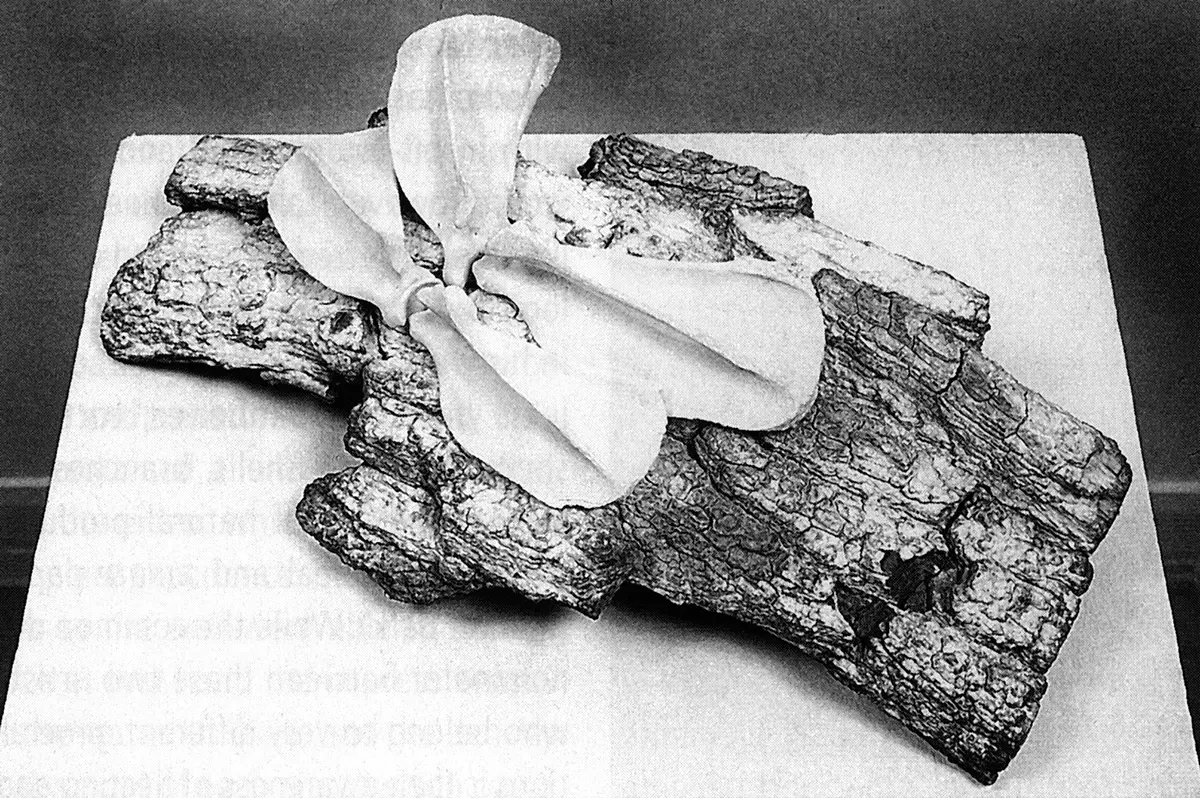
At the heart of the Jeu de Paume, an important and emblematic work entitled Threshold occupied the entire volume of the main space: 28 pairs of ox mandibles (and wood) were suspended by an invisible thread at varying heights, in a simulation of the (arrested) flight of strange birds without age. This timeless migration created a certain kind of serenity, an inspired floating in which all violence and cruelty, all aggression, and any idea of death disappeared, giving way to a feeling of permanence created by the evocation of the transfigured animal. In the mezzanine and at the Espace d'Art Ivonamor Palix, small objects recreated and invented another kind of nature, sometimes based on non-natural elements which suggested a kind of transparent cotton (Cocoon I, plastic and iron wire, 1991) or fragments of tree bark which reconstructed "primitive" architectures (Hurricane Seed, 1995, assemblage of tabachin bark).
Yolanda Gutiérrez's gaze is inquisitive: it goes deep, revealing things, and digging them up: it is the gaze of the researcher, but also of a magician with a deep love of nature. Feathers, shells, and plants are chosen and used as aesthetic elements, combined with grasses, wicker, reeds, and bamboo, which she assembles and weaves, before extracting and recuperating the remains of life (bones, entrails, jaws) as in Sprouting (ox bones, 1994) or Entrail-deep (pig intestine and agave thorns, 1995). Yolanda Gutiérrez recombines elements and restores life to them, creating a utopic and poetical nature of great delicacy, which we have never known, which we have dreamt about, or which we have lost, taking us back to original simplicity when forms and functions were but one in the nostalgic harmony of a Lost Paradise (The Dream of the Branch, 1997, eucalyptus leaves, palm tree, and wood).
CHRISTINE FRÉROT