
This exhibition, titled Interrupted Communication, at the Museum of Contemporary Art, was the first one-man show in Panama by the Honduran painter Armando Lara. The works, consisting of a series of small three-dimensional boxes and 16 large acrylic paintings on canvas, produced a considerable impact from the beginning, in particular, because of the monumental and realistic nudes which dominated them. Complete or parts of human bodies floating freely in a schematic world curiously recalled both the nudes of the Renaissance frescoes and the pictures of dead persons thrust at us every day by the mass media. The exhibition was full of contrasts and oppositions, beginning with the contradiction implicit in the title, the visual interplay between the little boxes and the large canvases, and the contrast between the deep spaces and the miniature worlds of the cardboard cubes. The first and most important contresens was evident in the bodies modeled in the chiaroscuro technique which we want to admire, but which disturbs us because they seem to be frozen in mid-air as if rotating or writhing in pain. There is a disquieting kind of ambiguity in the way in which these idealized and neo-classical figures remind us of the images of victims of torture, as well as the fact that despite their enormous and massive size, they seem to overcome gravity and float like beings in some atemporal space.
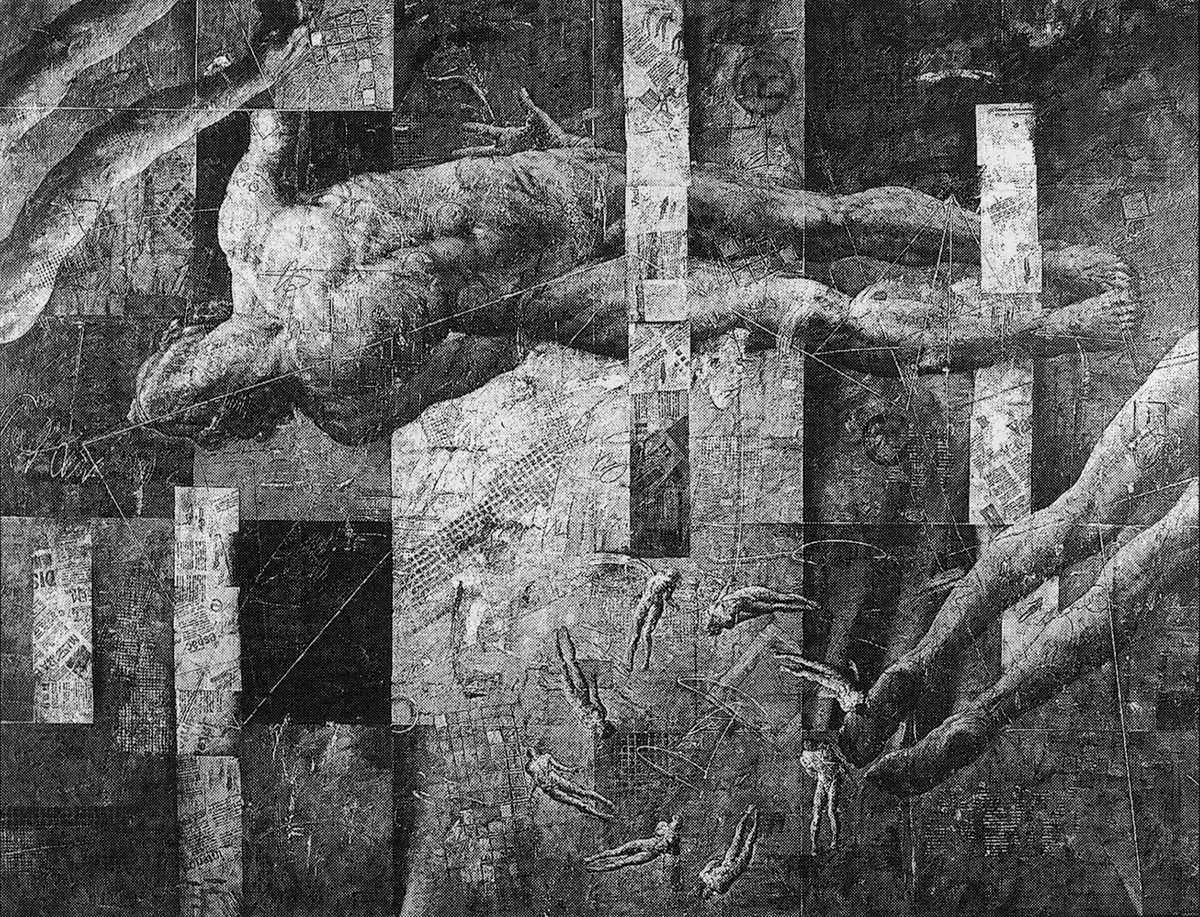
Despite the intimacy of their nearness and nakedness, there is no communication between these figures which appear anonymous and without any faces. We see them from awkward angles, and only the lower part of the jaw is visible —the historically vulnerable area of the neck— or the nape of the neck or the crown of the head. The painter puts us in a strange position that makes us question our attitude as witnesses to the canvas and to what we are being shown. Lara proceeds traditionally in the way he paints on the canvases, but is audacious in his total freedom with space. The compositions appear fragmented, with flat elements which cross, invade and interrupt the three-dimensional extremities of the figures. They include squares as if the artist has deconstructed bodies, and boxes, which are unfolded, with their surfaces drawn on the canvas. On and behind these desynchronized grids, Lara inserts a series of small, repetitive, and enigmatic images which, through their repetition and position, acquire an emblematic function. There are also surrealistic elements, such as boxes with legs, hands without forearms, semi-circles of bodies or pieces of bodies, and polygons of interwoven arms. They appear in arbitrary sizes as if we were observing the same image close-up and from a distance. There is a visual interplay that makes use of the spatial and reproduction concepts of photography, essential ingredients of the way we look at things at the end of the twentieth century.
As in a film or a photographic exercise by Muybridge, Lara repeats forms side by side and imposes compositional cuts on his figures. Some of the works even recall the walls of multiple television screens which bombard our eyes in electronic equipment stores. There are references to the cinema, the news, and contemporary life, with its constant computerized and televised images, as well as to the comprehensive or fragmentary information provided by the mass media and which, as in these pictures, show situations that we think we understand, but which we see only through someone else's eyes. Lara reiterates his message in his pictures through clippings from newspapers, with extracts from articles providing incomplete information, like all those omnipresent acts of communication which are not necessarily complete. Lara has managed in these works to establish a harmonious balance between his outstanding technical skills and the message which he wants to communicate. Although the "surrealism with a social conscience" which has always characterized his work is still evident, he has now moved on to a more subtle and personal language. It is a relief to note that he has left behind the Dalian surrealism of his early years, as well as the unfortunate period of his humanoid bananas. Towards 1990, he painted figures made with paper bags, in an expression of his concern with the consumer society, combined with elements taken from classical art, with romantic settings in the form of ancient, half-crumbling architectures. The path towards his present work dates from around 1992, when according to the respected Honduran historian Leticia de Oyuela, Lara "focused on the challenging search involving the fusion of the body and the soul", which led to "the (apparently extemporaneous)... re-examination and mastery of the human body".Around 1994, when Lara was awarded a gold medal at the Second Santo Domingo Biennial, repeated nudes in his work, as in Refugees, appeared in curled, fetal positions. These pictures already foreshadowed elements of his current discourse, such as the sharp bands and borders in the foreground and the search for an ambiguous space full of inserts, and the repetition of small symbolic images, which at that time included many obvious religious connotations. In other works, such as Brothers Against Brothers, Lara presented male nudes in positions of physical combat, as a representation of the social and political struggles of Central America. Finally, around 1997, the human figures rose up and became complete, from head to toe, although cut in the characteristically Laran fashion and surrounded by pieces of bodies, such as eyes, ears, and hands, as well as by another series of elements related to the consumer society, such as discarded cans and paper bags. Another thread in his work in recent years is the handling of color and the surface of his canvases, which generally appears to be scratched, stamped, and glued with imaginary kinds of paper, deteriorated like an old wall full of graffiti which we cannot always understand but where we sense passing of time and human presence. Lara's colors, which have become more subtle and interesting over the years, tend to be opulent, with a dark patina that heightens the impression that we are looking at a classical and ancient work. He uses rich, baroque colors, one might even say the colors of mannerism in his preference for rather bitter-sweet tones and textures. However, it is also worth noting the effect produced by the lack of color in two of the works in the show Long Distance I and Long Distance II, which depict a male figure seen from behind and another female figure, seen from the front, in anguished poses done in black and white. These compositions, which form a new and different exercise in Lara's work, confirm that his expression is not dependent on the use of color. Another new element in his work in this recent exhibition was the presence of the small three-dimensional boxes. They had appeared before, drawn on the canvases like little mysterious boxes covered with newspaper or open-like receptacles for pieces of human bodies. In the context of this "interrupted communication", the boxes act as representations of the television screen or the computer, and even of the house or some dark and unknown place. The new boxes, however, are real objects, lined outside and inside with paper produced with computerized images. Inside each box, between layers of printed acetate which create the impression of different levels of meaning —the chapters of some story or history— a single electrical bulb shines, as in the rooms in so many slums throughout Latin America. In Lara's career as an artist, these boxes mark a valuable step from the surface to real space and the use of the physical space of the gallery. However, the montage at the Museum of Contemporary Art, where the little boxes were hung from electrical cables next to the pictures, was not ideal. It gave the impression of a rather reticent, symmetrical installation too obvious in its concept, which failed to exploit the full message of the boxes and did not help the paintings, which in any case did not need any three-dimensional accompaniment. If all these boxes —alone or taken together— had been placed in their own space they would have undoubtedly produced their full effect through their careful construction, internal details, and the symbolism implicit in each of the works, as well as through the repetitive mass of their forms and transparencies. Armando Lara has made considerable progress in his dedication to his work and in the constant growth and increasingly universal nature of his discourse. The Museum of Contemporary Art presented a valuable exhibition, which clearly confirmed that it was fulfilling its task of showing the Panamanian public artworks by established or promising Latin American creators. However, it was unfortunate that the small catalog did not do justice to the works, with its monotonous blue cover and the misleading tones of the reproductions inside. It was a poor vehicle for the short but profound introductory text by Leticia de Oyuela, who rightly pointed out that Armando Lara has now reached a decisive stage in his career, "on the threshold of maturity" as an artist and as a conscious citizen of the postmodern and globalized world in which we are living.
MÓNICA E. KUPFER