Few exhibitions in Santo Domingo have raised as many questions as the recent one-man shows by Fernando Varela, presented in two almost simultaneous parts in two places: the Cultural Center of Spain and the Laramma Gallery. The first exhibition included paintings, installations, and assemblages focused on the concept of fear, both individual and collective, presented in three dimensions. In the second exhibition, which was linked to the first and yet different from it, the theme of fear gradually disappeared, with painting appearing predominantly as a language of introspection and signs.
In the Cultural Center of Spain, which is housed in the former chapel of a restored colonial building, the installation and main work in the show was essentially plastic in nature, particularly when seen from the second floor. Placed at the back of the central nave, it was impeccable in its structure and proportions. On both sides, two blackboards looked like hagiographic panels framing an altar or a sacramental enclave.
The conventional spectator who expects art to be limited to visual expression—something which can be immediately captured by the eye—would have been fully satisfied. Seen from above, the work had a perfect design of a minimalist kind, with permanent aesthetic elements in terms of form, space, texture, and materials. The colors, in a range of muted and relaxing tones, created an atmosphere of meditation.
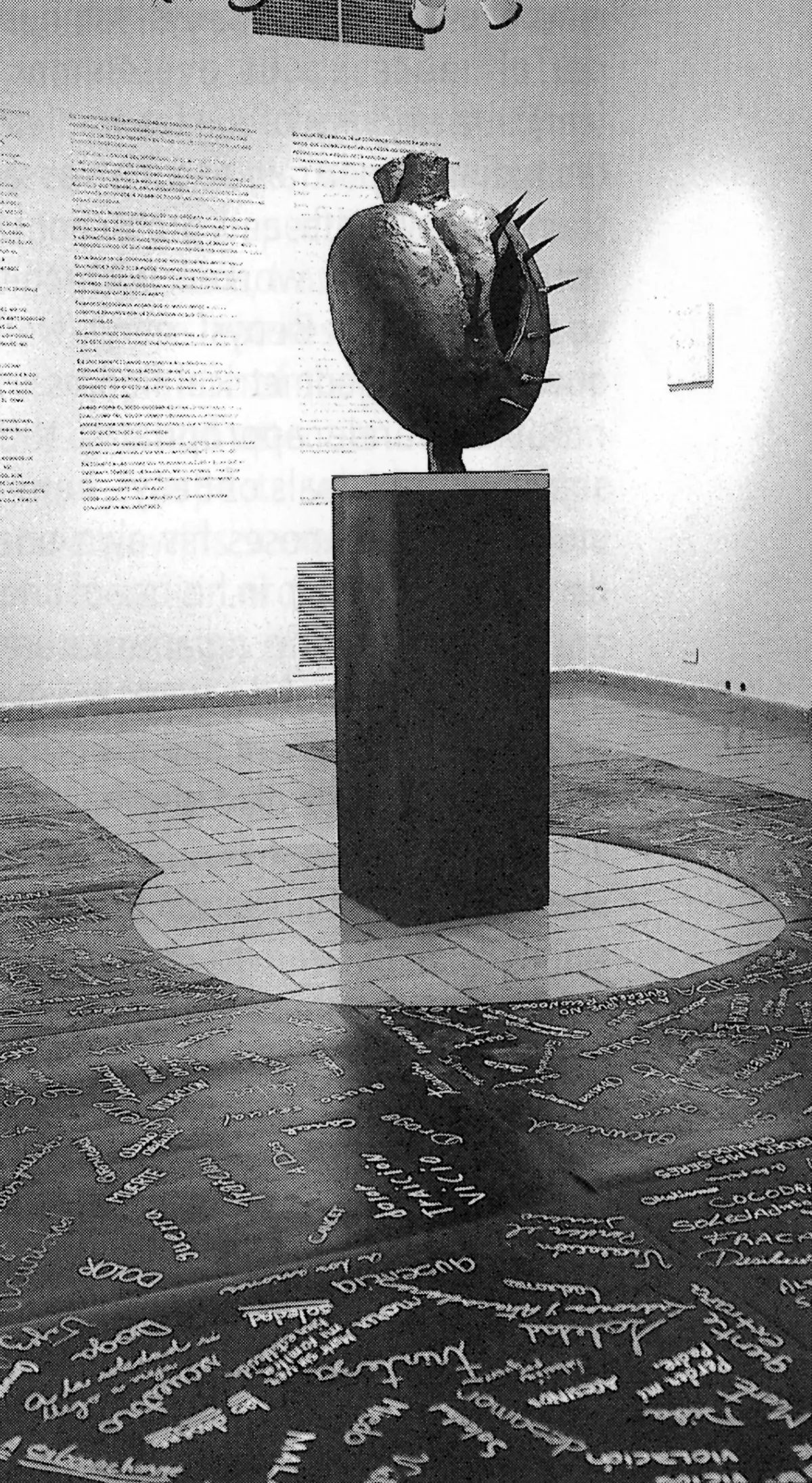
From a distance, therefore, the spectator was not conscious of the work's philosophical and sociological proposals. But despite the need for a plural and progressive reading of the work, it was only when seen up close that it revealed all its intensity and attraction. The installation was a kind of inquiry into the theme of fear as the predominant feeling in all societies and amongst all men and women, a feeling which sometimes leads to terror and the paralysis of all our faculties.
Confessions by people of different generations about their respective fears were transcribed onto the floor and on circular support. Visitors were encouraged to write (and rub out) their own apprehensions and value judgments on the accompanying blackboards. On the front wall, the text of a German philosopher who converted to Orientalism conceptualized the essence of Fear. Fernando Varela tried to engage the participation of visitors in an even more active way and help them overcome their own fears in the process by inviting them to place their hand into a slit/wound in a large heart/ceramic urn surrounded by barbed wire and to draw out a slip of paper. This reproduced the text on the wall: the message was going to be communicated by hook or by crook, even if it meant coming back until the heart bled...
Fernando Varela —or any other art— Fernando is from the Dominican Republic for Heart for that matter-had never embarked on such a radical process of sensitization through art as in this project. No one had gone so close to conceptual art, and the simultaneous expression of ideas and their tangible counterpart. The overall discourse —a kind of exorcism— was intended to free us from fear and give the best artistic expression to a piece of metaphysical and sociological research.
Although there were other good three-dimensional pieces in the show and one painting, the second most impressive work was a polyptych of five boxes, mixed media, and a wall installation, in tribute to Joseph Beuys. Beuys is probably the master whom Varela admires most, as can be seen from other references to him in earlier works. While Varela has managed to preserve his own personality, he explains Beuys' works in various "stages" the love of nature, leaves, and roses, his favorite flower, animals, and the coyote (Beuys' famous performance about overcoming fear), the enigmas of the fat and felt (including a portrait and hat as a source of warmth and protection). Varela has also worked with the square, one of Beuys' most frequently used geometrical figures.
But as Varela appropriates the signs and proposals of Beuys, he simultaneously imposes his own undeniable authorship in his use of line and proportion, the organic nature and construction of the work, his intellectual commitment, and the presence of signs. He also shows how very small forms can acquire the dimensions of a monumental homage if the elements are well chosen and given the right metaphors.
The other exhibition was presented at the Laramma Gallery, which opened recently with the specific intention of promoting contemporary art, irrespective of the preferences of the local market. This second show, although perhaps less disconcerting in that it included many paintings and drawings, was in fact far more difficult. The spectator's participation was not determined through visual, intellectual, or physical participation, but rather in terms of pure aesthetics and the existential concept.
Once again the show's effect would have been diminished if the account were taken only of the exquisite proportions of the spaces, the minute graduation of the tones, or the sophisticated textures of the surfaces. The reduction of expression to a minimalist process is not appropriate in the case of these works.
Duality, the title of the only painting in the first exhibition, provided the common denominator for almost all the works, not so much in terms of any contract between Eros and Thanatos, life and death, but rather as an expression of two successive stages, both positive. Origin and creation. Thought and language.
Fernando Varela's painting is oriented towards an inner equilibrium of a hybrid kind, both Western and Eastern in sensibility. Hence the repeated suggestion of a mandala, and Jung's observation to the effect that "the contemplation of a mandala is a source of inner peace, a sensation that life has once again found its meaning and order."
Here this sign and cosmic symbol of supreme harmony might be a kind of circle, an upward rising spiral, or two symmetrical graphisms. Fernando Varela's mandala usually appears on the surface with simple dots or a few letters. Far from being a confrontation with a void, it evokes a realm of peace or a concept in the process of gestation, which will soon achieve expression. The metaphysical proposal derives from the first figure, which is sacred and geometrical and is compensated by an optimal balance both formal and mythical. This is a multi-religious attempt to seek an essence, rather than the expression of some particular dogma.
The letters reinforce the mystery if we try to arrange them in some kind of semantic combination and decipher the message. However, we must react as though we were illiterate, mere witnesses to an expressive potential, a link prior to thought and language in the chain of creation. When Varela glues a page from the Bible into his work, he is not asking us to look at or recognize a particular verse, even though we are aware of the presence of the Holy Scriptures. Otherwise, he might as well have used pages from a newspaper or book.
With its austere perfectionism and subtle sensitivity, Varela's painting begins to lose its hermetic density as we look closer at his work. The resulting image creates a strong aesthetic emotion, although there is a stubborn resistance to this kind of iconography. Looking will lead to a moment of fruition and meditation, silently communicated through formal harmonies, chromatic elements, and modulated tonalities: violence and stridencies are firmly banished here. Artistic creation continues to be the route followed by the hero in Paul Coelho's The Alchemist, a personal legend, the triumphant path of Fernando Varela...
Though the exhibition at the Cultural Center of Spain was entitled The Magic of Fear, the Laramma Gallery exhibition was definitively about the disappearance of fear and the definitive triumph of Magic.
MARIANNE DE TOLENTINO