
"Now it is the artist's task to stroll through the history of art, appropriate what interests him and then give it a new innocence." Gillo Dorfles
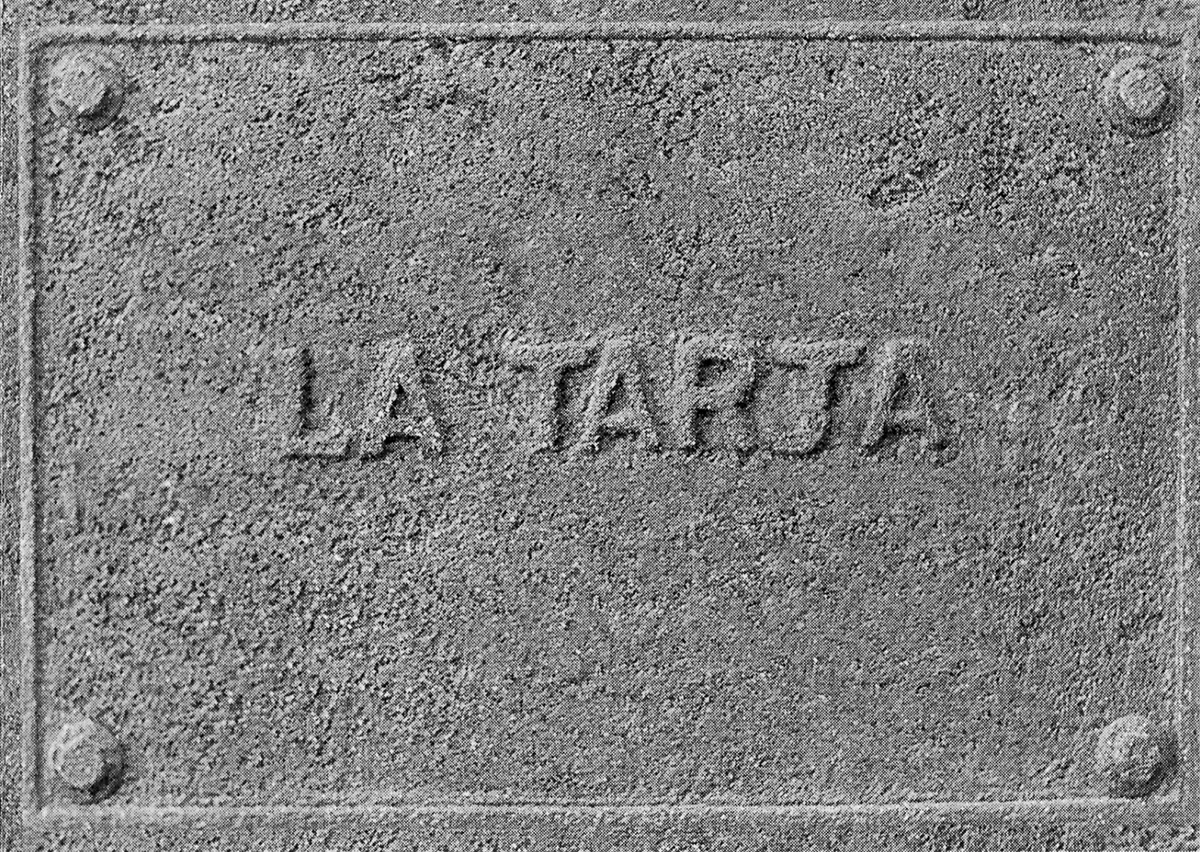
In an attempt to problematize the mechanisms of recognition at work in the artistic field, the Grupo Provisional recently presented an exhibition titled La Tarja (The Tally), consisting of 33 plaques commemorating the symbolic death of a group of emblematic works of contemporary Venezuelan art. The controversial nature of the show, which was held between 22 April and 9 May in the Sala Mendoza, was based on a paradoxical premise, namely that recognition is a source of pride but also kills since it separates the works from their original context and places them in a fictitious galaxy where they function like fetishes. The proposal was interesting in its skillful handling of intertextual and carefully articulated resources, where the laudatory tone of the inscription contrasted with the lugubrious nature of the support.
Juan Carlos Rodríguez, David Palacios, Juan José Olavarría, Domingo de Lucía, and Félix Suazo joined together to form the Grupo Provisional in 1997. Since then they have been developing a strategy of open creation, based on the specificities of context, a feature that has enabled them to explore different spaces and establish an organic dialogue with them. The group show titled The Salon (October 1997) in a small place belonging to a distributor of art materials was conceived as a simulacrum in which the participating artists, works, and curators were all fictitious. The Water Festival was another show held between 6 and 12 April 1998 in an urban residential district in the flagship neighborhood of Caracas. This time the experience was articulated through recourse to contextual problems dealing with the shortage of water and their material and symbolic implications for the community. Finally, From pre-batching to the forklift, a multimedia proposal presented on 20 June 1999, the group highlighted similarities between the field of art and the production system. For this piece, the group installed itself in the art pigment plant belonging to the Artquimia enterprise.
The group in fact tries to offer a critique of various fields of human activity which are all governed by a series of more or less regulated behavioral patterns. Perhaps it is rather pretentious or rather purist to say so, but the proposals are not directed towards the production of objects for aesthetic enjoyment, but rather the critical analysis of processes and beliefs that allow cohesion to be established between cultural fields, whether institutional or alternative. Hence the ephemeral nature of these experiences, the emphasis on performance, and the use of photographic and audiovisual documentary resources depend on the nature of the experience and the possibilities of the context.
The Tally is the group's most recent provocative project, conceived in the form of a large installation. It attempts to pay tribute, through the support of decoration plaques (a highly insignificant resource that is easily accessible) bestowed on a number of contemporary artists who over the last thirty years have persisted in their proposals. Simultaneously, the plaques are used as a sad or honorific symbol of death; they also automatically constitute a ready-made panorama of a historical kind, which fortunately provides an opportunity of filling the void that the past leaves in the memory. Thus these works have another kind of continuity in their proclamations and offer resistance to the customary scourge of oblivion.
The spectator is encouraged to look at the plaques with a cruel curiosity. The works are ironically enclosed within a funeral metaphor and are definitively or ''provisionally" buried, acquiring a false dignity within an atmosphere of nebulous freezing.
It is important to note that the artists included in The Tally are those who have worked within the framework of contemporary art. The list, therefore, excludes the names of Jesús Soto, Carlos Cruz-Diez, and others synonymous with the kinetic and constructivist currents. It includes only those who are present in our rational and foreign barricades, such as Carlos Zerpa, Javier Téllez, Roberto Obregón, José Antonio Hernández-Díez, Meyer Vaisman, and the representatives of the most recent generation, such as Luis Romero, Diana López, Carlos Molina, Alessandro Balteo and Juan Nascimiento, amongst others.
The Grupo Provisional is well trained in the carrying out of strategies involving multiple efforts of a technical, conceptual, and manual kind. In this sense, very few multidisciplinary experiences of this type have been seen in Venezuela, where the art of recent decades has been dominated by a more conservative and solitary attitude on the part of creators. Two of its members —Félix Suazo and David Palacios— are Cuban artists resident in Venezuela. As for Juan José Olavarría, who was trained in Venezuela, he has been strongly influenced by the discipline and critical force of the art on the island. His artistic approach is heavily oriented toward political themes. Juan Carlos Rodríguez is a clergyman of the evangelical church and is active in that capacity in some of the poorest neighborhoods of Caracas. Finally, Domingo de Lucía is an artist who has worked in the entrepreneurial field.
Despite the precarious aesthetic value of this shows —a precariousness which is sometimes a characteristic of Latin American art from the colonial period down to the present— what is impressive is the explosive power it generated in terms of reflection. It focused on a silent echo and a spirit of anguished impotence in the definition and broadening of our socio-cultural context. It also expressed the anxiety to seek out ways of responding to the tradition of the past in contemporary art. In a sense, these artists have come together here to demonstrate the pathetic role of the established artist in Venezuela.
The great achievement of the show was the many-sided critical interpretations to which the installation gave rise, particularly among artists.
Some were offended because they were not included, others because they were. The works were not there to be appreciated in aesthetic terms but to serve as a means of engaging in an abstract discussion. However, the metaphor of the morgue —rather than a cemetery— remains in our minds, raising a question that has been asked on many occasions: with what authority does this group allow itself to bury three decades of Venezuelan art? Is there not here a new strategy of invasion and appropriation, not of the work, but of the prestige of the artist? Because of its logically subversive nature, The Tally includes itself at the end of this sort of chronicle, participating in the same process of distinction and demise, along with the other works included in the installation.
Perhaps one evocative aspect of the show was the influence exercised by curatorial and museographical methods, in which false arguments are continuously confused with the real pretensions of a specialized elite.
EUGENIO ESPINOZA