Significant aspects of the realities of New York, the history of art, and the private world of the artist were some of the pictorial bases of this one-man show by Herman Braun-Vega. The artist, a Peruvian architect, painter, and accomplished draughtsman, lived and developed a solid career in New York two decades ago. "New York is always fascinating. I had managed to get a studio on the corner of Broadway and Canal Street. Already at the time the noise was intense. In order to concentrate on painting, I had to find a way of blocking out the noise from the street. I looked everywhere for a solution, to no avail... the days passed and I could not get on with my work for an exhibition. In despair, I turned up the volume of the music to the maximum. I then found I could paint. I had to work outside Peru, you know about the situation in our countries... After that exhibition in New York, I had to go to Paris. Things gradually developed and I stayed there. So my professional activity has been carried out in France and in Europe, with constant trips to Peru."1
Braun-Vega's painting is a statement of pictorial excellence. It is not aggressive, but intense, it constantly achieves a sense of balance through its visual and conceptual tensions. The human figure, painting, and its authors are the apparent bases of these works. Although they are visual and real elements, they are merely the pretext for the organization of architectural visions and acute sociological reflections. Although the works are "well inhabited", each figure evokes a situation of isolation which includes being a symbol and sign of the culture of their times and a defined situation. This is the case with Tek-Mik Me-Tek. The ancient civilizations of the Far East appear in the left panel of the triptych. In the central panel, we have Toulouse Lautrec, with a newspaper in the left corner of the picture placing us in an historical reality. There is a still-life with fruits, fish, and a cat, a friend of the artist in a portrait of the male nude. The abstract elements and the pictorial stains are present as aesthetic reminders of the twentieth century. The themes and the composition are fused together, as in the case of sexuality and the male and female nudes, painted opposite each other but with a voluminous space separating them in the form of a chaise longue, where two very different representatives of social norms are sitting. The light, the symbolic decoration, and the relationship between the internal and external elements contribute to the richly elaborated composition which the artist develops in his pictures, drawings, and architecture. His work is based on a concept of totality which might remind us of the Gesamtkunstwerk, although Braun-Vega belongs to no specific artistic current. The analysis of the above-mentioned work would require an entire essay; let it suffice to refer here to the relationship between the support and the frame, which help give these pictures a three-dimensional effect; the written letters which reflect the artist's concern with Peruvian and international society; and the recognition of the drawing, which always appears, whether real or merely suggested, as the very lungs of each picture.
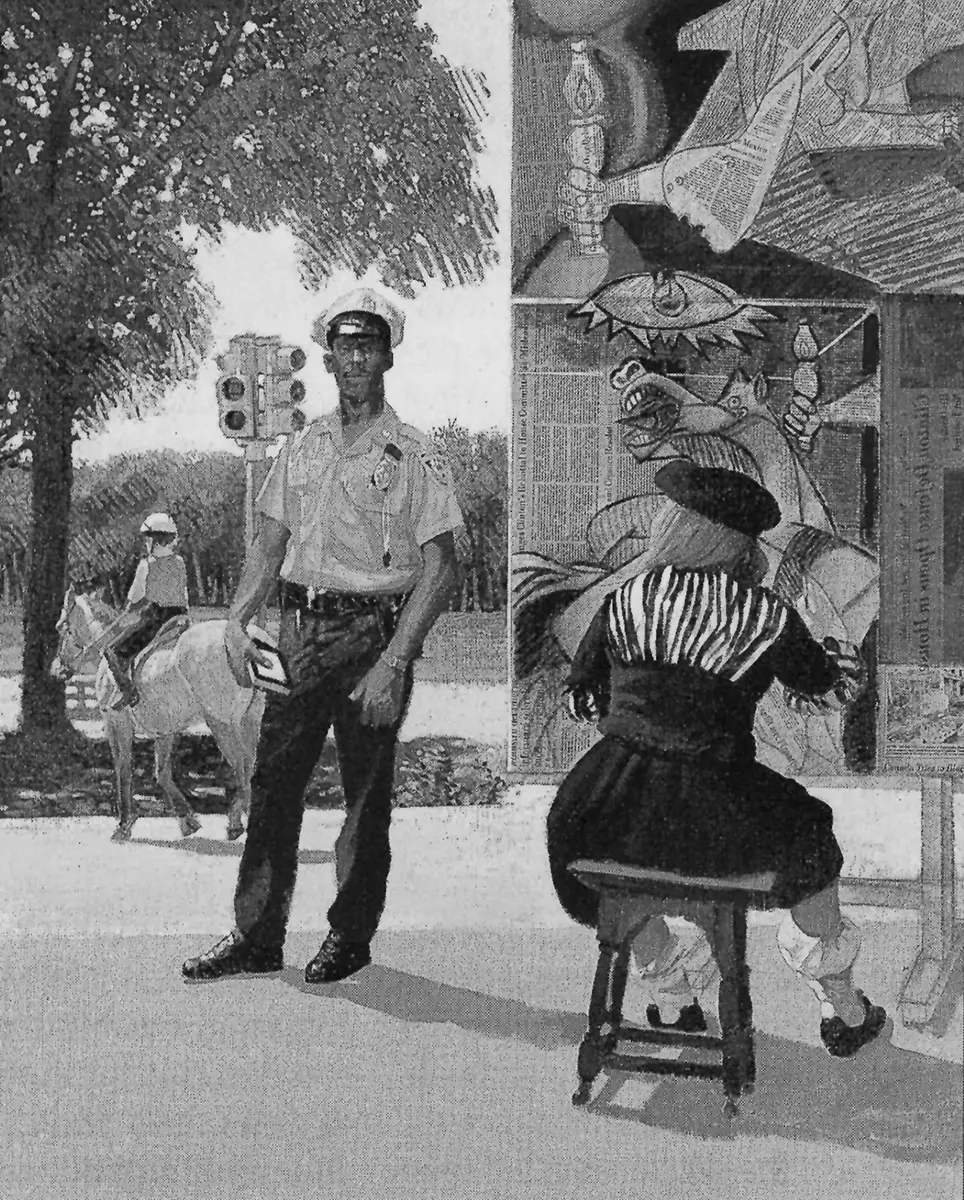
Is that you Mr. Vermeer? and Interior by the Sea (Manet), from 1999, reflect the elaborate composition and the light which structure the spectator's reading. The palette is broad and vigorous, elegant even in its tragic signaling. The artist combines the vigor of the indigenous culture with the central European exercise of serenity. The composition is all-embracing, cutting up and invigorating each picture with various diagonals which create a kind of operatic effect. Two explorations prior to this exhibition, involving walks through the city, resulted in such works as Spanglish (Velásquez) and A Quiet Sunday in Central Park (Vermeer, Picasso). "The police officer we so often consult for information, and the infinitely frequented Central Park, appeared in my memories and drawings. This led to the painting which identifies two artists —Vermeer and Picasso. I did the officer's portrait, a powerful and dynamic figure. Of course, I asked him for permission to do so while he was performing his duty."2 There is a lot of grey and blue in this work. The grey color has intellectual connotations and it was furthermore a fashionable color in New York during Braun-Vega's two trips there. The blue is a register —whether conscious or unconscious— of the powerful features of North American and New York formality, of which many people are unaware. Blue is the color of authority; the shadows are modulated in blue, and accompany Vermeer, their noble creator. Then there are the inevitable ecological references and the love of the sport. The light in this work also defines New York through a path that extends on both sides of the picture, under a sky that soars up into infinity (the artist forgot the stones which cover the path, both literally and figuratively).
Much has been said and written about Latin American painting, and much research has been done; and the debate continues about the advantages and disadvantages of any kind of pigeon-holing. Braun-Vega suggests in this exhibition that the casual nature of our place of origin —since we do not choose where we are born— is a source of intelligence, nourishment, and reiterative expression. There is no one formula or law for defining what Latin American painting is, and those who try to do so by using specific labels are merely addressing its commercial aspects. Latin American art exists in the tools of inventive and powerful aesthetics which belong to each artist.
This exhibition by Braun-Vega marks his re-encounter with the New York scene and indicates his alertness. His work is painting-painting. It is not an alternative or ephemeral work; there are neo-conceptual elements, which can be seen in the preliminary drawings for the paintings, reflecting his training and practice as an architect. In all respects, the work of Braun-Vega belongs to classic modernity and has the quality of museum pieces.
NOTES
GRACIELA KARTOFEL