Inés Tolentino is an artist who has acquired an international reputation, as can be seen from the important prizes she has won. These include the Grand Prix of the 8th Salon of Contemporary Painting (France/Japan) in 1997 and a decade earlier, the Victor Choquet national prize in Paris, which is awarded to artists under the age of 40. These prizes are impressive credentials. In 1989, she presented an exhibition at the Institute of Porto-Rican Culture and another in 1994 at the Botello Gallery in Hato Rey. She is now back at Botello with a new collection, titled Babel by Day and by Night.
For Inés Tolentino, who lives in Paris, this subject has special meaning. The continuing relevance of the Babel story (Genesis 11.4-9) which serves as her point of departure, is of such importance that thousands of years of history have not diminished its transcendent meaning. The painter uses the image of the ziggurat, an ancient Babylonic temple in the form of a tower or inverted cone. As far as we know, the highest point in the structure was used as an astrological observatory, probably by the priests themselves. In the Biblical story, the attempt to construct a building that would stretch up into the celestial vault was motivated by a desire to acquire knowledge that belonged to the Almighty alone. God's response to the intruders was to unleash a multitude of languages dispersed over the face of the earth.
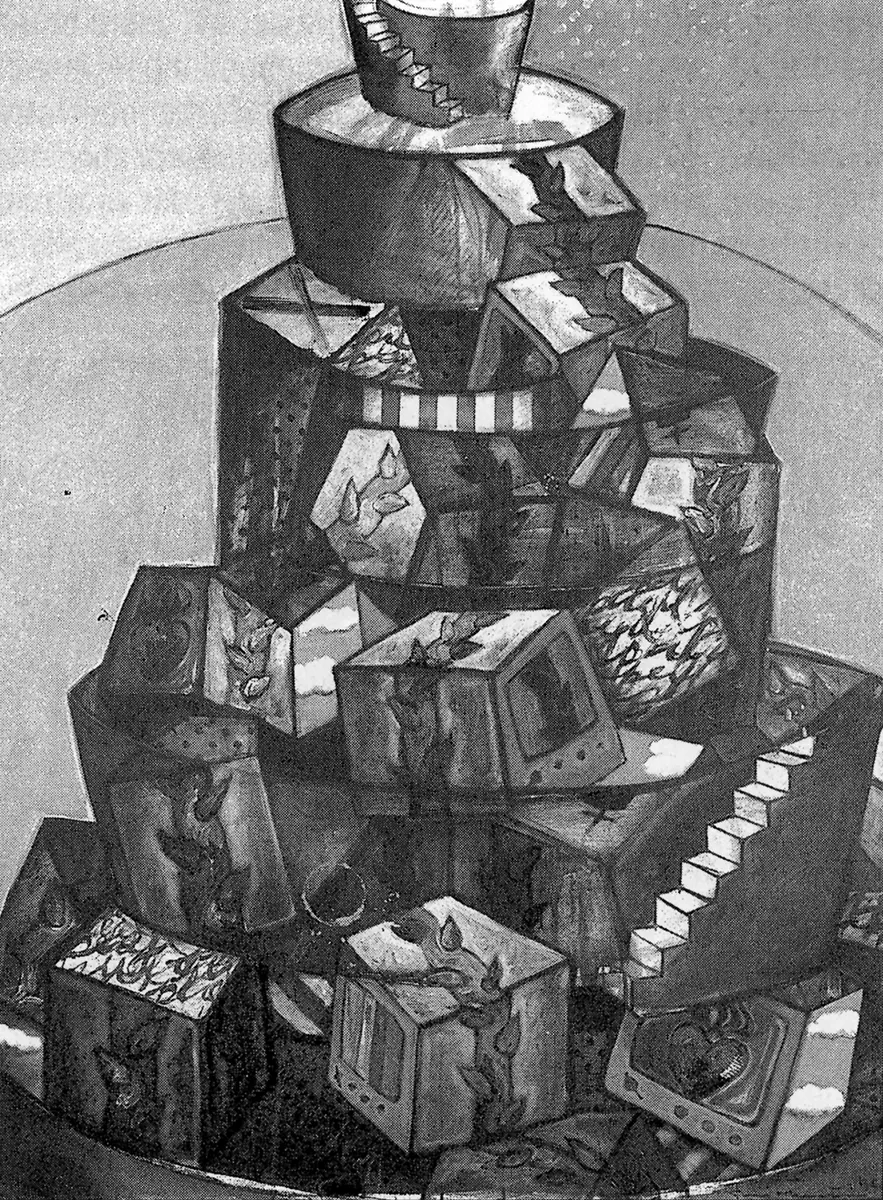
In a different way, this disintegration is a feature of the lives of many people living in the metropolis of the modern world, where the organization of civil society is becoming increasingly precarious. These cities have acquired an unusual kind of solitude because they are also places of a multitude of languages. This lack of communication creates a sense of tension so that the ghetto becomes a place of refuge where family life provides a respite from the discordant polyphony of the street. The sense of protection provided by persons in the same situation creates brief moments of joy that help them cope with the recurrent tensions and problems caused by our cosmopolitan societies. Those who live in such situations find themselves in a state of flux between joy and anguish. As Pope John Paul II recently pointed out... "for many people, especially young people, the city has become a place of rootlessness, anonymity, and inequality, the result of which is a loss of identity and a sense of dignity" (El Visitante, 24 July 1999, Porto Rico).
Inés Tolentino has used one of the symbols of Western civilization to involve the spectator in the emotional lethargy of those who live in places that are simultaneously marked by poverty and luxury, hunger and consumerism.
Her exhibition at the Botello Gallery in Hato Rey offered a number of possible interpretations, referring us back to the Old Testament as a means of emphasizing the continuity of concerns that have always been the destiny of man.
At the same time, without disregarding the Latin American tradition, Inés Tolentino manages to propose work of an international kind, in which she combines a controlled kind of expressionism with certain elements taken from magical realism to create a world that rises up in a spiral. Inés Tolentino makes us question the reasons why we pursue certain goals and the direction we take when those goals have been achieved.
JOSÉ ANTONIO PÉREZ RUIZ