After having shown their work —painting, and sculpture respectively— since 1989, Nicolás Guagnini and Karin Schneider, after settling in New York, joined forces to establish the Guacha Productions Union, a artists' film company. The couple immediately obtained a grant to work in the city of Lodz, Poland, where they went with a 16 mm. camera to study the cultural riches of the Stuki Museum, "the treasure-house of Lodz", as Guagnini describes it.
They soon became fascinated with the works of a couple of modernist Polish artists, Wladyslaw Strzeminski and Katarzyna Kobro, fascination which served as the starting point for Limbo fantasmal (Phantom Limb), a film work which they presented last August at the Museum of Modern Art in Buenos Aires, after its projection at the Museu de Arte Moderna in São Paulo and the Luisa Strina Gallery in the same city.
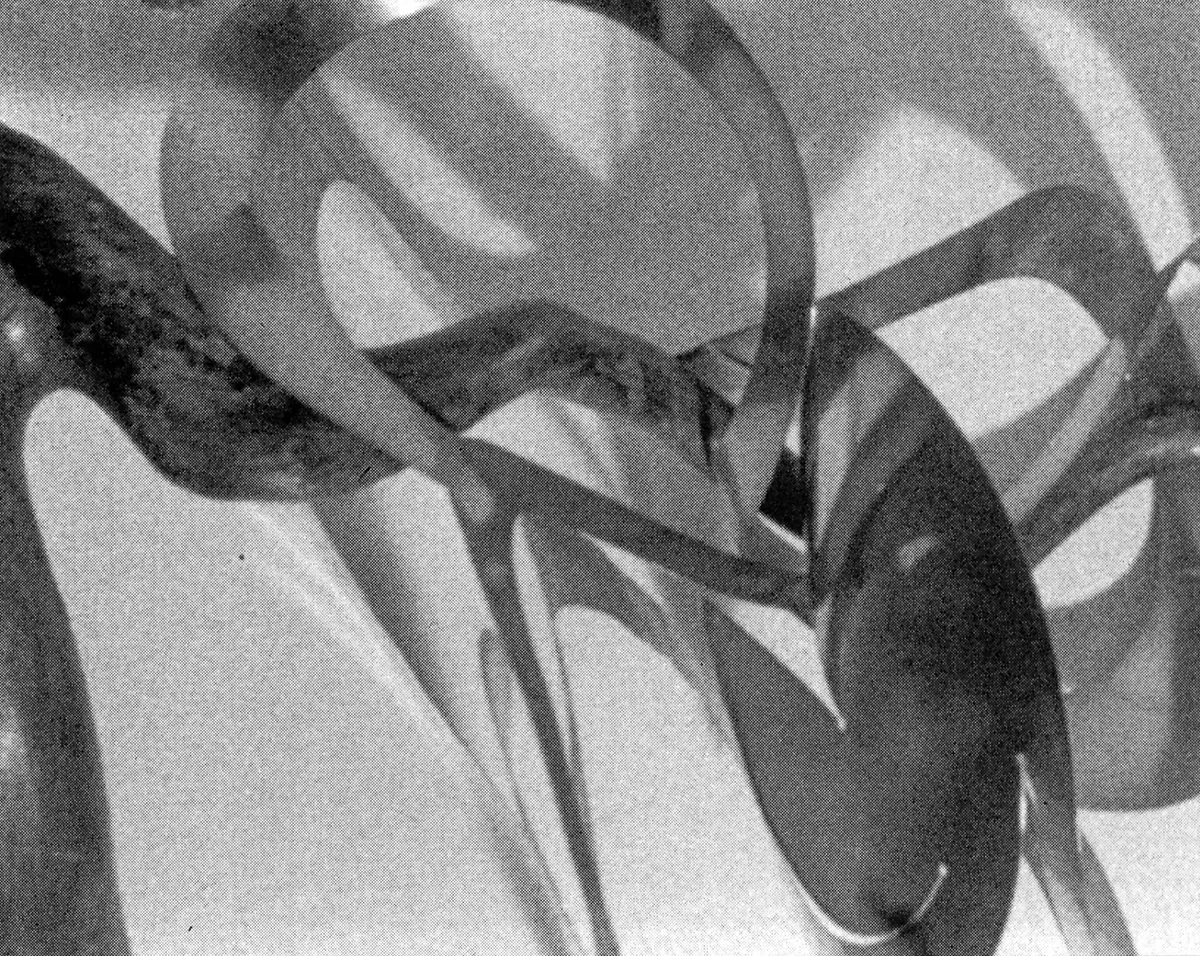
Limbo fantasmal is a silent film, in black and white, lasting 22 minutes. It is filmed in 16 mm, in the compositional and didactic style of a documentary, and with certain features taken from the films of the 1920s —although it is in fact rather a poetic parody of the genre and the times.
The film depicts the making of an absurd collection of images of modernism from the periphery, mainly from the 1920s to the 1960s, in the style of a documentary. With the ingenuity of cinematographic techniques clearly belonging to the past, the work establishes analogies and connections between a selection of modernist works by the Strzeminski-Kobro couple, the Argentinian artist Raúl Lozza and the Brazilian artists Lygia Clark and Hélio Oiticica, combined with other rather surprising images, such as a hippopotamus with a gaping mouth, or scenes of bodies in a trance taken from a Haitian documentary, and which were selected for their formal and poetic links with the filmed works.
In this way, Limbo fantasmal is constructed on the basis of formal associations between images generated in various historical contexts, as Guagnini notes: Utopias from the periphery, which have not been subject to the system of the successive avant-garde movements, which developed in a relatively isolated and synchronic manner with respect to the centers. In this sense, the film deals with distance as a condition for the critical reformation or re-fictionalization of history. Not only through the works and the artists documented —modern Polish, Brazilian or Argentinian elements with their respective distances and specific deviations from the history of modernism in the central countries— but because in this case film itself, the relatively virginal relationship of Guagnini's and Schneider's fascination with film, seems to provide the distance that allows them to decompress and de-solemnize their relationship with their basic materials and, as they themselves have pointed out, to create a kind of "didactic comedy" about a given period of history.
As regards specifically the case of Buenos Aires, where for a few years now a group of artists, mainly painters, have been working with certain images derived from concrete art, the work of Schneider and Guagnini shows for the first time how, prior to the deforming process of absorption, an artist's gaze operates on a given historical heritage. By this, I mean that until now, the images of Argentinian modernism of the 1940s were arbitrarily mentioned here and there, without any reference to the channels through which their reading was communicated or to the motives and secret passions that this "comedy" reveals. Limbo fantasmal exposes the operations involved in the re-reading of history as a map of elastic relations, a constellation in which approximations are no longer based on power but on a simple but corrosive poetic will.
In each of the venues in which Schneider and Guagnini have shown the film, the presentation has included some additional elements. In the case of the Museum of Modern Art, the artists proposed an installation made of a black and white paper border or frieze with repeated photograms of the film, indicating the path from the entrance to the Museum to the entrance of the auditorium where Limbo fantasmal was shown.
INÉS KATZENSTEIN