
Following the model established by The Museum of Modern Art (New York City), institutions, fashioned on modernist paradigms, have come to terms with contemporary art by presenting postmodernist endeavors within the confines of a project room series. While many institutions are engaging in the fanfare and ritual of marking the turn of the millennium by means of revising the century, others are entertaining proposals that address issues around audience diversities, new technologies, and definitions of art. Institutions that historically have been reticent of change and who have long considered the curatorial paradigm of parallel space and series as too threatening, are finally opening up to new proposals.
Last June, the Rufino Tamayo Museum, inaugurated the Sala 7 Contemporary Projects as its program dedicated to ongoing contemporary art proposals. First conceptualized by Gabriela Eugenia Lopez, the museum's former Assistant Director, Sala 7 was conceived as the site from which a dialogue between contemporary art with the museum's permanent collection would ensue. Sala 7's goal is to provide new frameworks for its permanent collection as well as a kind of passage into and an itinerary for contemporary art and thought. Linder Tere Marquez, its current Director, and the curatorship of Taiyana Pimentel, the Sala 7, has finally taken off.
Up until the Sala 7, all the Rufino Tamayo Museum's exhibition program revolved around 'international' and Mexican modern art that was related, for the most part, to lesser or greater degrees, to the works donated by the Mexican master. Along with a representative selection of his work, Rufino Tamayo acquired important works by diverse artists —Francis Bacon, Henry Moore, Robert Motherwell, Louise Nevelson, Antoni Tàpies— that along with the Mexican master's oeuvre, form the bulk of its permanent collection.
For the Sala 7 Contemporary Project Series, Pimentel, who has studied in Havana, New York City, and Mexico City, will focus on monographic proposals from Latin American artists. While the curatorial vision of Pimentel for Sala 7 came as no surprise, her inaugural artist: Miguel Calderón, who lives and works in Mexico City, did.
Concerned more with serious research than bad boy antics or indulgence in questionable taste, as some US and Mexican critics contend, Calderón dwells further into the research of urban visual culture, particularly its power relations, and discourses. Joven Entusiasta, his first solo museum exhibition, is a landmark in more ways than one: Calderón is the first living artist from Mexico not directly connected to the permanent collection to exhibit at the Rufino Tamayo Museum.
In Joven Entusiasta, Calderón brings together his ongoing concerns with his critical outlook regarding the museum as a site of power through its collecting and exhibition practices as well as through its web of relations with its staff and audience. With his Artificial History series (1995), a performative intervention involving the dioramas of the Museum of Natural History of Mexico City, Calderón began his foray into these topics, particularly issues involving display. This early but most successful work inscribed Calderón into a tradition that spans the foundational works of Marcel Broodthaers and Hands Haacke onto the more recent endeavors of Sophie Calle, Thomas Struth, and Fred Wilson.
Calderón's participation in the exhibition, En Crudo (1999), National Museum of Art (MUNAL), Mexico City, was, formally and qualitatively speaking, the work that most adhered to the site-specific nature of the proposal. Inspired by the 19th-century Mexican Academic School that indulged in religious and historical themes, Calderón reenacted the paintings in collaboration with the MUNAL janitorial staff. Rendered in his tableaux vivant style, the large-scale c-prints are an exuberant depiction of the men and women who take care of the MUNAL and how know the paintings by heart. Utilizing as props as well as complex compositional devices the tools of their trade mops, brooms, and trash cans, Calderón reenacted the themes on the rarely seen terraces and rooftops of the monumental Neo-classic building.
Brought to life, Calderón gave the paintings of the MUNAL permanent collection, a real and lived visual cultural context, drawing registers from various genres he admires such as movie posters; comics; billboards; and, the telenovela (soap operas). Art historically, this series playfully referenced Baroque masters such as Caravaggio who established conventions and tropes by using real and identifiable figures from all walks of life, particularly humble and marginal ones, to portray religious and historical figures.
For En Crudo, Calderón also dwelt in the institution's staff and audience relations by means of mocking, in a bittersweet manner, the established Mexican museum convention that highlights a work of art each month. Staging the MUNAL staff in a popular pyramid pose, Calderón called attention to their invisibility and centrality in the institution, by placing the resultant C-print image, the fruit of his collaborative work with the staff, in the MUNAL lobby. To top things off, Calderón executed a work on the fictional 'visitor of the month,' that depicts an art aficionado who poses irreverently on top and behind a life-size marble female nude of the Mexican academic school.
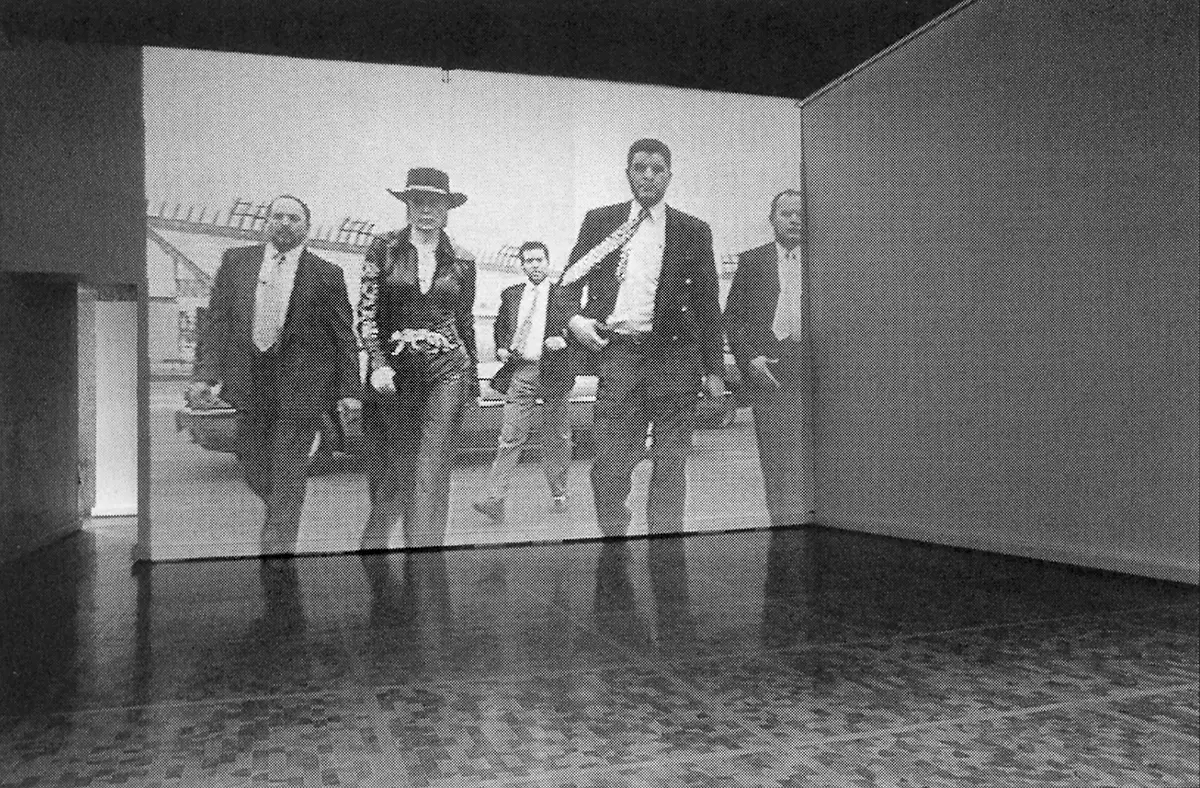
In Joven Entusiasta, as Pimentel notes, Calderón "continues to research the line of power, but in this occasion, his work deconstructs a new phase of relations of domination ". A short video loop repetitively depicts Ema, an urban femme fatale completing a full lap in Mexico City's racecar track, stepping out of the vehicle and gear, the actress strides directly towards the camera. The model completes numerous laps, attired in different outfits —a true pastiche of signature and faux Euro fashion— driving a different vintage racecar each time. Ema performs, again and again, the masquerade of her desires and embodies the artist's shameless hyper-masculine gaze, which self-consciously directs her in an amateurish bad way.
The video is a hybrid that brings together a myriad of genres: telenovela, commercials, fashion clips, family movies, bad cinema soft-core porn. Joven Entusiasta, at one level, may read as a self-referential work, that is, it calls attention to the blurring of boundaries in contemporary practices that result from but challenge visual culture at large. In a humorous gesture that references museum storage, and security devices and invites audience participation, a rolling screen door may be activated by the visitor and in doing so, blocks the video projection.
Along with the Joven Entusiasta, there are two other components to the inaugural exhibition, a 'corrected readymade' and a 'live sculpture'. The Duchampian piece is an altered emblem of a line of mattresses, advertised throughout Mexico City. Painted on the entrance wall of the Sala 7, is a smaller scale of the ad with an altered inscription: Calderón has changed dormimundo (sleep on the world) to moribundo (die on the world).
The live sculpture, recalls yet departs from the work of Gilbert and George as well as Ann Hamilton, artists who have used themselves or assistants as integral components of their art. Calderón's twist involves a security guard listening to a popular self-help cassette program, The Art of Negotiation. Conjuring T.W. Adorno's dictum that psychoanalysis is the mass culture in reverse, the work problematizes the role, need, and commercialization of popular dictums and parables as sources of wisdom. Given the culture of crisis in Mexico and the commercialization of desires and subjectivity, some truths from the tapes do resonate in the lives of Sala 7's visitors. Undoubtedly, the vertigo of commodified desires and its multiple expressions do not provide feasible answers but might well address needs and the potential power of agency within "readymade" relations of power and representation.
An interdisciplinary practitioner, Calderón crisscrosses artistic fields, redefining and blurring their lines. A co-founder of La Panaderia, an important and unique artist-run space in Mexico City, he also is the lead singer for Intestino Grueso, an up-and-coming group with quite a following. For the opening of Joven Entusiasta, Intestino Grueso played to the delight of a public that is not yet accustomed to the ritual of visiting museums and to the surprise of museum visitors who were not aware of all Calderón's music.
Calderón is a representative artist of a generation whose research, formal qualities, and conceptual undertakings also involve the cultivation of a fierce though humorous attitude. Calderón's work underlines, that serious art-making need not be boring nor doctrinaire, to express layered and complex experiences and even give a breath of life, as short as it may be, to its audiences.
VÍCTOR ZAMUDIO TAYLOR