Rolando Penñ is a Venezuelan artist who has been attracting international attention for a number of years. In his recent work presented at the MACCSI, he raises his ever-present concerns with pure art an "art of ideas", as the late critic Roberto Guevara defined his work to a sublime level of interaction between the possibilities offered to man by humanistic knowledge and the new technologies. The Standard Model of Matter: Tribute to the XXth Century —a very significant title in Peña's work—is a large installation that he defines as "virtual multimedia, using as always the golden oil barrel as a structural model, to create a labyrinth which converges in the symbolic representation of the basic elements of matter." In this way, he demonstrates that the power of science and technology, coupled with the humanistic knowledge that is the legacy of civilization, can lead to value judgments in which a problem-based approach to the questioning of art itself as an object of value remains an open-ended option.
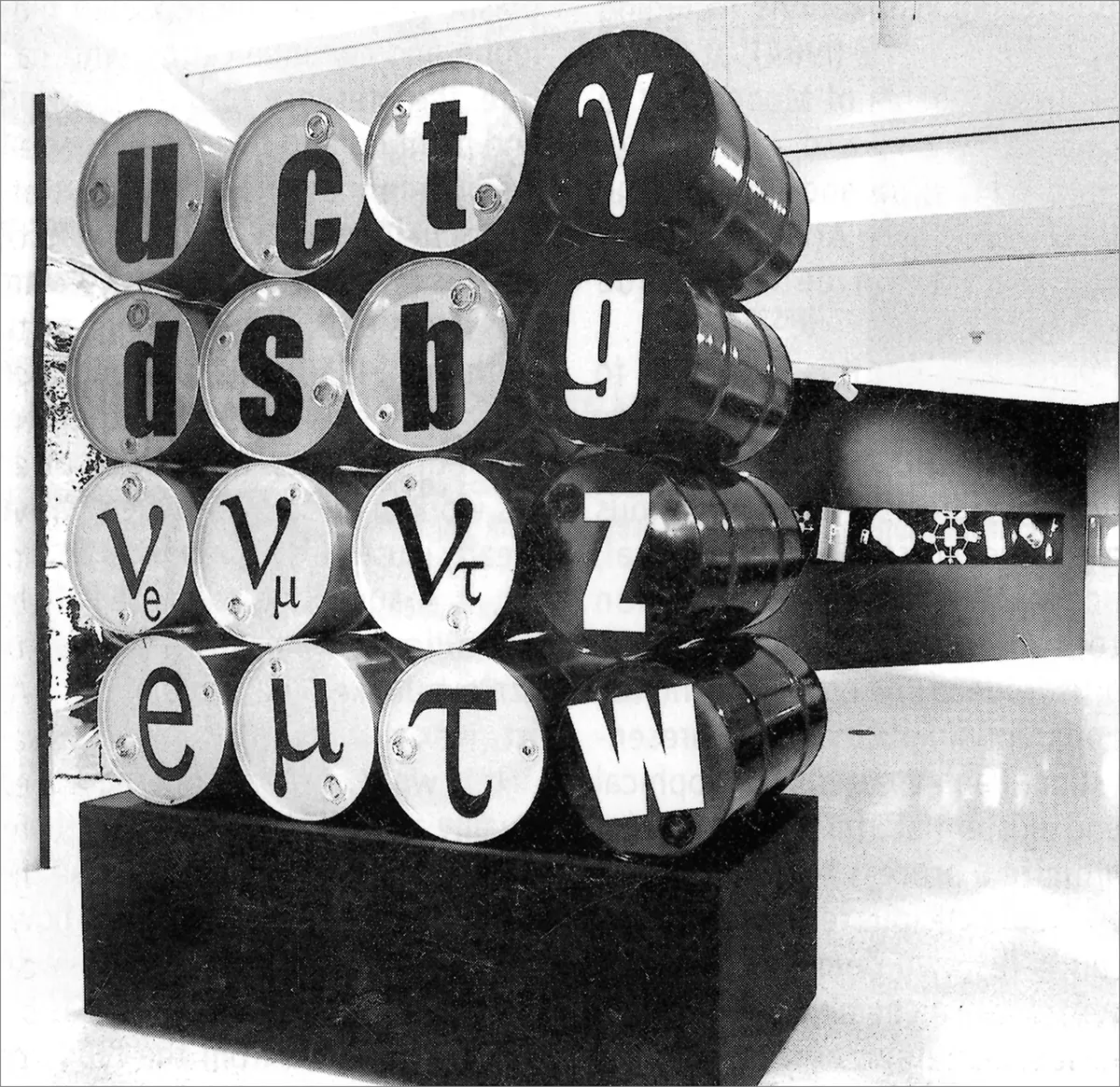
Several institutions joined the Museum, as part of the celebrations marking the fortieth anniversary of the Venezuelan Institute of Scientific Investigation (IVIC) and the twenty-third anniversary of the National Council of Science and Technology (CONICIT), in the construction of Peña's multimedia installation which was conceived as a new kind of aesthetics resulting from an independent sensibility working in a new cultural sphere. A large room housed a labyrinth of mirrors (Heraclitus' infinite river?), inside of which the spectator could see (with surprise) 16 oil barrels (a constant feature of the artist's work) making up the proposed model, in a kind of symbolic fusion of atoms and other particles. At the same time, a series of large format computerized images created "gigantographs" projected onto a screen of the standard model of matter: Einstein's barrel (theory of relativity), the Greek atomic model, the fission of uranium, alpha decay, the meson, the helium atom, Thomson's atomic model, the proton, the noble octuple path, strange particles, electro-magnetic repulsion, beta decay, and Rutherford's atomic model. A set of very full and extraordinary information about everything happening in the theoretical scientific-philosophical universe of the work was available on various computers located behind the installation for consultation by the public.
Peña proposes a system whose complexity is greater than the segments of which it is composed. For this reason, a conventional perception of the work does not lead to a full understanding of the installation. Each constituent element has separate messages, but when taken together —and without there being any contradiction— they create a meaning which is directed to the most valid aspects of the reality of contemporary art at the end of the millennium. The work as a whole reverberates like an enormous metaphor that brings together art, science, and technology. Claudio Mendoza, an astrophysicist, who acted as advisor to the project, says that the standard model of matter is one of the basic scientific achievements of the twentieth century, a compendium of the proposals made by various researchers in the fields of chemistry, physics, mathematics and philosophy, and based on the primary parameters established by the Greek philosophers and thinkers. For Mendoza, Peña's installation refers to the "first expressions made visible in the blocks of Stonehenge, the Mayan pyramids, the Inca walls, and the Greek temples, the most up-to-date particle accelerators, and the construction of the standard model itself. The installation also alludes to abuse, greed, and the neglect of the environment which have resulted from the improper use of the powers resulting from this scientific quest."
Before achieving this masterwork, Rolando Peña (1942) had to cover a long path. From the beginning of his work, in the mid-1970s, his performances and happenings revealed that he was a non-conventional artist and transgressor of conventional codes in his use of multiple languages which combined various theoretical and plastic options. In 1980 he embarked on an exploration of the theme of crude oil as a complex metaphor for the reality of his country, Venezuela. According to Fernando Castro Flórez, the author of the presentation text for the MACCSI installation, Peña "re-writes the symbolism of petroleum, beginning with the vision which the indigenous peoples had of it as a thick substance (name) that could be used to caulk their canoes, down to the references to excavators and the obsessive barrel code. Petroleum is not only an element of identity; it is an ambivalent symbol that refers to both extreme richness and poverty and the dialectics of social order and natural disorder."
In refining this theme, the artist uses the black liquid as a means of communication and expression for his artistic obsessions. Peña has become fully identified with the petroleum theme and made it his own. Thus in the 1980s, he combined technology and art in a number of multimedia installations, including Oil belongs to me (1984), at the La Tertulia Museum of Modern Art in Cali, Colombia, and I am Petroleum, from 1985 and 1986, at the Museum of Fine Arts of Caracas and the Maison de L'Amerique Latine in Paris.
In conclusion, it is important to note that Peña's obsession with the oil theme functions as an interaction of systems involving various aesthetic, artistic, social, political, economic, and communication codes. Hence the complexity of the artist's ideas and concepts, and the apparent simplicity of the presentation. Peña creates philosophical and existential atmospheres to legitimize a process combining both real and fictitious realities. He himself is his own demiurge, he himself is the alchemist ordering his works. The invention, as a fundamental strategy of art, is thus given a new dimension in the creative and rigorous hands of this creator who sees art as a challenge.
BÉLGICA RODRÍGUEZ