
Saúl Kaminer (1952) belongs to a generation of Mexican artists who have remained unaffected by the geometric movement which predominated in Mexico in the 1970s. He has also asserted his independence from a plethora of groups (often spontaneous and short-lived) which during the same decade called for the renewal of a militant mural art freed from the formal and ideological constraints of muralism. Saúl Kaminer, whose training as an architect might explain his interest in construction, has been able to direct his work on forms towards a twofold kind of explosion/implosion, in response to the spatial alternation of voids and filled spaces which constitutes the framework of his work. He is an artist whose originality is expressed within a personal pictorial system which above all can be read as a sensitive questioning of space. The codes that make up this system are both formal (drawing and volume) and pictorial (handling of color and density of texture), although it is the iconography that provides the indispensable and constructive framework of his plastic thought.
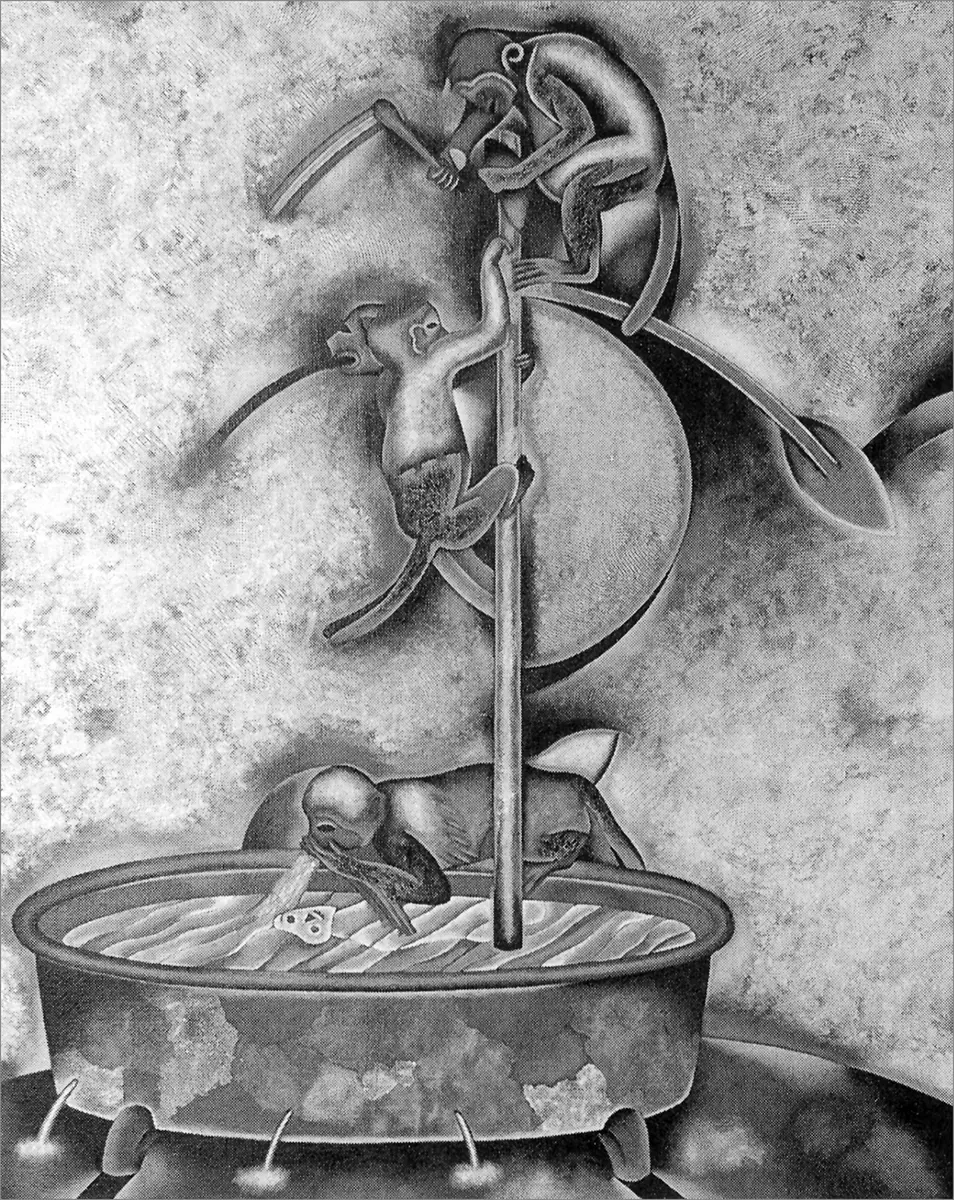
Although certain "masters", from Miró to Lindner, Magritte to Toledo, spring to mind in this connection, Kaminer nevertheless remains an inventor of forms and a teller of multicultural fiction which reveals a narrative poetics in the "marvelous-real" tradition exemplified in the work of Alejo Carpentier. Saúl Kaminer has not merely assimilated and experienced the artistic fruits of his period of residence in Paris; he has developed and enriched that experience by questioning and casting doubt on his knowledge of the world for more than fifteen years. Distance has acted as an undeniable catalyst in the development of his cultural consciousness, in the identification of limits and the measurement of frontiers, and in the acceptance of his own reality, which is no longer virtual. Kaminer, who was honored by the Ministry of Culture of Mexico in 1998, is now more or less permanently resident in Mexico, where he has been working for just over a year on a project entitled Cruce de Caminos —in the form of a thematic as well as a geographic and ritualistic journey.
The one-man show which Kaminer recently presented in Paris (oils, sculptures, works on paper, and objects from 1998 and 1999) confirmed the timeless validity of inspiration (the search for meaning), the reality (existence) of imagination, the ability to transform or transpose everyday anecdote into metaphor, the coexistence or dialogue between rural (animals, flowers) and urban (bathroom, telephone) references in the creation of an autonomous and dream-like universe. The works were also characterized by visual vibrations, both external and internal, created on the retina, fusing the artist's gaze —of both wonderment and interrogation— within a temporality that is itself out of time, made up of images that are both local and universal, images which at the same time reflect and participate in the transformation of a culture which has been rediscovered and shared, a culture rooted in tradition and modernity. In Kaminer's recent works, water is an omnipresent theme (Between two waters, acrylic on paper, 1998, The Rivers, triptych, mixed media, 1998), as is the female figure (Adam, Eve and the Devil, screen, mixed media, 1999), in a burst of colors in which the figures seem to be lit from within with a fluorescence which sometimes becomes a kind of aura (Au bout du fil, oil on paper, 1999 and The devil, the siren and the hand of God, 1999).
These different dualities, which provide points of reference for understanding his work, are used by Kaminer to express the essence of his intellectual and pictorial reflection. His knowledge of art and his mastery of drawing and color allow him to act boldly on the skin-like surface of the canvas (cuts, lacerations, both real and in the form of trompe l'oeil, constructions, deconstructions, vanishing lines, truncated perspectives, juxtapositions, allusions, transformations, reliefs). These features also explain the refined nature of the line work and the care and attention lavished on detail, aspects which might for some viewers seem to be an excess of decoration or to place a limit on the expression of an authentic display of forces and tensions, of things unsaid which make up the discrete sensuality of the artist's unconscious. But this apparent mastery of form is also the result of the constant withholding of both meaning and feeling, which allows Kaminer, in his constant search for and concern with construction, to transcend in a modulated manner both the self and the fact of being in the world. It is a genuine and constant challenge that his art reflects and translates with a certain slowness but with unwavering constancy and an absolute consistency between his own philosophy and the philosophy of which creation —the most secret of visible faces— is the true depository.
CHRISTINE FRÉROT