
Teresita Fernández sculptures space by decontextualizing (or using her own expression, miscontextualizing) ordinary scenes, artifacts, and symbols, and in the process discovering a new order and a new logic for them. In her recent show titled Borrowed Landscapes, Fernández creates strange and austere enclosures in which she goes beyond any merely minimalist expression, using the vocabulary of architectural conventions and literally transforming symbols and representations into physical matter and volume. Real and simulated construction elements are used one next to the other to create the illusion of distance and a lack of contrast and to highlight the relationship between physical and symbolic space. The most spectacular piece in the exhibition consisted of a group of five compartments of different sizes, suspended and lit from above by a single light of intense color (lemon, cerulean, violet, blue, and lemon).
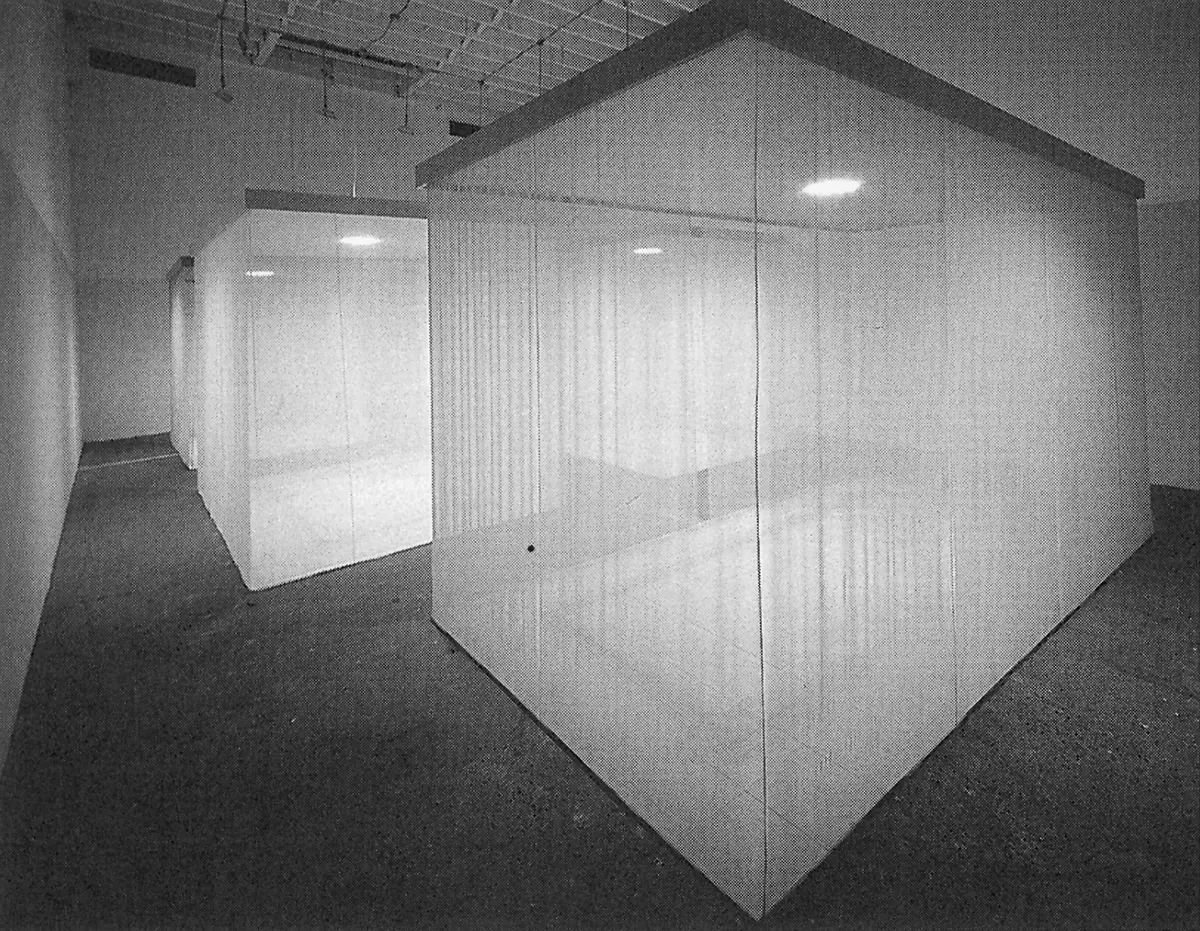
Within these spaces, the floor was covered with hand-painted designs vaguely inspired by the European gardens of the eighteenth century and Ottoman pavings, similar to those which she presented in her previous show. These drawings recall another brilliant minimalist, Tess Jaray, whose work is also inspired by perspective-based architectural drawings. The installation combined architecture, sculpture, and painting in an attempt to create an authentic series of strategies and gestures based on optical illusions which fused what the spectator was seeing with what he thought he was seeing: from the illusion generated by the parterre patterns —which, incidentally, were painted by hand and stained on paper— to the ghostly effect of the transparency and opaqueness created by the veils or the pieces of cloth used to mark out the enclosures. The walls took the form of a kind of barricade, protecting us from nature and marking out the various spheres of human activity: interior/exterior, space for living/working, public/private, sacred/profane. By using semi-transparent and flexible resources as walls, Fernández is not separating spaces or creating hidden places, but taking the spectator from the outside to the foreground, leaving the outside as a backdrop. The artist focuses her attention on soft and feminine architecture, devoid of any hard surfaces or sharp edges, an architecture that integrates both the external and the internal, dissolving and yet broadening the concept of intimacy. This strategy seems to be a comment on the feminist critique of minimalism, a school that has been domesticated, assimilated, appropriated, and "softened" by the mass media. At the same time, Fernández plays with the contradiction between the idea of excess in oriental art and the austerity of Japanese design, in particular the shakkei, the concept of a setting or "borrowed landscape" which is used as an element in the composition for the design of gardens or interiors.
With a surprising economy of forms and a restricted palette of colors, Fernández creates a labyrinth of light in which the spectator can walk around the enclosures, receiving with each step a different perception of the colors and the sense of depth. Presumably these fragile and transparent structures were meant to be contemplated from the outside, as though each one was formed by four adjacent screens lit from behind, and designed to project shadows. The translucent boxes could be seen at the same time as warm and attractive, or cold and exclusive. As the spectator walked around the illuminated rectangles, the sense of separation between the interior and exterior disappeared. The boxes might also evoke the seduction of the harem or a mosquito net in some tropical hotel, or the anguish of a cell in a panoptic structure, designed to instill in the prisoner a state of permanent and conscious visibility, like the automatic functioning of electricity, in the words of Michel Foucault.
The spectator is not allowed to enter the enclosures, but he is invited to look inside through a narrow slit, providing a view of a space without any objects, but which is nevertheless full of mysterious and secret suggestions. The thin walls recall Japanese architecture; the apparently seductive designs of the floor are reminiscent of elaborate carpets, and the claustrophobic enclosures seem like the inner patios found in the Mediterranean or strange cubicles from some science fiction movie. Under the intense flood of light, the pencil-drawn lines acquire a fascinating realism and sense of depth.
NAIEF YEHYA