
On May 24, 1999, Marlborough Gallery opened Tomás Sánchez's first-ever exhibition in New York. In the mecca of urbanism and materialism, the paintings of this Cuban artist showed a contrasting vision of nature and spirituality. More than twenty recent works represented almost all the series he had developed throughout his career. Without falling into repetition, and displaying an extraordinary talent, Sánchez presented a retrospective view, which included the majority of the themes of his visual repertoire. In one work, The Contemplator of the White (1999), a white canvas serves as the background for an imposing tropical jungle. The focal point of the piece is the profile of a very small man, sitting at the edge of the jungle in a meditative position, observing the white area of the picture. The painting deals with a recurrent theme in Sánchez's work: the act of contemplation as an ideal stage, not only for the artist (the small man pictured is a self-portrait) but also for each person that looks at the painting. The picture represents a state of contemplation and, at the same time, it invites the viewer to observe, appreciate the world, and meditate on it. The white background also suggests that the act of contemplation may well become more spiritual and introspective. In this painting, like in most of the artist's works, the theme is closely related to his personal experience, which is highly inspired by Hindu philosophy and yoga. From an aesthetic point of view, the picture exemplifies Sánchez's mastery as a landscape artist. The detailed way in which he reproduces every detail can be seen, for example, in the reflection of the grass that grows at the edge of the shore. By creating an almost-perfect landscape and superimposing it on white space, the artist plays with light and color to create a piece that is both realistic and abstract.
The landscape, although reproduced in a traditional way, becomes a contemporary scene within the white of the canvas.
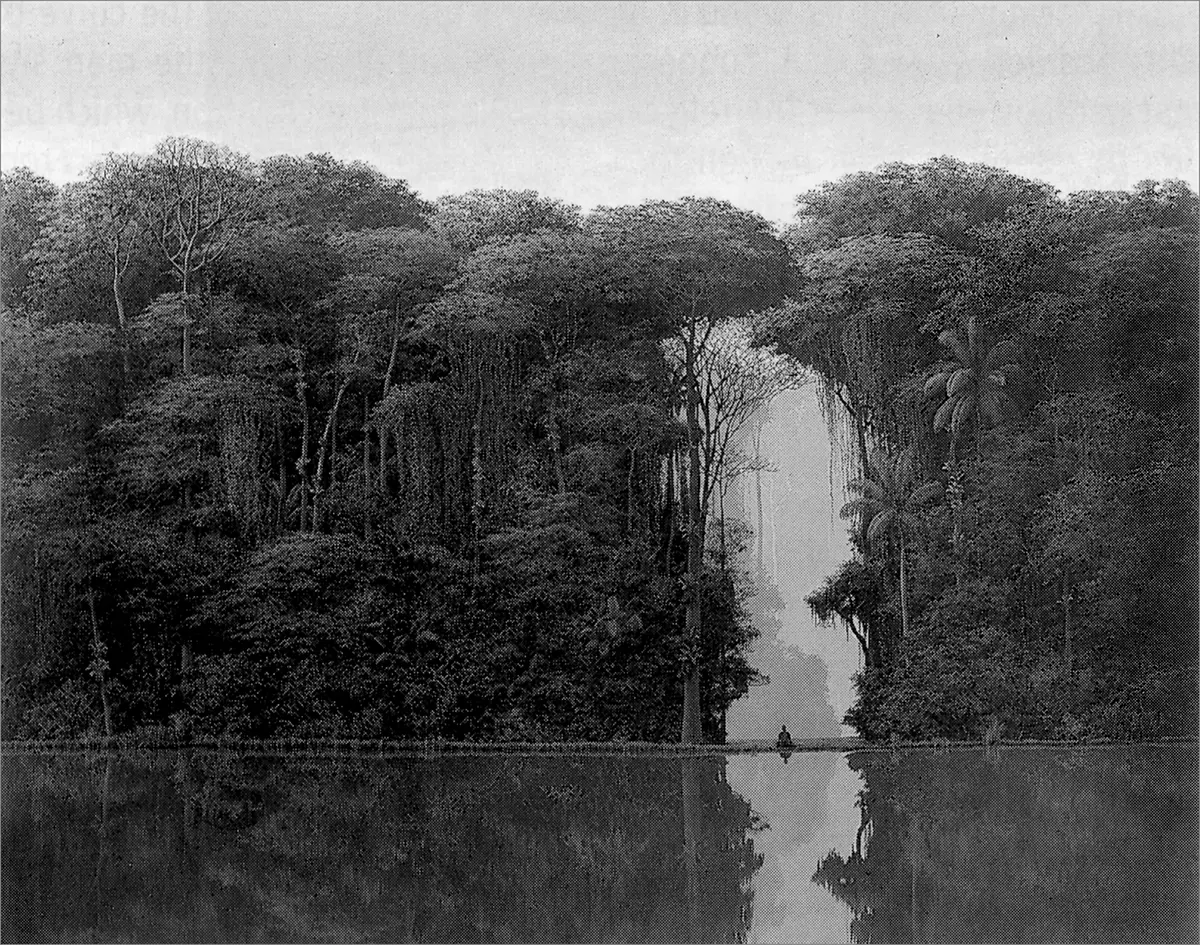
Another work that .deals with a similar theme is The Meditator at the Shore (1998), a picture in which the jungle, with all its richness, appears imposing before a cloudy sky. A narrow opening allows a small man to see the interior of the vegetation from the edge of the shore. The handling of the color is intense in this canvas. Sánchez uses multiple opaque greens, following the colors of the sky. One of the characteristics of his work is precisely the use of monochromatic palettes, from which he develops multiple tones that enrich and make the landscape more emotional.
The majority of the works in the show transmit feelings of peace and tranquility. Such is the case of Once Again the Shore in White (1999), a painting that reminds us of the drawing From the White Waters made in 1980 and awarded the XIX International Drawing Award by Joan Miró. The white canvas is divided by a thin line, which seems to disappear from the horizon. Only by observing closely can we discover within the line the leafy details of a forest and its reflection in the water. The use of line has always been fundamental to Sánchez's work. In several of this series, the sky, the jungle, or the forest and their reflections in the water are represented by lines or color fringes. In some cases, these fringes are so thin that it is hard to identify the elements that are represented. In most cases though, they are large horizontal areas representing imaginary jungles or forests, full of color and detail. That is the case, for example, of Shore Disappearing in White (1997) and Shore Disappearing in Black (1997), two versions of the same landscape included in the exhibit. In the latter, the use of dark blues creates an intense composition. One of the most interesting works of the exhibition is Nocturnal Reflections (1998). In this painting, an opening that connects two bodies of water creates a vertical band, which divides the horizontal fringes of the sky, the jungle, and its reflection in two similar areas. The opening reminds us of the one in The Meditator at the Shore and allows us to see a lagoon and the interior of the forest. Two little people facing each other, sitting in a yoga position at each end, suggest that perhaps one side is the reflection of the other, even though the nature on each side is lightly different. The nocturnal atmosphere, the unusual presence of two people, the use of obscure tones, and the reflection of the moon in the water (represented by a delicate white line in the interior lagoon), give the painting a magic feeling. Of all the works in the exhibition, The Contemplator of Clouds Over the Valley (1998) introduces the newest ideas. This large canvas (200,7 x 249,6 cm) shows a man contemplating a chain of mountains, which emerges behind a leafy valley. The mountains dominate over a series of clouds and occupy most of the skyline. The grandiosity of the landscape and the aerial vision, from which the spectator contemplates the scene, are recurrent in Sánchez's work, which has always conveyed an ecological and spiritual meaning. What is unusual in this case, is the dynamic feeling that this painting suggests, as opposed to the peace and tranquility that dominates in most of his works. The grass that appears in the front, bent as if a strong wind was pushing it towards the center of the canvas, follows a diagonal that continues through the relief and ends at the peak of the tallest mountain. The use of diagonal perspective lines contrasts with the use of horizontal bands, which characterize his previous work. The curve of the mountain where the man sits also suggests a variation, which becomes even more evident in From the Silence (1999), a picture in which the man is surrounded by undulated mountains and in which the contrast of the wavelike lines is reinforced by a combination of lights and shadows. The exhibition offers a synthesis of twenty years of artistic work and reveals new tendencies in the art of Tomás Sánchez. The changes can be seen at the formal level and establish a more dynamic kind of confrontation with the spectator, without diminishing the spiritual meaning of the pictures. Each work continues to create a sense of spiritual elevation in the viewer, taking us to a new level and into a world that is very different from that which we inhabit in everyday life.
FRANCINE BIRBRAGHER