
Puerto La Cruz, in west Venezuela, is a relatively new city that is trying to establish its own profile in the urban and cultural contexts of the country. In this context, Professor Guillermo Barrios, who combines his interest in architecture with studies of the contemporary visual arts, proposes to us an imaginary city which, after being photographed by six photographers, begins to acquire an original iconography, rarely seen in the urban spaces in the provinces of Venezuela.
Six photographers, with very precise languages, spent time in Puerto La Cruz exploring its everyday life, its particular features, and its less ordinary aspects, including those not normally considered relevant to aesthetic reflection. Six photographers with different artistic visions and conceptions came together in the same urban context and ended up producing rich and critical views of that context.
The photographs are in a single format, each measuring 90 x 400 cm. Some artists use black and white, others color. Some present a single image, while others fragment the view or highlight its multiplicity. The participating photographers were Luis Brito, Antolín Sánchez, Ana María Ferris, Ángela Bonadies, Ramón Lepage, and Cedismundo Quintero.
Luis Brito focuses on the faces of people of humble origin at the two extremes of childhood and old age. His compositions are closed and his models appear next to a wall. The gaze of these figures expresses both expectations and questions. Often the gaze is humanized, in the face of a donkey or a Christ figure on some poster. In the center, a child on a bicycle smile in some arid place under a fierce sun, Ramón Lepage also photographs people but focuses on those who are at work in city streets or in unexpected situations. Thus the city is a place of exchange and opposition between simple tasks and futuristic architecture. In one picture, some adolescent figures are dressed in military clothing, which reflects in passing the political fervor now sweeping through the country.
The real military can be found in the passenger terminal featured in the photographs of Ángela Bonadies. Here the setting is made up of corridors and the fleeting image of passing travelers.
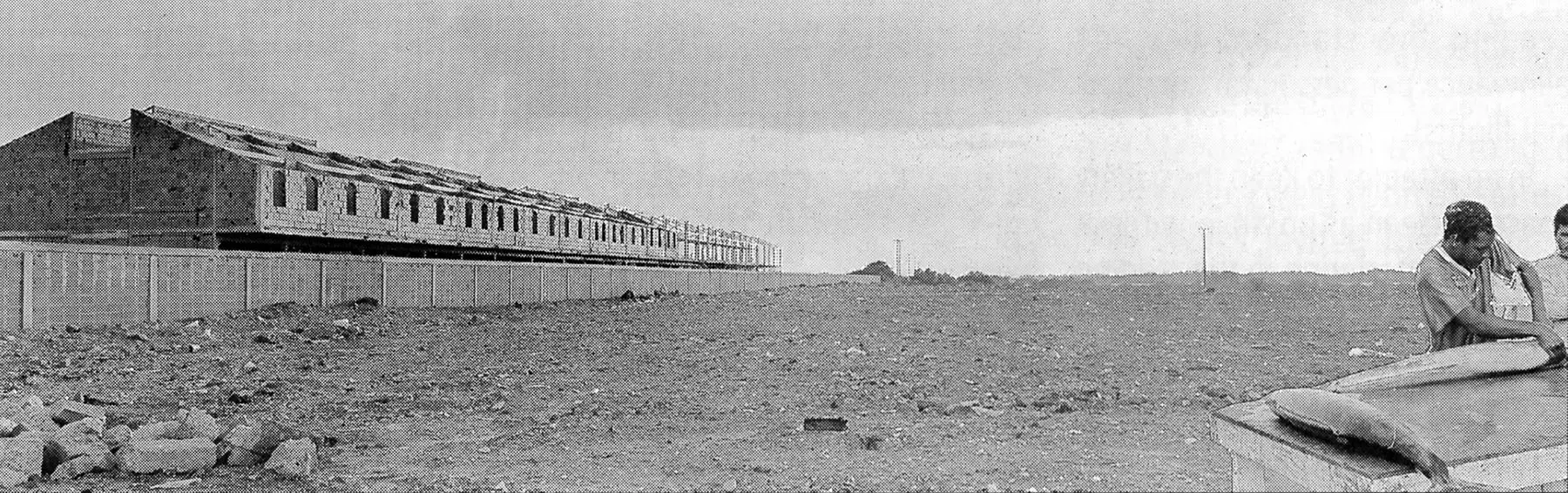
Antolín Sánchez presented only two panoramic-sized photographs. One showed rows of beach condominiums in a pseudo-Spanish Mediterranean style contrasting with a garbage dump in the foreground. The other image was based on an infinite perspective, with a seemingly abandoned building at one extreme, and an informal street vendor selling fish at the other. It was a photo of immensity and solitude. Ana María Ferris roamed the city, meeting its people and discovering surprising places-neglected monuments of great sentimentality contrasted with popular murals depicting religious themes. The inhabitants are proud, dignified, and simple.
Cedismundo Quintero was drawn to a main avenue, which he photographed by day and by night. He presented his work like a kind of comic strip, with the addition of extravagant texts. The photographs make use of various elements of photojournalism, the postcard format, some surprising angles, a dash of landscape art, and finally the artist's own authorship. In this way, Puerto La Cruz itself became a work of art.
JUAN CARLOS PALENZUELA