
When we are driving a car along the street and suddenly come to a "Y" junction, we have to make a decision, a decision which in principle is preceded by the very uncertainty of the act of freedom we perform when the vehicle is moving along. Who has not experienced the almost mortal anguish of deciding which road to take just as the obstacle of a bridge looms up before us, while at the same time, we must continue to control the car despite all the dilemmas posed by these roads leading to God knows where. Of all the many kinds of decisions/(in)decisions which Trini paints, this was, without doubt, the theme raised by the artist's exhibition this past summer at the Praxis Gallery in Mexico City.
One of the characteristic features of his art is the way in which he makes painting into a matter of evocation and a story. We might also see his work in terms of a specific atmosphere and a narrative, the murmuring of the air and the brilliance of the light, although it also emphasizes the solidity of objects, and the presence of animals, people, and things. When we look at the works in this show, some of them focusing on the urban landscape of Mexico City, but the large majority describing urban landscapes and seascapes in Cuba, we are immediately confronted with questions involving our sense of smell, vision, and the movement of our bodies.
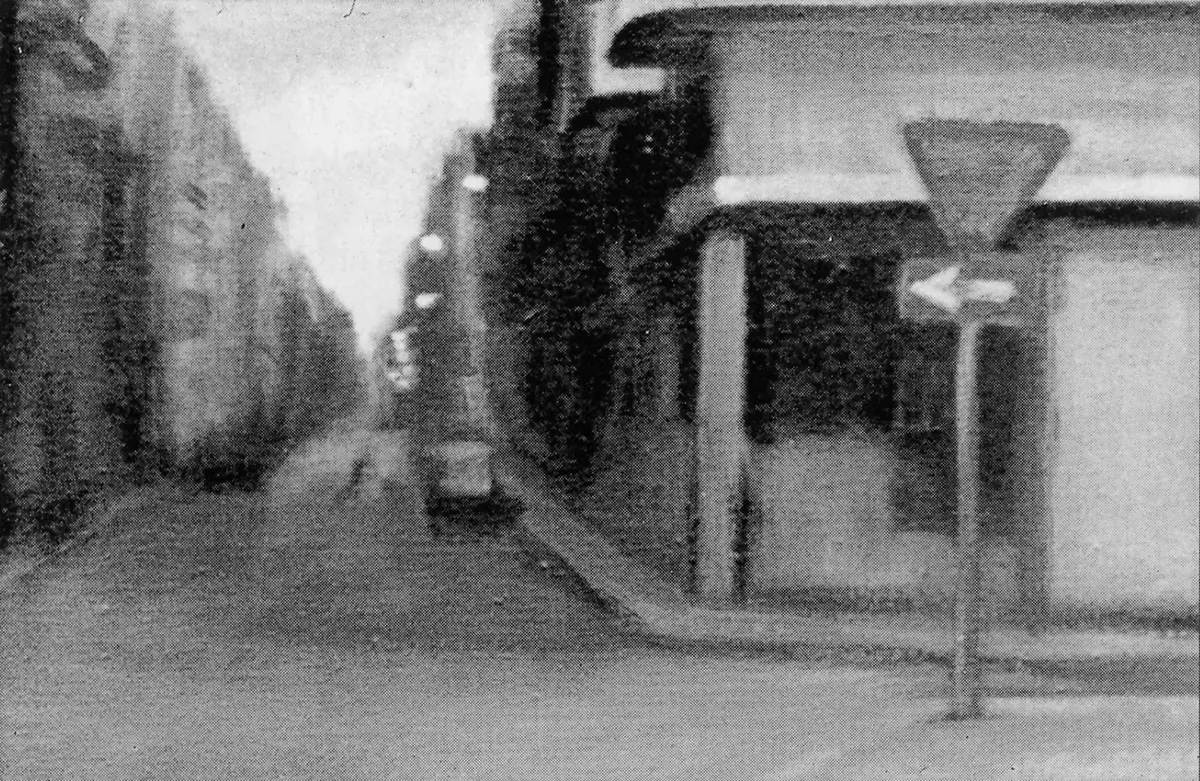
It would seem that in these streets of old Havana, along the seafront of the tired ports of Cuban beaches, or in the inner circuits of Mexico City, it has just been raining. In Trini's work, there is a pervasive smell of water. Water is also present in the porosity of the textures, with their eternal interplay of touch and vision. But above all, water is present in the artist's use of chiaroscuro, an artistic technique in which things and space open up the inner dimension of their movement. The formal resolution that this artist of Belgian origin gives to his use of chiaroscuro is accompanied by a displacement of the gaze and the body in space. This relationship is, in my view, his principal achievement. The handling of the light allows the artist to avoid the repetitive, monotonous, and uninteresting solutions of hyperrealism, while the implicit process of painting two points, situations, or aspects of the same object or space leads to a sense of relaxation in the composition, which in turn results in the configuration and structuring of the narrative element in his works. The narrative involves the spectator in two ways: in terms of the emotive and affective meaning of the scenes being depicted and as regards the objective and real displacement which the spectator is required to make in these compositions to understand something which seems, in principle, to be dislocated, without there being any connection between the space and the places which the objects occupy and produce. This general "tone" of the exhibition was even more noticeable in the small-format triptychs (Jump or give way?), which are like cinematographic "takes", not from left to right, but from right to left: here the objective participation of the spectator is indispensable in the construction of the picture's narrative, depending on the displacement required by the work. The painting of Decisions is a painting of visual, dynamic, and tactile simultaneities, a pictorial exercise in which, over and above the first impression that the works might create, we are confronted with the intelligent construction of an artist's perception of the world. But above all, there is Trini's reflection on painting as a way of seeing and moving in and on the world, things, and objects. Several of the pictures in the exhibition reveal that the spectator is also a participant in the construction of their meaning. To consider the dilemma of a bridge indicating two possible paths (Predecided) is to consider it from outside the picture and at the same time from within the car barely suggested in the picture.
This explains why such solid forms and objects such as a bridge or traffic signs with the names of streets and avenues seem to be moving. Something similar occurs in the picture titled Stopping. The woman is too close to us to be at the same time sitting on the wall of what is possibly a seafront in Cuba. But this feature, rather than revealing a lack of proportion or perspective, is in fact an expression of the simultaneousness of at least two perceptions of the same situation and two different distances suggested in the work. It is through these techniques that the artist's use of chiaroscuro, shading, and light achieves its full effect and meaning. These elements encourage a kind of internal relaxation of the gaze, temporalization, or the expansion of time in the narrative construction of the works. The spectator notes with surprise the almost hyperrealistic tone of the painting, where the figures and bodies are filled with the intimacy of vibrating color. This is a painting that functions in some intermediate place between relaxation, the hermeticism and silence of objects, spaces, and bodies, and the murmuring, movement, and expansion of light and color.
Reality is the limit of language in art. Literature, painting, and theater have their frontiers in the place where things impose their own radicality: their exterior aspect, which can always be depicted, and their inner dimension, almost always unfathomable. For Trini, painting is related to these inner and outer aspects of the world. That is, with the instant of what is seen and with the movement of the gaze, and the body in the midst of and through things. It is a painting of affirmation and participation.
JOSÉ LUIS BARRIOS