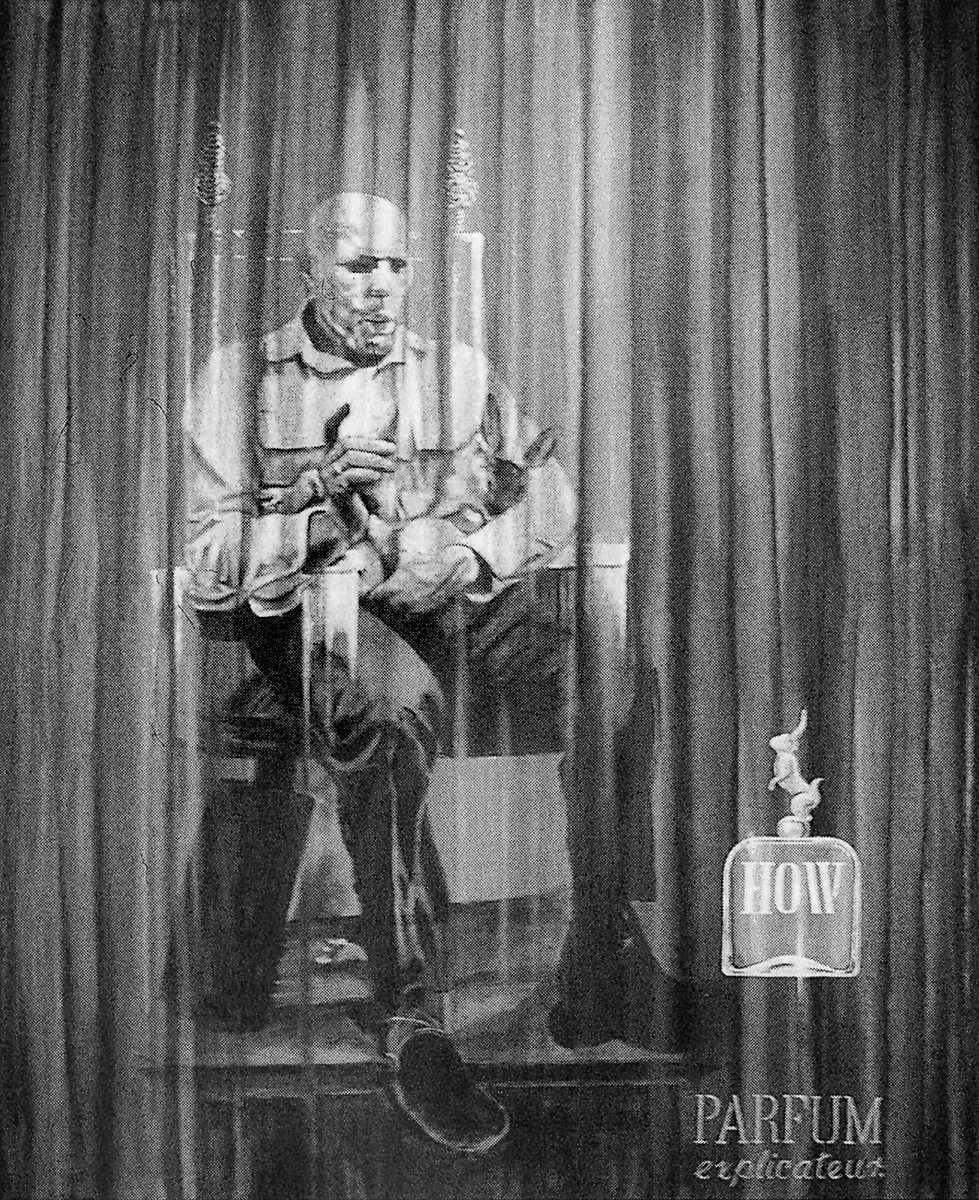
Joseph Beuys pontificating from the throne of Innocence X, revisited by Francis Bacon, during one of his performances, How to teach pictures to a dead hare; in the lower corner the stopper of a Wow perfume bottle, and in an explanatory presentation, a small rabbit apparently questioning the dead hair that is the focus of this solemn and didactic moment, and at the same time assimilating the sensible explanation of the artist. There was a mocking tone, a sarcastic streak running through the paintings in this series by the artist Carlos Márquez.
During the months of June and July, the second oldest gallery in Mexico City, founded thirty-five years ago by the Pecanins sisters, presented this exhibition titled Perfumes by Carlos Márquez (Aguascalientes, 1956), marking a return to the innovative dynamism which characterized the gallery in the 1960s and 1970s, decades when it was a place of experimentation and cultural dialogue between a Spanish view of modernity and the world —Catalonia and in particular Barcelona— and jubilant Mexico, which was in the process of breaking with the Mexican school of painting and official aesthetics.
Perfume, which Márquez considers yet another status symbol within our consumer society, is used as a pretext in these works for exploring concepts referring to the history of art, society, politics, and even the economy. Presented in the form of large bottles or seductive publicity posters on the traditional supports of painting, with stretchers or canvas, these perfumes are a synthesis of conceptual art and formal plasticity. The series is significant in that it goes against the tradition of modernity, which incorporated extra-artistic elements into art, such as the influence of Celtic sculpture or African art in Picasso's cubism or the celebrated urinal of Duchamp, or a large number of consumer objects and goods which the pop movement elevated to the level of art. The most recent incorporation of this kind concerns personal obsessions and affirmations of identity which are proliferating in contemporary artistic expressions and transforming the art world into an infinitely expanding universe.
In contrast to this trend, Márquez uses the images of great art, the grand style to which the writer from Trieste, Claudio Magris, refers, incorporating them into a supposedly mass circulation product, but whose advertising strategy is targeted on its personal and elitist value. So far, this might merely be the gaze of an aesthete who delights in suggestive images (most of the works have a formal beauty, one of the categories which modernity, and in particular the period of the manifestos, expelled from art and which took refuge in the world of advertising), but the perfumes contain a cultural reference in the form of subtle paradoxes or contrasts which give the works a very definite air of parody.
By means of this conceptual acrobatics, the artist celebrates the icons which form the cultural foundations of the West, as seen from the geographical and cultural periphery. A periphery that is also seen as a market of cultural and consumer goods, which are inundating us with brand names and trademarks in English or French, startling us with the paradigm of First-Worldliness.
Without a doubt, the key concept in this work is irony, an irony that is also critical of art transformed into merchandise, a depository of the values of consumerism and nostalgia that evokes the sense of some lost totality. As regards the latter, it would seem that we can only celebrate the modern story of art through humor and its transmutation into a small, banal, and fragmented object, something which belongs to everyday life but which is full of exceptional qualities, like a bottle of perfume.
Pedigree can be seen as a potted history of painting from the twentieth century. In his deconstruction of The Scream by Munch, Márquez uses the bridge with two grey figures in the background, an allegory of expressionism, but replaces the central figure with one of the demoiselles of Avignon, in a tribute to Picasso, in a gesture similar to the subversive dadaist joke of giving a mustache to the Mona Lisa. As a background, there is a ghostly, metaphysical building reminiscent of de Chirico, and the sky, a fragment from a picture by Kandinsky. What better celebration of the century's artists than this visual melting pot! The advertising poster emerges when a brilliant perfume bottle appears against this background, with an avant-gardisateur text. A fragrance is recommended for those who wish to enter the world of contemporary art with all the key essences.
In Duchamp, Parfum sans arôme, an analogy is established which reveals the gradual disappearance of the artistic object that led to the much-proclaimed death of art in our century. A striped bottle with the image of The Fountain in the center, in a spray presentation, in which Márquez reaffirms the Duchampian idea that art can dispense with manual skills and the object, just as a perfume can dispense with its actual smell, without necessarily losing its poetic essence. On the basis of this conception of the "artistic", a playful link is established in which art appears as a quotable reference within a personal worldview. Thus Márquez has prepared perfumes that allude to Democracy (a perfume with a dropper), Crisis (a permanent economic experience), or Style (a parody of the artist's fingerprint).
The banalization of artistic objects through consumption and the paradoxical destiny of the avant-garde challenges which, according to Octavio Paz, were enshrined in the museum or acquired by an avid bourgeoisie in the auction houses are critical elements that were present in this exhibition. That art cannot exist except in and with the market is undoubtedly the greatest irony of the spirit of rebellion which has characterized our century. Artistic products devoid of their explosive content have also lost their denotative quality, they are mute objects, and status symbols that gradually become diluted. Not because the concept is given precedence over the object, but because of the wear and tear and routinization of the market, until it becomes a fragrance.
ERNESTO SOSA