
Since the 1970s, Carlos Zerpa has been developing his work like a kind of enormous wrestling match or hurricane that sweeps up all kinds of objects-mementos which are then transformed into monstrous appearances. He is, as Manuel Espinoza recently said, an artist gone astray, lost in his nihilism.
It would be almost ridiculous to try and analyze his work in formal terms. It would be even more ridiculous to say that it is good or bad. It can be described as a violent mass of ingenuous evil or very bad goodness. Zerpa has always been interested in depicting, through ragged objects, in particular mannikins, dummies, and popular prints, the world of violence, magic, and terror.
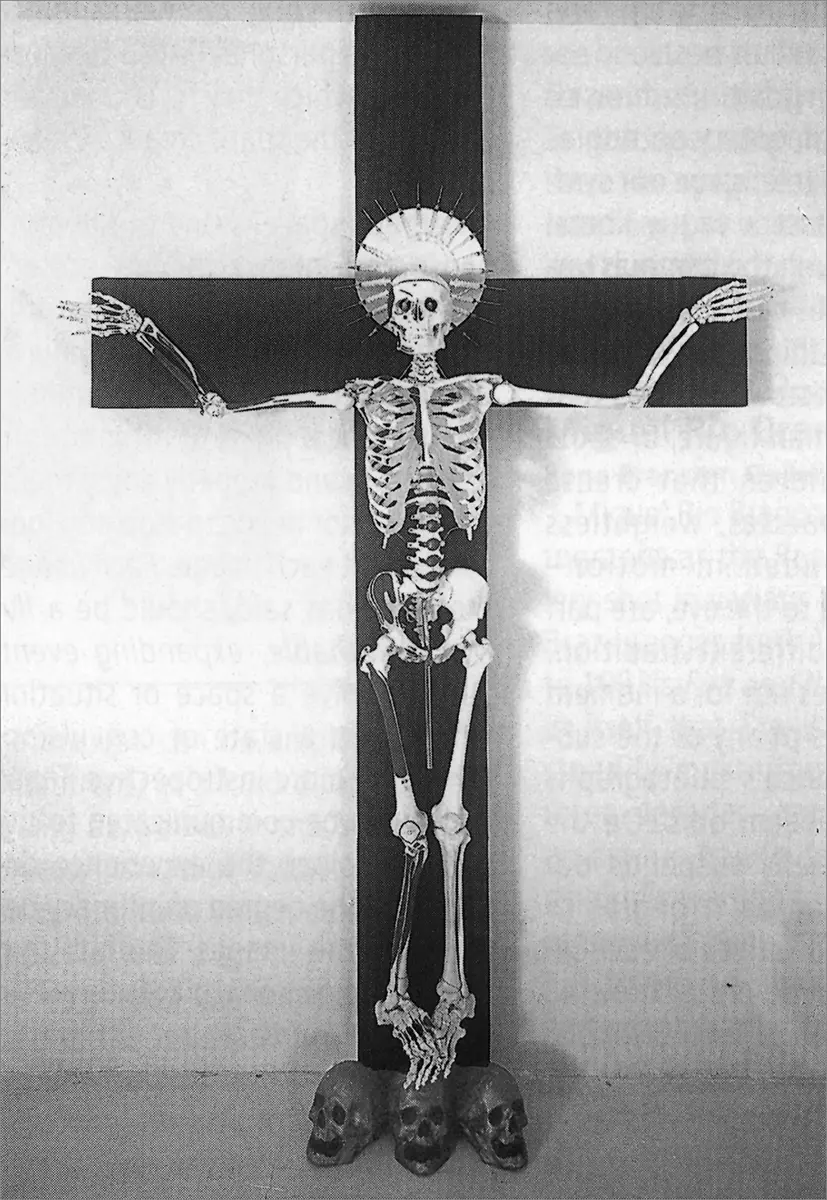
It is also interesting to note his relationship with the popular culture of Mexico, in which terror and violence are expressed with great frenzy. Here in Venezuela, we are experiencing major urban violence, the apocalyptic spirit of which has never been depicted in the field of art.
Zerpa feels a great need to put a stop to this violence by embodying it in his work. It is impossible not to sense this crude reality in the flesh continuously burning itself. But the violence which is more perceptible is that related to self-defense (karate and vampire practices) and the violence of the individual who obsessively arms himself, not to attack the other, but himself.
This process began in the mid-1970s. At that time Zerpa carried out some provocative performances which were suddenly transformed into violent spectacles. Both the artist and the audience were exposed to some possible tragedy. All this was to some extent the result of the effects produced by the oil boom. Our society is developing complex violence that goes beyond what we actually see. In Zerpa's vision, we are living in a country full of multi-colored fantasies revolving around satanic rituals, with our streets and squares adorned with human skulls decorated with colored frost. All that is left is a city totally destroyed by the continuous hatred of its citizens.
However, despite this observation, Zerpa's work is not in fact about violence. It is violence itself. His dolls and dummies are continuously tortured, and the artist dispenses a sadistic kind of treatment to the surfaces of his objects, with their twisted ornamentations. This emphasis generates a kind of sadomasochistic pleasure for the artist. The work is also saturated with the cries emanating from the specific sub-cultures of rock and the influence of the master of inventions, Frank Zappa, as well as the anti-Christ Manson. This makes the work into a kind of fusion between two cultures: Latin American folklore and the alienating norteño music.
Wrestlers, for example, are one of the icons of our popular culture. They are there like the lifetime friends of the artist, filling the atmosphere, like the figures on the cover of the Beatles' classic Sergeant Pepper album, and the solitary Hearts club, from the 1960s.
The horror is seen with cinematographic simultaneousness. It bombards the spectator and assails his innocence, brutalizing him into establishing complicity with the artist. However, this works lacks drama. It is in fact amusing, since terror, in its complex expressions, can also be a source of entertainment.
There are a number of differences between drama and terror. Drama springs from tragedy, while the terrifying spirit of Zerpa's work is more reminiscent of a comic strip, and its audio-visual counterparts, such as film and rock music. Grrr, an exhibition presented in the Museum of Fine Arts in the 1980s, referred to a sound that was synonymous with the comic strip, evoking rage and threat.
In the final analysis, Zerpa's work is a kind of Latin American pop. It constantly presents the heroes of our popular culture and the comic strip, who are exalted and interwoven in a violent manner, as though the artist were some precarious kind of Hieronymus Bosch from the tropics, especially in his handling of objects almost in the style of Mario Abreu. Cruel details are taken from popular culture and violence, such as the self-defense tactics of the kun-fu or karate tradition. All the figures are engaged in some action; arguments arise, but there is almost never any reference to the place where the crime takes place. There is only the victim's body which is transformed into a dummy or unknown object. Perhaps Zerpa is the incarnation of Freddy, the main figure from the film Nightmare on Elm Street, about to murder the protagonists of his dreams.
Zerpa is more interested in the brutal presence of his victims than in the aesthetic reflection of his work, with the possible and delicate exception of his collection of squashed mosquitos on paper, unparalleled works with significant artistic content. His impetuousness is necessary in any response to the aesthetic trends of the times. Hence the validity of the remark by Simón Rodríguez that Latin America should not pursue servile imitation, but try to be original. Zerpa's work is an anxious and precipitated attempt to crash into the realms of originality.
His victims do not belong to minimalism or conceptualism. His works are totally atemporal and free of any tendencies; their goal is to transcend the limits of formal and affected postmodernity.
This show transforms Zerpa's victims into an enormous circus of horror. They orchestrate a great display of joy at their assassination and they are pathetically happy that they have been created. Frankenstein was able to see himself and to understand, with sadness, that he was only a monster. That is something that many human beings have yet to understand for themselves.
EUGENIO ESPINOZA