The vibrant world of Charo Oquet is more than an invitation to our senses; it is an adventure that takes us to the limits of a culture and a way of being. A child of the Caribbean, born in the Dominican Republic, and an artist by nature, Oquet has taken up the fabulous task of recreating the spirit of her land, offering us the noblest gift possible, a platter of dreams and virtues, a constant balance between myth and reality, the ingredients of a history which continues.
The Kingdom of Our World was the title of this exhibition at the Ambrosino Gallery in Miami. The work was the result of the artist's search and discoveries, her experiences, and her spiritual heritage over a long period of time and in different places.
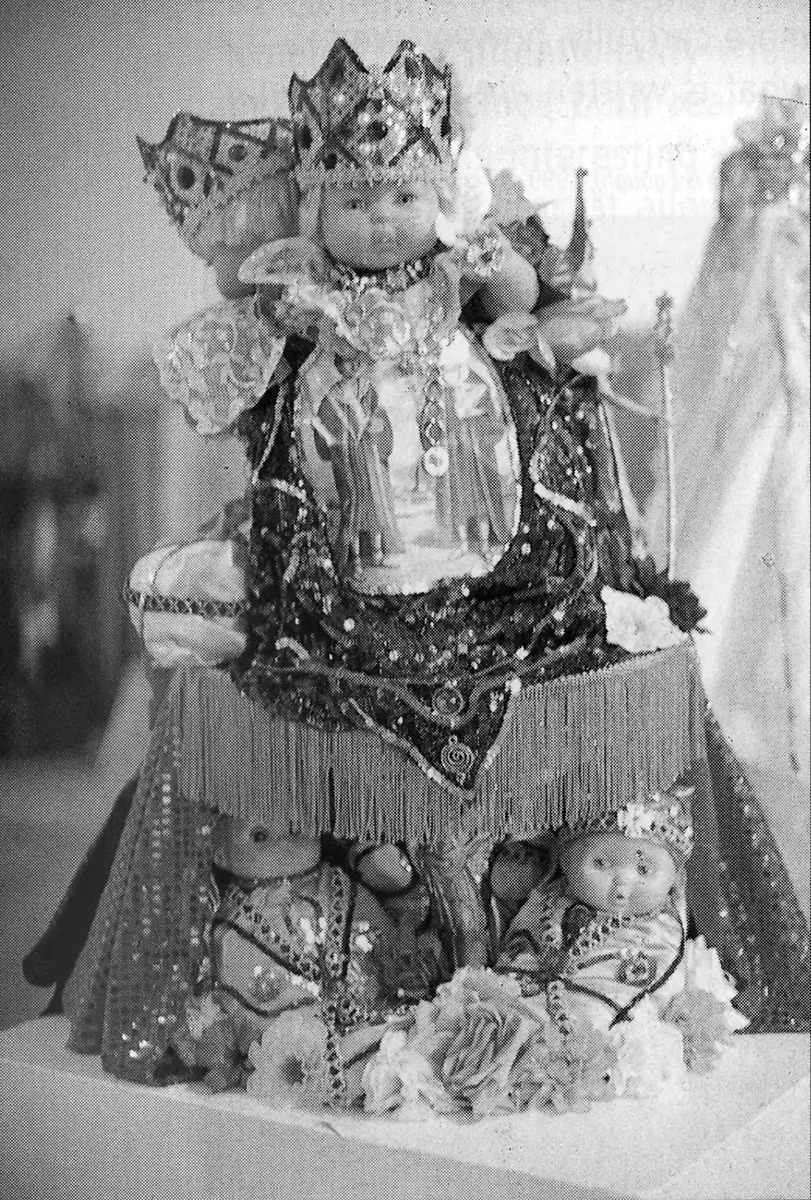
Inspired by the altars to spirits and ancestors —a tradition of the black neighborhoods in the north of Santo Domingo—, Oquet has set her scene, an enclosure of fragile brilliant walls in which sacred figures from the Land of Yemanya appear, in the form of decorated dolls, filling the air with a strange sacredness.
The spectator, initially overwhelmed by the images unfurling before his eyes, finally gives way to a spirit of celebration, becoming both the participant and protagonist of the ritual. A large table full of cakes and various fruits, sumptuous empty thrones, and music pulsating with guttural sounds, complete this hymn to the transience and intensity of life.
Oquet multiplies the tradition of her predecessors, recovering the primitive side of Dominican culture through an interpretation that takes us back to the practice of voodoo, where the figure of the priestess is used to reaffirm the powerful presence of women in the Afro-Dominican religion.
Her creations evoke crucial moments of existence, from the cradle to the tomb. A terrible dilemma is debated —between paganism and the Catholic faith— but the work avoids any kind of absurd melodrama and becomes a constant celebration of life. These objects recovered from the popular baroque of the Caribbean, fabrics in various colors, forgotten toys, recycled clothing, flowers, photographs, and sequins, make up a pathetic reality, but one which is full of incandescent magic. Oquet has found them in anonymous corners, small shops, and flea markets, between old women in a rush and restless children who have quite a lot in common with the people from her country.
Oquet's goal extends beyond matters of individual expression. Her work proposes a kind of general praise and is a serious attempt to re-assert cultural identity in which she unleashes a sea of images that reflect the duality of life, where beauty and horror make up —as they have always done— the metaphor of existence.
CECILIA LUEZA