
The paintings of Venezuelan artist Corina Briceño and the photographs of Polish/Venezuelan Gabriella Morawetz express elements of man's interrelationship with nature. They begin, however, from distinctively different philosophical approaches to the natural world. Briceño takes the experience of the Amazon's indigenous peoples as her point of departure for visual exploration. By contrast, Morawetz's pieces are clearly rooted in a neo-romantic European assessment of the spiritual alienation of the civilized world.
The new works by both artists also demonstrate divergent approaches to expanding themes that have fascinated both artists for significant segments of their creative careers. Briceño's works have moved from describing the exterior world that shaped the beliefs of Venezuela's Amazonian peoples to represent spiritual realities. Morawetz continues her explorations of humanity's place within nature while adopting a new technical and formal approach to the creation of her images.
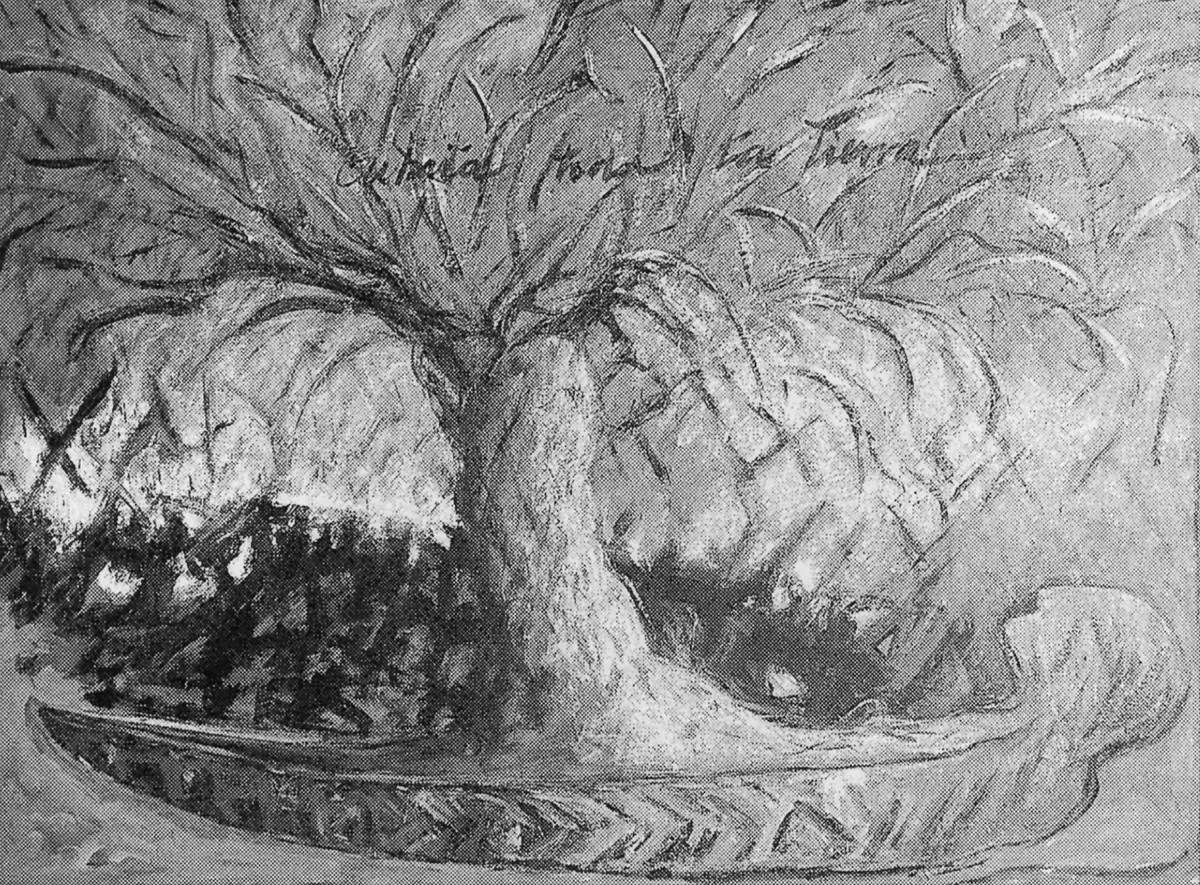
Briceño's earlier works, which also focused on the symbolic and religious life of the native peoples of Venezuela's Amazon basin, situated their beliefs within the primordial landscape they inhabit. Where earlier works depicted houses within the jungle, her current work takes us into the world that exists within their homes, or, more precisely, within their minds.
Works such as the Árbol de Marawaka (Marawaka Tree), with its edenic tree sprouting from an almost human canoe, connect the spiritual world with its visible manifestations. Like the related works in this series, it illuminates the poetic connections that have always inspired a reverential approach to the surrounding world and provide an entry to a theology that most of humanity has lost.
The series of ladders extending to land from the human canoe in Tierra de Wanadi recreate mankind's literal emergence into the world of experience. Even for those unfamiliar with the common themes of Indigenous American creation accounts, the ladders provide a cogent visual metaphor and remind us of the ritual possibilities of the simplest of acts.
The strong graphic symbolism of rock art which Briceño has studied and integrated into her personal visual world reemphasizes the possibilities of such apparent simplicity. Even in complex, multi-layered compositions like Akato Ocultoy Visible, simplicity, again, plays a major role. The iconic, genderless figure that dominates the composition clearly announces the work's human connections. At the same time, the colorful, miniature repetitions of this figure scattered across the paper enliven the visual field and suggest unseen dimensions of existence.
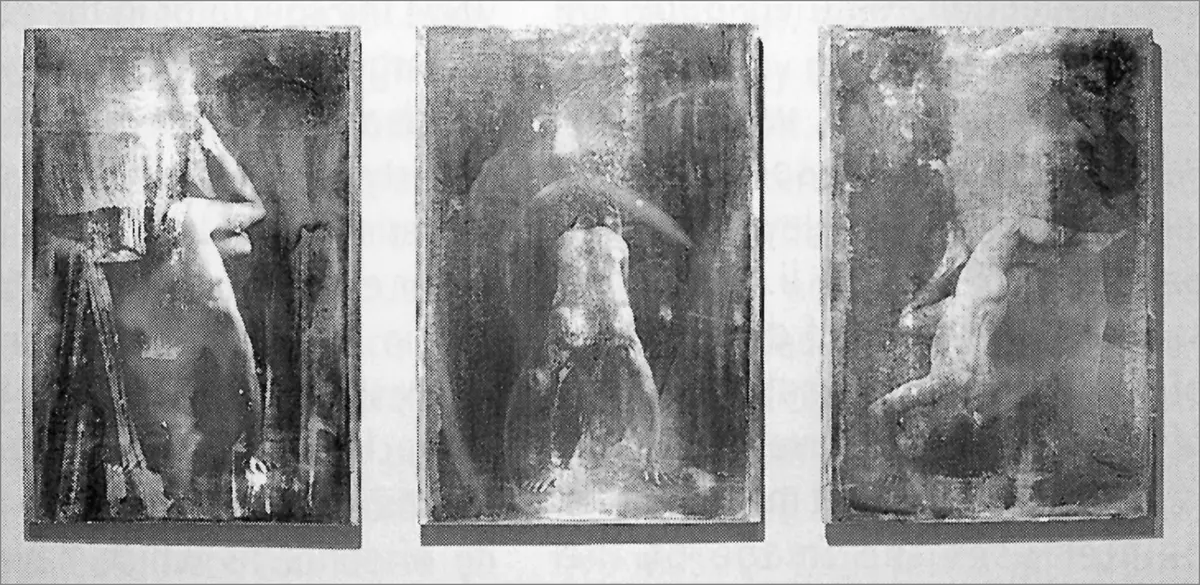
Morawetz, who once worked on photo-sensitized stone, has broken free of the slate surfaces she once used. In her latest works, she uses emulsion on canvas, which allows her greater control of both the surface work and the underlying painting that adds visual and psychological depth to her images. By moving to canvas, she is now able to expose the struggles of her protagonists on a scale that matches the monumentality of the emotions they contain. Each of the untitled, larger-than-life-sized painted photographs contains a struggle for union, or reunion, that reaches beyond their physical boundaries.
Conversely, the series of River Books, small diptychs united by lead bindings, convey equally monumental messages. The left panel of each book holds the orderly, converging lines of an irrigation canal, only slight variations in the clouds and trees reflected by the water distinguish these images. The adjoining panels hold a human figure, or figures, all involved in ritualistic evocations of the natural cycles of fertility, birth, and death. Significantly, the two sides of these diptychs remain firmly separated unless they are folded together. Only by rendering their division invisible do these narratives obtain unity.
One of Morawetz's loveliest works, the triptych Deep Water, contains no figures at all. Instead, the upper register of each panel depicts the same waterside scenes as the River Books, while the lower register holds nothing more than a simple twig that Morawetz has extracted from the tangled stream banks. These formally elegant segments of wildness speak to the endless fountain of mystery, and knowledge, inherent in nature.
Works by both Briceño and Morawetz ultimately require the viewer to rethink assumptions about man's role in adapting to nature or reshaping it. While Briceño shows the rich potential of coexisting with the natural world, Morawetz gives insights into the perils of trying to live beyond the imperatives of the world surrounding us. Despite the differing origins of their inspiration, these works illuminate the necessity of embracing life beyond the confines of today's concrete jungles and remembering its messages.
K. MITCHELL SNOW