
1924 is a key year in the history of modern art in Argentina. In that year the Friends of Art Association was formed, the journal Martín Fierro began publication, and the first one-man show of paintings by Emilio Pettoruti was held. These three events are often considered as marking the arrival of avant-garde art in Buenos Aires. The artistic renewal which had already been announced in 1921 in the magazines Prisma and Proa, established its polemical and militant discourse in 1924 in the Martín Fierro Manifesto,1 with its exhortation "to perceive that we are in the presence of a NEW sensibility and a NEW understanding which, if we achieve agreement amongst ourselves, will reveal unsuspected panoramas and new means and forms of expression. Shortly afterward, on October 13th, the painter Emilio Pettoruti opened his exhibition in Buenos Aires, "2 showing the inhabitants of that city the images of this new sensibility proclaimed by the poets of Martín Fierro. Unusual pictures hung on the walls of the Witcomb Salon in which the figures and objects did not seem to be reproduced mimetically, but through geometrical forms and planes of color; these were new images with none or few of the usual vaguely realistic or impressionist solutions which were commonplace in Buenos Aires at the time. According to the biography of the painter and the memories of his friend Córdova Iturburu, the exhibition caused a scandal and marked a watershed in the Argentinean artistic scene. Pettoruti's painting was attacked and also defended, both with words and blows. What is undeniable is that the young writers grouped around Martín Fierro magazine immediately joined Pettoruti's ranks. The exhibition catalog already contained a text by the architect Alberto Prebisch, who was at the time responsible for the plastic arts section of the magazine.
As in the case of any unusual phenomenon, the critics tried to classify this painting and place it within some known category. There was talk of futurism, cubism, expressionism, pure art, the avant-garde—words that in Buenos Aires of the 1920s evoked with little precision the new art, words which we continue discussing today as we reflect on the plastic arts in Buenos Aires in the 1920s and their relationship with the European avant-garde movements. In the midst of the perplexities to which his paintings gave rise at the time, Lozano Mouján asked the artist: "How do you classify your art, objective or subjective, and to what tendency does it belong: cubism, expressionism, or futurism?" To which Pettoruti, who refused to be classified, replied: My pictures are personal, not as you think, like the large majority produced by artists in Europe.3 This concern expressed by Pettoruti in 1924 would be a constant feature in his future statements and was shared by his early biographers, Julio E. Payró and Cayetano Córdova Iturburu.4 Both painter and biographers agreed that his painting could not be pigeonholed into any school, that it was a personal form of expression, something individual and his own.5 This concern undoubtedly reflected the need to affirm the seriousness of Pettoruti's work. Artists who sought to innovate were frequently accused of having appropriated some European artistic fashion and presenting it as something new in the ingenuous artistic world of Argentina. In this way, the new art could be downgraded by being described as a passing fashion, and something that had been imported. In 1945, when Payró wrote the first biography of the artist, it still seemed necessary to prove the seriousness and importance of Pettoruti's work. To write about Pettoruti was to take sides, to define oneself on behalf of artistic innovation in an environment that was considered hostile to modern art. This was what Payró pointed out at the beginning of his book: "A person of my generation approaches the life and work of Emilio Pettoruti with a little apprehension. A cold analysis cannot be made; one feels rather a muffled, boiling, and repressed sense of exaltation. Fervor and rage."6 Following this parti pris, it was essential to establish the originality of the artist, since originality appeared as one of the strongest values of artistic modernity. In contemporary historiographical terms, we could review Pettoruti's place in aesthetics and note his debts to distant artistic movements from the turn of the century, without detracting from his artistic merits. There is no doubt that the determination to emphasize the extreme originality of the artist, apart from being an innocent one, also ran the risk of lapsing into a simplification that says little about his work. Despite his intentions, Pettoruti's painting was usually and continues to be classified as futurist and cubist. While at one time these epithets were an intellectual shortcut for expressing the complexity of a work of art in one word, we now know that futurism and cubism encompass extremely complex realities that cannot be exhausted with a simple taxonomic label or with the paradigmatic work of an artist. The importance of futurism and cubism in the art of the twentieth century lies precisely in the fact that they were not "closed" schools, but rather paths with many different bifurcations, explored in different ways by different artists at different times and in different places. The richness of futurism and cubism undoubtedly lies in the many interpretations to which they gave rise.
In this way, looking back to the 1920s, if the futurist label was applied to Pettoruti's paintings, it was undoubtedly due to the fact that the artist was returning from a long period of residence in Italy, rather than to any careful examination of his pictorial imagery. At the same time, futurism was generically synonymous with modern art, the avant-garde; but the term also had strongly negative connotations and was used to reject any artistic novelty that was considered fraudulent and merely extravagant. Undoubtedly this was also the judgment being passed on Pettoruti's unusual pictures. Those who spoke in terms of cubism were doing so after a rather more scrupulous examination of the imagery that the artist used in his pictures. There was also talk of pure art, and if the term referred to the purity of Le Corbusier and Ozenfant, then it would seem to be quite appropriate.
A review of Pettoruti's life and work done between 1913 and 1924 in Italy highlights the presence of significant contact, initially, with the protagonists and aesthetics of futurism and cubism and, at a later date, with what was to be called from 1924 the Novecento.
During his period in Italy, Pettoruti first stayed in Florence (1913-1917), then spent a few months in Rome (September 1916-July 1917), finally settling in Milan (1917-1924). From there he made journeys to Austria and Germany (1921, 1922, and 1923) and to Paris, where he spent several months (December 1923 - June 1924) before returning to Argentina.
Pettoruti traveled to Europe on an art scholarship from the government of the province of Buenos Aires. It should be noted that his artistic training had its peculiarities. If we accept his own memoirs and the word of his biographers, he was self-trained, or at least he studied unsystematically, both in Argentina and Europe. In his native city. La Plata, he had studied at the academy directed by Atilio Boveri. According to Pettoruti, he stayed at the academy only "a couple of months, when nobody taught me anything."7 Despite this statement, he must have been there for a longer period, since in 1910 he participated in the exhibition of work done in 1909 by students at the academy and published a caricature of Boveri signed "your disciple E. Pettoruti" in the magazine Ars.8 What is certain is that he soon left the academy and, at the young age of 18, held his first one-man show of caricatures in 1911, and then in the following year, another exhibition of oil works, both in La Plata. This very early La Plata period ended in 1913 when he was awarded a scholarship to go to Europe. Pettoruti's unusual path continued, for unlike most scholarship holders of the time, he did not choose France to continue his studies, but Italy, "the land of my parents and of all my ancestors."9
Florence
Pettoruti spent his first years in Italy in Florence. These were the years of training and apprenticeship (according to the artist, he had studied little or nothing in La Plata), but also of production. In 1914, less than a year after his arrival, he was already participating in various exhibitions in the city.10 As in La Plata, his artistic studies followed a very personal path. He did not systematically attend any academy: the only activity of this kind which he mentions in his memoirs was his passage through the Accademia Internazionale under the guidance of the Swiss painter Augusto Giacometti. According to Pettoruti, his artistic apprenticeship was carried out mainly in the museums and churches of the city where he studied the work of the Renaissance painters, and in particular the artists from the Quattrocento. Pettoruti said that in the painting of the "primitives", such as Fra Angelico, he sought and found the formal values of art based on order, balance, harmony, and proportions, i.e., classical art. However, Pettoruti also established contact with Florentine futurism, at the time led by the painter Ardengo Soffici and the writer Giovanni Papini. This is the other side of his artistic training, an element which is absolutely contrary to the art of the museums which however Pettoruti incorporated and tried to harmonize in his painting.
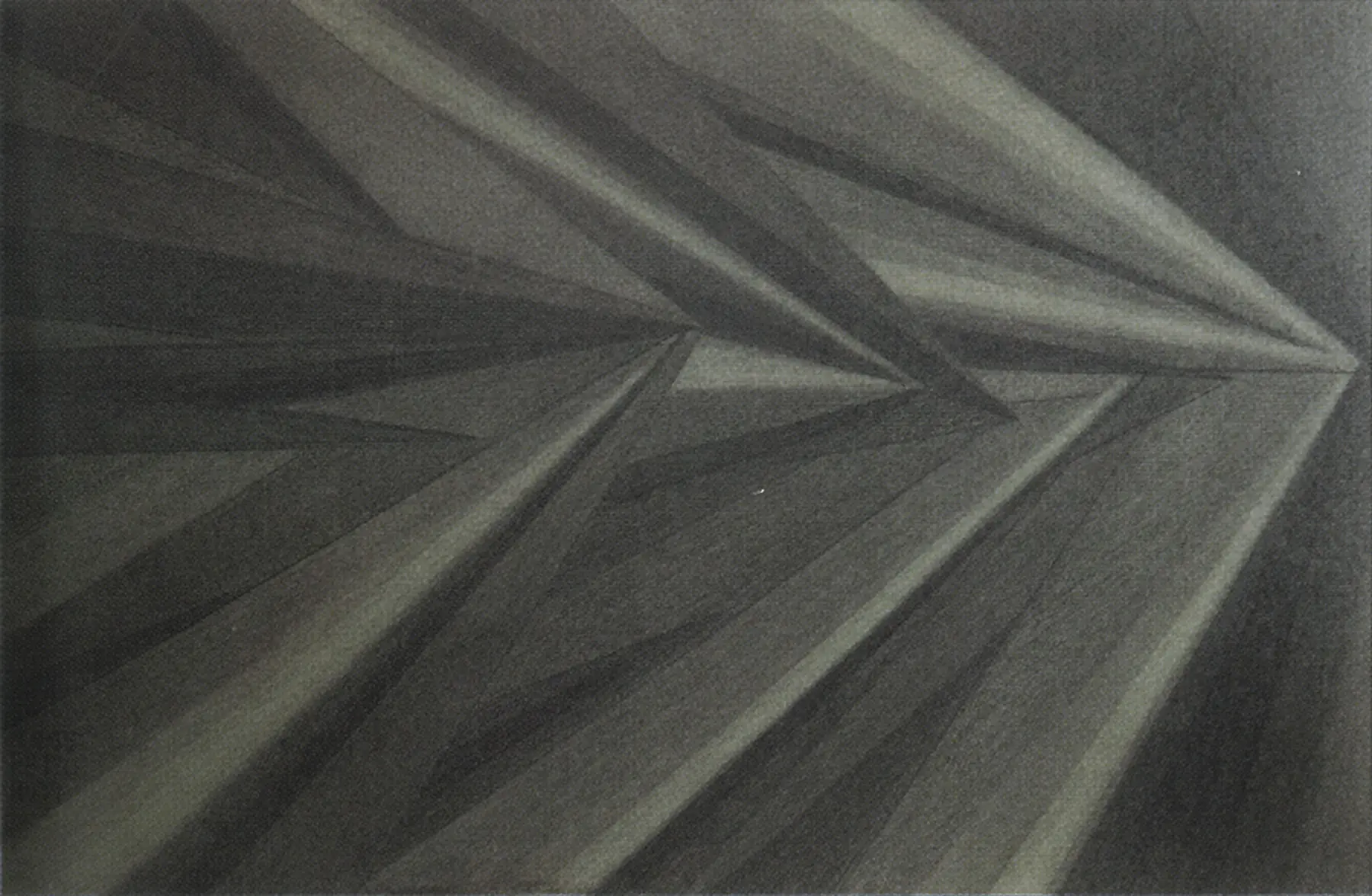
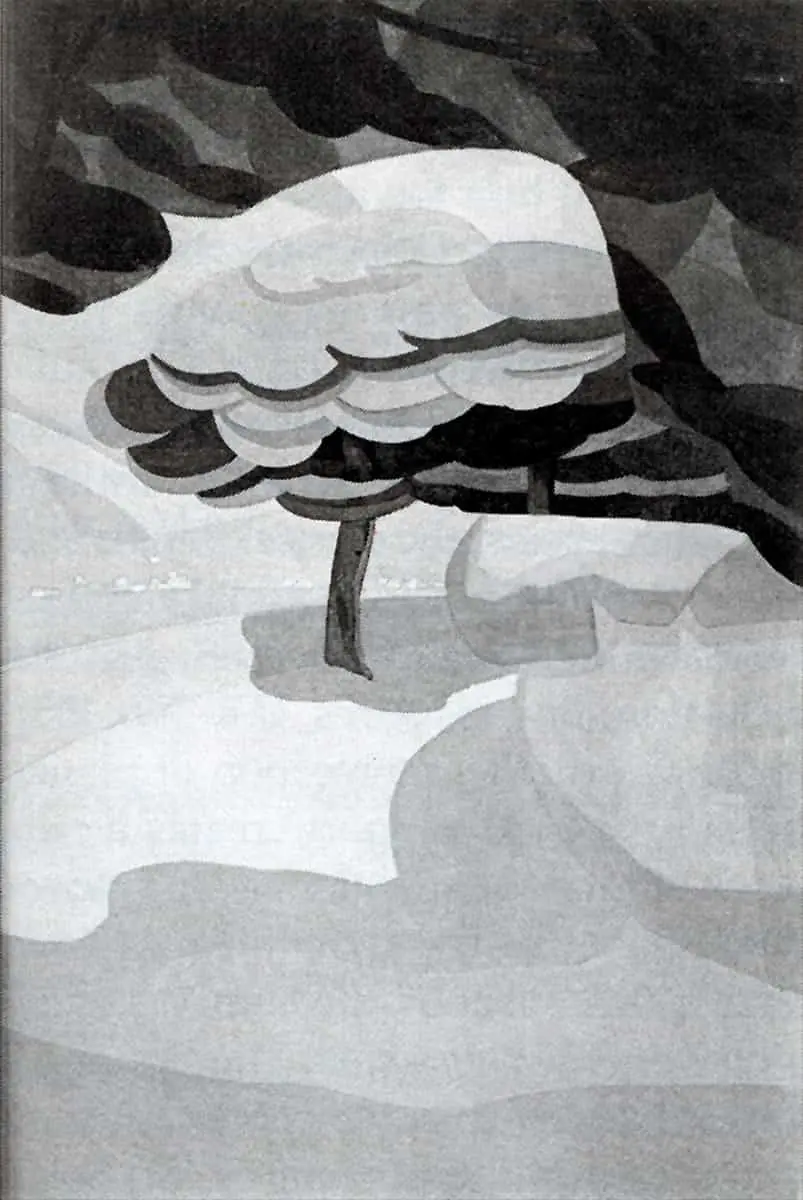
The painting of the futurists had a strong impact on the young Argentinean painter, and a large number of his works dated between 1914 and 191511 are abstract drawings of considerable dynamism. Some are dominated by curved lines, as in Harmonia. Movimento spazio. Disegno astratto (1914, A. Sartoris collection, Lutry, Switzerland, CR # 21), others by diagonals, as in Dynamics of the Wind I (1915, National Museum of Fine Arts, Buenos Aires, CR # 42), although there is an association of movement and light in all these works. The drawings were closely linked to futurist imagery, and in particular to the abstract experiments with dynamic and luminous forms carried out by Giacomo Balia,12 one of the few painters given unreserved praise by Pettoruti in his memoirs: "the only painter, for me, among the futurist painters."12
Pettoruti's first collages, generally applied to still-lifes, also date from 1914. These collages, with their objects reduced to a meeting of planes without reference to the perspectival cube, also take us toward futurism, and much more clearly towards cubism.
According to Pettoruti, the relationship between his painting and cubism was problematic, since the artist always denied having known about the movement-at least up until 1921, when he traveled to Munich.14 The constructive nature of his compositions was attributed by the artist to his studies of the work of artists of the Quattrocento.15 However, the presence of formal, technical, and thematic solutions from cubism is already evident in his work from 1914. Furthermore, the artist never denied the contribution made by futurism, although he noted that the influence was limited. In this sense, it should be recalled that the futurism which Pettoruti knew in 1913 was a futurism that had undergone important changes, following contact with the cubists after the journey by Boccioni, Russolo, and Carra to Paris in 1911, and the exhibition at the Bernheim Jeune Gallery in 1912. It is well-known that the contact between the futurists and the cubists affected both camps in various ways. From 1912, the futurists adopted formal and technical solutions taken from cubism (which at the time was also a complex space in which different and opposite positions co-existed), such as the fragmentation of planes and the technique of collage (a transformation that can be seen, for example, in the significant change which Carlo Carra's work underwent in 1912).16 Thus to know futurism in 1913 was also a means of knowing cubism.
It should also be remembered that Florence had been a peripheral territory of futurism and was at one time hostile to it. However, Pettoruti's arrival in the city coincided with a very special moment, since in 1913 Soffici and Papini established a temporary reconciliation with the futurists. In the same year, they both founded the magazine Lacerba, which became the most characteristic mouthpiece of Italian futurism. Pettoruti said that he was an assiduous reader of the journal, and a frequent visitor to the Giubbe Rosse cafe, one of the meeting and discussion places of this late but intense Florentine futurism. At the same time, in November 1913, an important futurist exhibition was organized in Florence precisely by Lacerba. Undoubtedly this event was to have great significance for an artist like Pettoruti, who was training himself mainly through his observation of works. Barely two months after his arrival in Florence, Pettoruti was able to establish direct contact with the very new images being developed in the paintings of Boccioni, Carra, Russola, Severini, and Soffici:17 "I went back to the exhibition the next day and every day thereafter, without exception during the forty days the exhibition remained open," Pettoruti confessed.18 He added: "I learned many lessons from the Lacerba Futurist Exhibition, which helped me reflect on a thousand things with which I would not have otherwise concerned myself."19 In this sense, it is important to emphasize that the lessons that Pettoruti drew from the futurist paintings done after 1912 already included many elements from the cubist aesthetic.
However, although the works of the futurists left undeniable traces on Pettoruti's plastic language, this was not the case with the "actions" that these artists- headed by Marinetti-undertook on a systematic basis. Pettoruti recalls the Grande Serata Futurista held in the Verdi Theater in Florence as a chaotic, absurd, and depressing event: "I don't think I have ever seen or heard such a rumpus or anything more incongruous...After the session, without anyone having listened to what these men were thinking, the crowd went out into the streets and dispersed, shouting, waving their arms, and making remarks; I did not even think about going to see my new acquaintances, since I was very depressed; the collective expression of human bestiality has always brought me down, making any immediate recovery impossible."20 The scandalous public interventions of the futurists, which are now seen as one of their most clearly avant-garde activities, left no mark on the Argentinean painter; indeed, he rejected them. The negative impact which the serata futurista had on Pettoruti is clear from the fact that he did not make use of the avant-garde, iconoclastic, and anarchical potential of this movement, but rather the formal solutions which were oriented at the time towards a "pure plastics". Indeed, all the work that Pettoruti did from that time on was oriented toward the development of an autonomous pictorial language, according to the "essentially" plastic principles of order, balance, and harmony. This position distanced him from the avant-garde movements which, according to Burger, "can be seen as an attack on the status of art in bourgeois society,"21 a status defined by the concept of the autonomy of art. An autonomy which, it must be emphasized, Pettoruti maintained both in his ideas and in his artistic practice.
It was in this Florence of 1913, where Pettoruti discovered cubism through the intermediary of futurism, that Ardengo Soffici played an important role. This artist, who was so influential in the city at the time, was very familiar with the problems and plastic solutions of the French cubist painters, thanks to his frequent trips to Paris. He was furthermore their enthusiastic champion and publicist in articles published first in La Voce and then in Lacerba. On more than one occasion Pettoruti's theoretical concerns and plastic solutions were related to those of the Florentine artist and theorist. Pettoruti's interest in the primitives might have been stimulated by his reading of texts by Soffiti who, in La Voce in 1910, recommended modern painters to study the perspectival solutions adopted by such "primitives" as Giotto and Fra Angelico.22 As regards cubism, it is interesting to compare the following observations by Soffici with the particular and characteristic use of light in subsequent paintings by Pettoruti. Soffici says that cubism "considers light as something measurable and as something which can be sketched out"; thus both light and its reflections can "take definite shape and form and can in a sense themselves be transformed into objects."23 In addition to these theoretical texts, the role of mediator between French cubism and Pettoruti which we can assign to Soffici becomes even clearer, and certainly more effective, in his own plastic work of these years, in which there is a large number of collages with still-lifes24 of a clearly cubist affiliation.
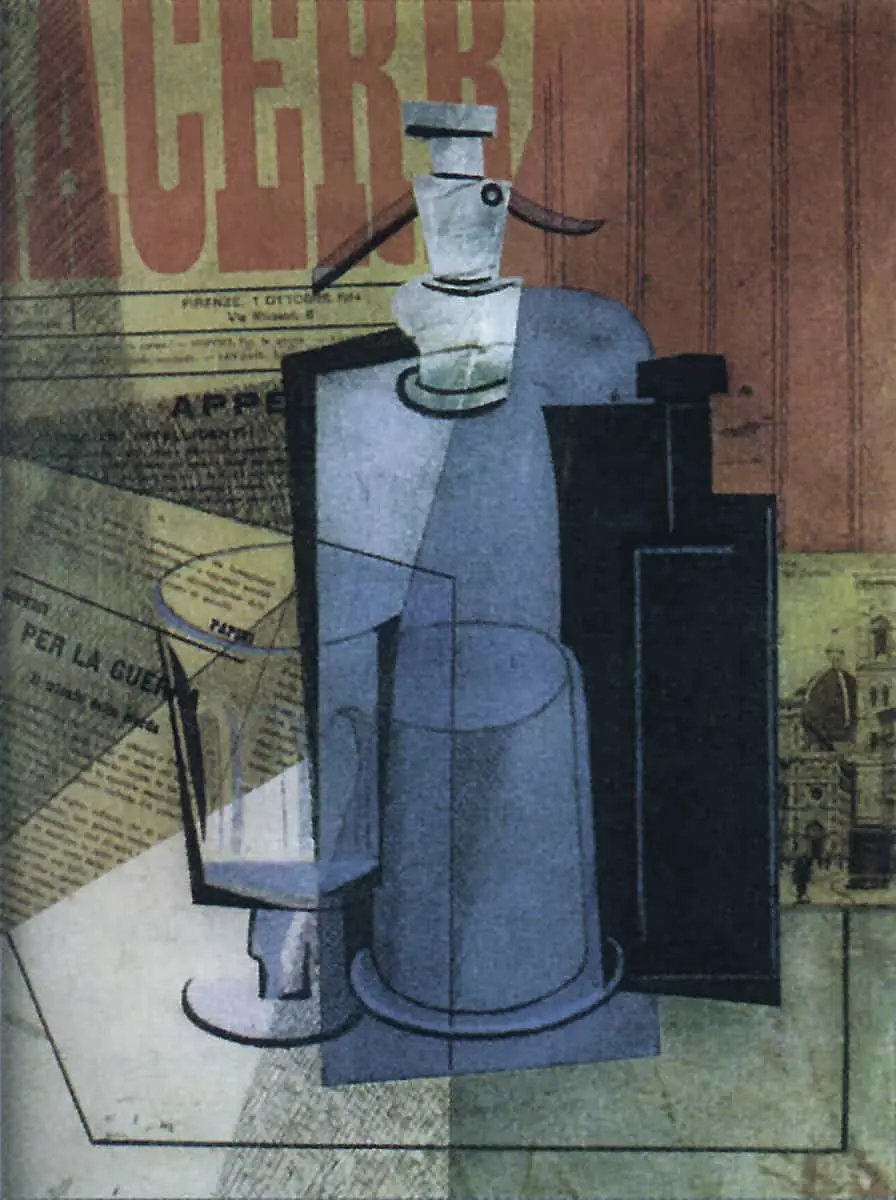
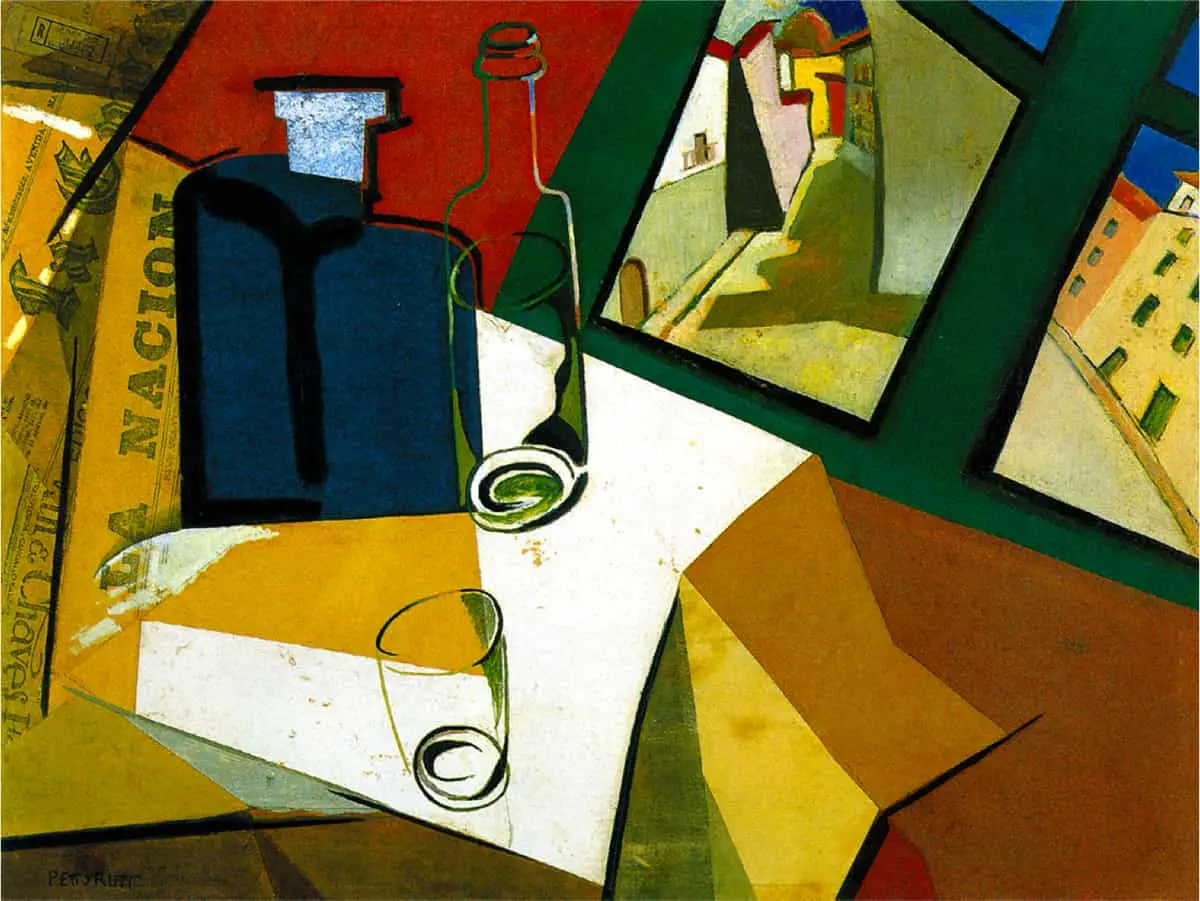
Not only by the collage technique and their still-life themes but by the treatment of the forms in planes, the collages and other paintings which Pettoruti did between 1914 and 1917 can be clearly set within the aesthetic codes of cubism. In The Syphon (1915, National Museum of Fine Arts, Buenos Aires, C.R. No. 43), the use of papier collé, as in the work of Picasso, and then in Boccioni and Carra, acquires a significant density of meaning. The large letters on the first page of the futurist journal Lacerba, with the names of Soffici and Papini on the left and a cartolina of the Florence Duomo on the right, clearly reflect this particular kind of co-existence between the present and the past which Pettoruti found in the city. At the same time, this collage can be read as a kind of personal statement, since it suggests the reconciliation between tradition and modernity which was so important to him. In My Window in Florence (1917, private collection, Buenos Aires, C.R. No. 126), the inclusion of headlines from two Buenos Aires newspapers. La Nación and La Época, and an advertisement for the Gath and Chaves store are not only reminiscent of Le Journal of Picasso and Braque, but indicate with their identity marks the artist's own space vis-á-vis the space of the Italian city seen through the window. It is interesting to note how this young Argentinean artist, with the scant academic training he brought from his own country –a training which included his ignorance about the avant-garde novel ties– was able to incorporate with such speed and skill a new and provocative procedure like collage, introduced in 1912 by Picasso and Braque.
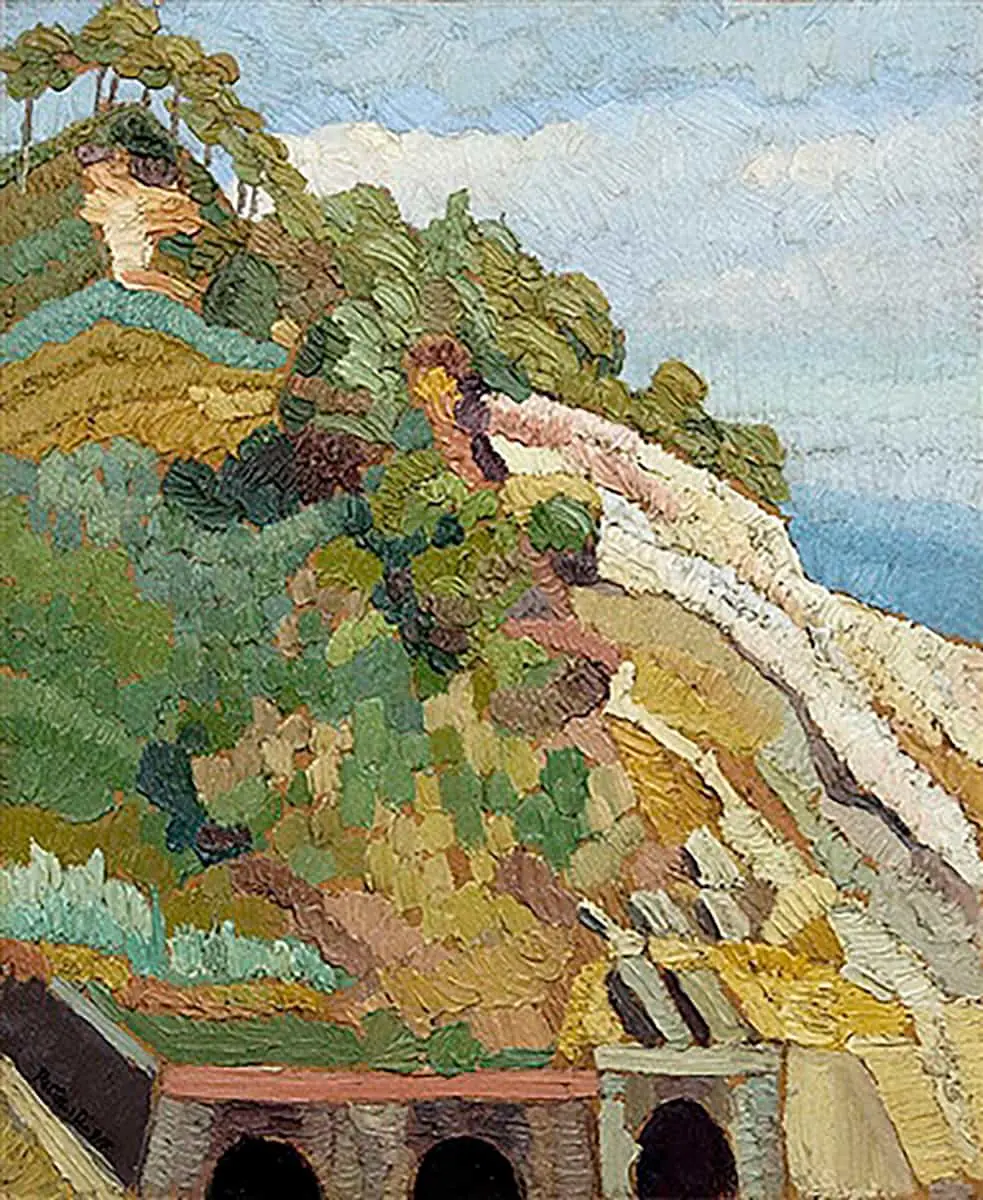
The catalog of Pettoruti's works includes very few portraits during the years 1914-1916. The portrait of Xul Solar, however. Luce elevazione (1916, M. and N. Kohen collection, Buenos Aires, C.R. No. 68) can be interpreted as a continuation of his abstract experiments of 1914-1915, now with the light acting on cubist surfaces. The painting has a dynamic sense that links it with futurism as well as a certain kind of spiritual symbolism. Other less well-known works from the Florentine period reflect Pettoruti's interest in landscape painting. In most of these works, unlike the still-lifes or figures, the perspectival space continues to exist, despite the synthesis of forms and color. In some pictures, such as The Tunnel (1916, Perez Lazo collection, Caracas, C.R. No. 62), even the color is applied with heavy impasto, in a fauve manner. It would seem that on moving from the painting of objects to that of spaces, the artist would have renewed recourse to tradition. These landscape paintings already reflect the modernity/tradition tension that characterizes a good deal of Pettoruti's work. At the same time, the formal leap that is evident between most of his landscapes and his figures and still-lifes is an indication of the continued validity for Pettoruti of the academic division between the "pictorial genres."
The Florentine period culminated in 1916 with the holding of Pettoruti's first one-man show in Florence at the Gonelli Gallery (thirty-five works done between 1914 and 1916). In the same year, the National Salon of Fine Arts of Buenos Aires accepted his tempera titled Harmonies (1914) in the decorative arts section. 1916 was also the year of the meeting between Pettoruti and Xul Solar and the beginning of a long friendship between two figures who, at least superficially, seemed so different.
After a review of the paintings that Pettoruti completed in Florence, it is difficult to accept the view that he reached these solutions only by looking at work from the Quattrocento, as he himself emphatically claimed so often. "I maintain here that my only masters in the plastic adventure which I undertook from the age of 21 were the great artists of the Italian quattrocento and the Etruscans. Naturally, there was also the shock I felt at seeing the exhibition of futurist art, which opened up many eyes toward new horizons. The rest consisted of sparks that filled the atmosphere."25
Following the meteorological image used by Pettoruti, I believe that during the war years and the period immediately after the war, the atmosphere was full of more than just sparks and it is to the credit of the Argentinean artist that he was able to see these things and incorporate them into the essence of his work. This is not to say that the work is not personal. Pettoruti's extraordinary valorization of the lessons of the painters of the Quattrocento must undoubtedly take us to another period of his Italian residence, the Milan period.
Before going to Milan, Pettoruti spent some months in Rome, where he frequently met with Bragaglia and Prampolini and met Mario Broglio, who at that time was about to launch the magazine Valori Plastici,26 which was considered one of the most immediate and important antecedents of the Novecento. Pettoruti, who received the magazine in Milan, said that it was "the best magazine...devoted at this time in Italy to the modern plastic arts."27
Milan
In 1917, the war that Marinetti had exalted, and which had taken Boccioni and Sant'Elia, was reaching its end and the Milan in which Pettoruti arrived was no longer the futurist city of 1910. As in other European centers, towards the end of the war voices were heard calling for a revision of the avant-garde movements of the early years of the century. Voices that denied the anarchic nihilism of futurism and advocated, in contrast, a constructive and ordered art, a modern art that at the same time would preserve the fundamental values of the classical tradition. A tradition which in France and Italy, after the nationalistic exaltation brought about by the war and the defeat of Germany, was felt to be an essential part of their national roots. In the very year in which Pettoruti moved to Milan, Apollinaire wrote in Paris his famous text "L'Esprit nouveau et les Poetes," where he censured the futurists, calling them the "excessive offspring of the esprit nouveau," and anticipated the new artistic classicism, tinged with nationalism, of the 1920s: "the esprit nouveau makes use above all of order and duty, which are the great classical qualities embodied most clearly in the French spirit."
In Italy, Milan was the cradle of one of the movements which most clearly embraced this modern classicism, the Novecento. When Pettoruti arrived in the city, the Novecento did not yet exist, but the Argentinean painter was moving in the circle that was at the origin of the movement. Through his friendship with the critic Raffaello Giolli, he got to know such artists as Aldo Carpi, Arturo Tosi, Mario Soroni, Adolfo Wildt, Achille Funi, and, above all, Piero Marussig, with whom he was to develop a great friendship. His link with these artists resulted in his becoming a socio pittore in the Famiglia Artistica of Milan-a society in which he would hold and organize various exhibitions. With most of these artists, he was to participate in the exhibitions of the Bottega di Poesia (1920-1921) which, according to Ugo Nebbia, "were the first attempts to group together those artists who sensed the new times, with the support of many of those who were subsequently to define the Novecento movement."28 Another strong link between Pettoruti and the future Novecento was his friendship with the driving force behind the movement, the art critic Marherita Sarfatti, whose weekly meetings he frequently attended. To these contacts, we must add his relationship with Carlo Carra, who in 1921 provided the prologue for his exhibition at the Famiglia Artistica. The mention of Carla brings to mind another aspect of this modern classicism of the 1920s, which differed from the Novecento but which was equally concerned about restoring the traditional values of painting, and in particular Italian painting. It had its starting point in metaphysical painting and became consolidated in 1919 with Giorgio di Chirico's proclamation of il ritorno al mestiere.29
This list of the relations that Pettoruti established during his residence in Milan suggests that the Novecento was another important aesthetic reference in his painting. His concern with plastic values, order, and balance achieved meaning within the context of this ritorno al mestiere, as did his declared debt to the painting of the primitives. In 1916 Carra published two fundamental texts: "Parlata su Giotto" and "Paolo Uccello costruttore," which highlighted the revalorization of Italian primitive painting by modern artists who distrusted and rejected the iconoclast of the avant-garde movements, and in particular the futurist movement. Did Pettoruti discover and assimilate the lessons of the primitive painters in Florence in 1913-1914, or did this happen in Milan in the artistic context described above? Undoubtedly the atmosphere in favor of a return to classical plastic values that he found in post-war Milan encouraged him to develop paintings that would harmonize the modern forms with the principles of classical art. Furthermore, in this context, the cubist element in his painting could be given a new legitimacy: of all the pre-war movements, cubism appeared as one of the few artistic alternatives in which this harmony between tradition and modernity could be achieved. This was the ex-futurist Gino Severin proposed in his book Del Cubismo al clasicismo, and it was the inspiration behind the purism of Le Corbusier and Ozenfant, in their articles for L'Esprit Nouveau. In the 1920s, cubism no longer seemed to be painting bent on the destruction of the traditional system of representation, but a modern form of constructivism, although based on the values of classical art.30
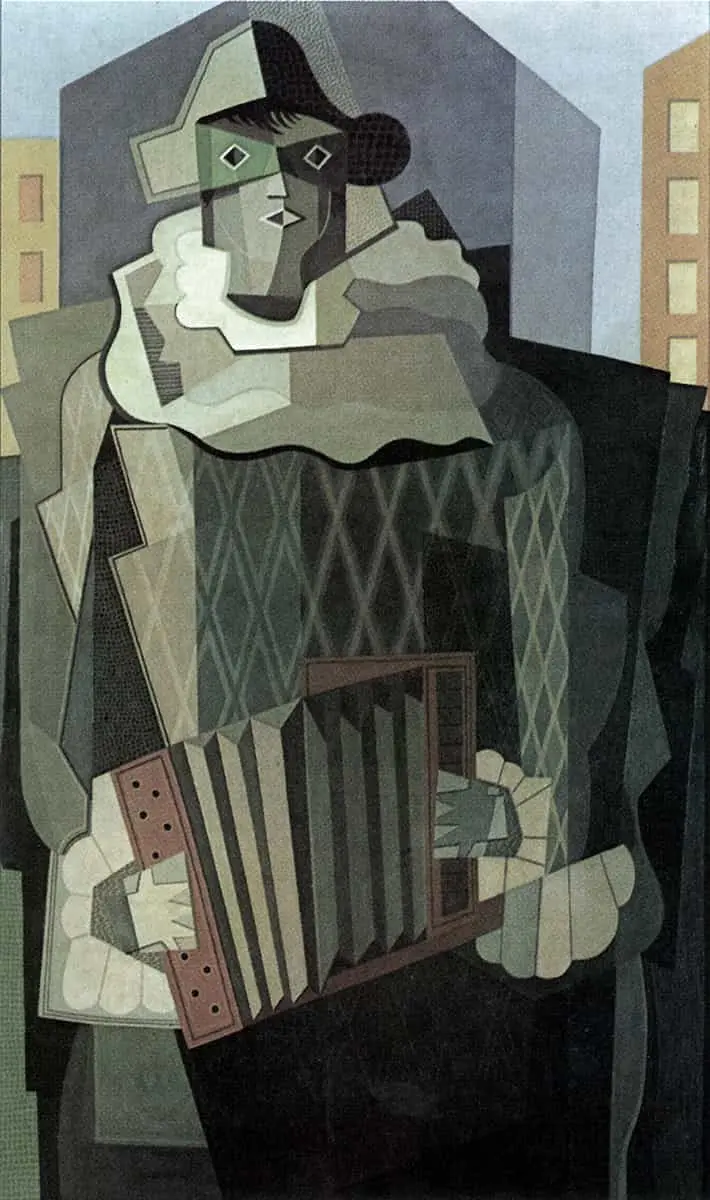
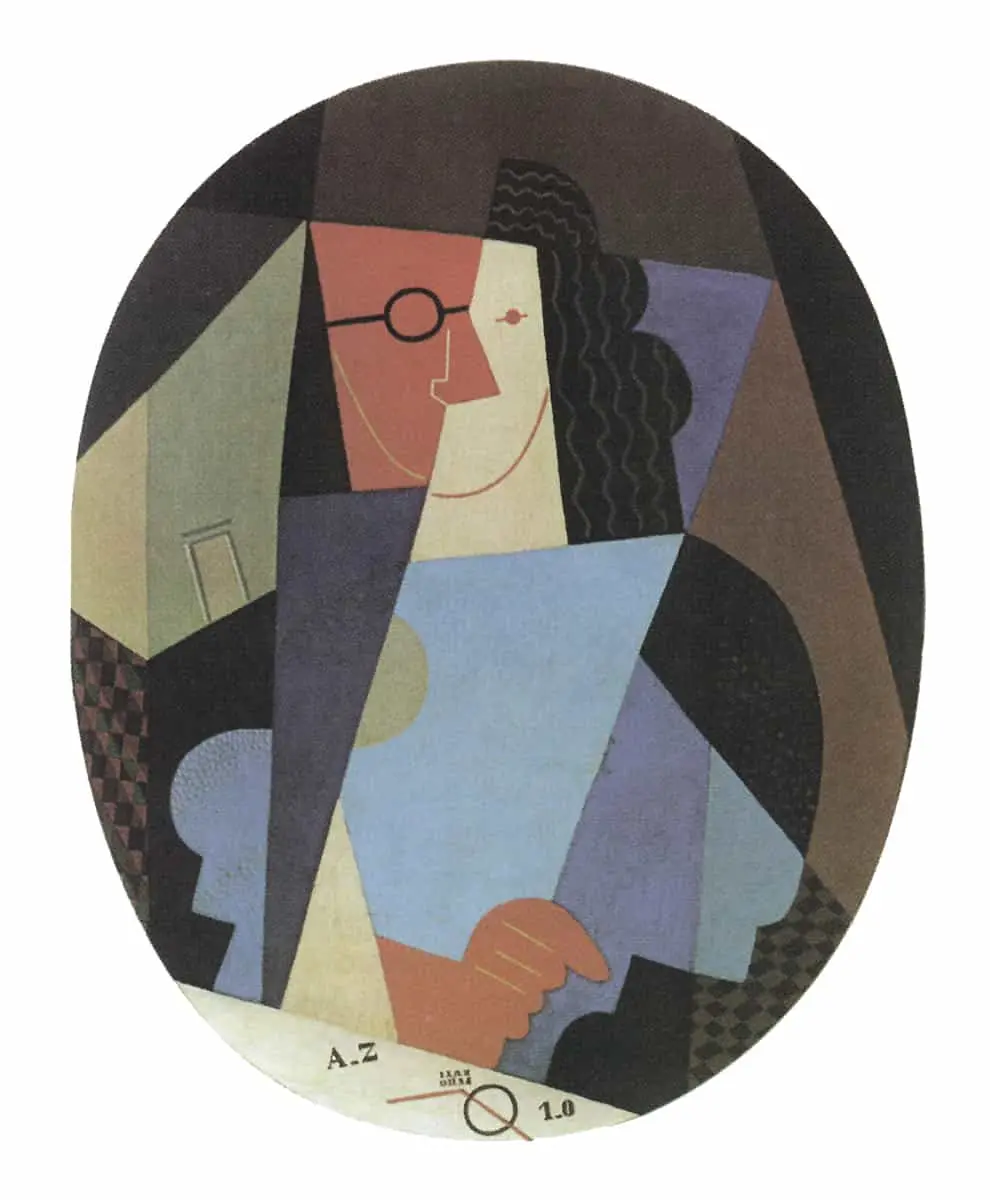
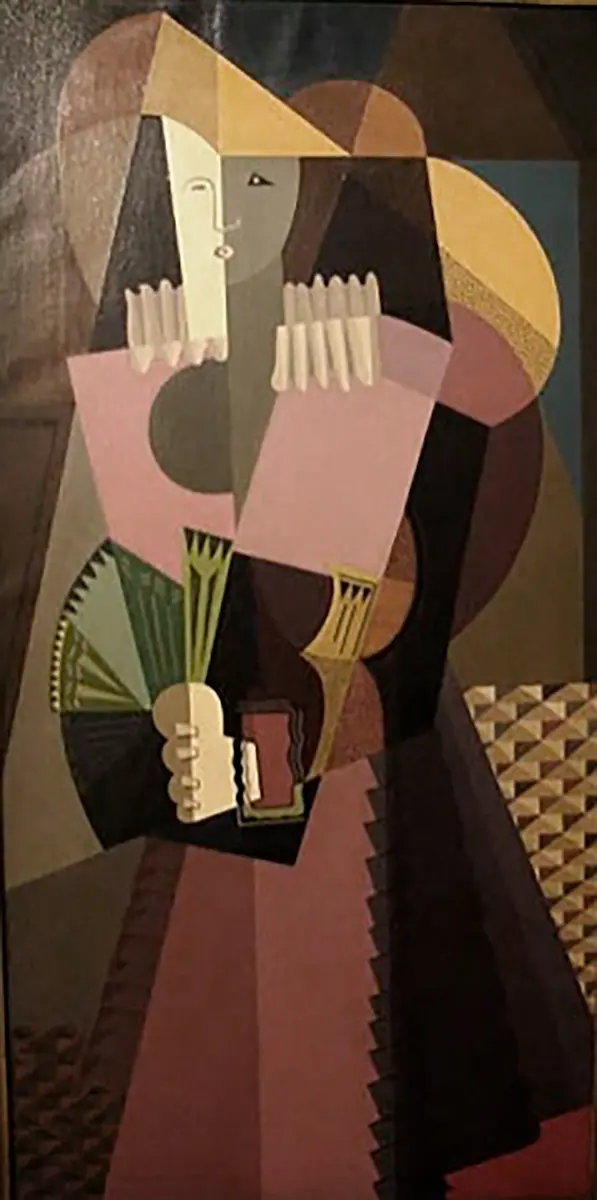
The network of professional and personal relations that Pettoruti established in Milan did not, however, take him away from the path on which he had embarked in Florence. The recuperation of the Mediterranean classical tradition did not lead him towards the restoration of archaistic pictorial forms, as in the case of some of his painter friends from Milan. Pettoruti continued to paint cubist pictures, but which now had greater constructive solidity. In his paintings from these years, the planes of color and light established solid pictorial architectures, as in L'istitutrice (1918, private collection, Buenos Aires, C.R. No. 155). In this work, the intersection of planes within the oval support creates a network of formal equivalences and directional balance. The dynamism of each diagonal is offset by the compact symmetry of the composition. The figure no longer has any spiritual connotation, as in the case of the portrait of Xul Solar from 1916, and now appears as a pure composition. Indeed, one of the clearest signs of the recuperation of classical values in Pettoruti's painting is the importance now given to the problems of composition, which becomes the central focus of his pictorial practice. At the same time, these compositions organized on the basis of colored planes generate their own space which results in an unusual recuperation of perspectival depth. In L'istitutrice, a very schematic architecture appears to the left of the figure: the two walls forming an angle and the frame of the door are set in chiaroscuro and included within a perspective that suggests the "psychological perspective" of the primitives which Soffici had spoken of in 1910. This recuperation of perspective along with the planimetric proposal of forms would become one of the most interesting aspects of his paintings. In fact, Pettoruti had never totally discarded perspective. As noted earlier, many of his landscapes —a genre which he continued to practice in Milan—are based on space which is synthetic but organized in the final analysis within the perspectival cube and with references to chiaroscuro, as in Lago di Como II (1917, private collection, Buenos Aires, C.R. No. 107). What is certain is that from the time of such pictures as L'istitutrice, Demoiselle a Teventail vert (1919, "Eduardo S{ivori" Museum of Plastic Arts, Buenos Aires, CR. No. 184) and The Guitar Player (1920, Domingo Minetti collection, Rosario, CR. No. 199), space and the volumes of his landscapes are combined within the same pictorial space, with the flat forms of his figures and objects generating a very suggestive and disturbing kind of ambiguity. Is this the Quattrocento cohabitating with cubism? This particular recuperation of space and volume defined by an intensely cold light will be a characteristic of the future paintings of Pettoruti. The strangeness of his figures, particularly the series of harlequins that he painted in Argentina in 1926, is much indebted to this harsh light and spatial ambiguities. They are figures which are half human and half robot, recalling the mannequins of Giorgio di Chirico and placing Pettoruti's painting once more within the context of the ritorno al mestiere of post-war Italy.
The period that Pettoruti spent in Milan marks a point of maturity in his work. The efforts made in Florence by the futurists were consolidated on the basis of his work in Milan where the Novecento was in gestation. As a corollary, in 1923 Pettoruti exhibited his work at the prestigious Der Sturm Gallery in Berlin. The following year he went to Paris, where he finally met the protagonists of cubism, including Juan Gris. In Paris, Marinetti introduced him to the Marchand Leonce Rosenberg, who became interested in his painting, encouraged him to settle in Paris, and offered to represent him. Pettoruti accepted: his international career was about to start. However, a decision that, according to the artist's memoirs, had already been made earlier was to pose an obstacle to this project. Pettoruti had planned to make a trip to Argentina, which would last six months. And so after organizing various matters concerning his return to Europe, in the middle of 1924, along with his friend Xul Solar, Pettoruti took the boat for Buenos Aires from the port of Hamburg. His stay in Argentina would last much more than six months. He returned to Europe only in 1952.
Epilogue-Prologue in Buenos Aires
"The time has come to confront my return to my homeland and to ask myself in what state of mind I arrived, what I was hoping to find or do in the time I planned to stay there. First of all, and I say it without vacillation, I longed to see my family and to be seen by them. Secondly, I wanted to show my compatriots the work I had done during my ten long years of absence."31
Pettoruti arrived in Buenos Aires on July 31st and on October 13th inaugurated the exhibition at the Witcomb Salon with works from the Italian period. As noted earlier, this exhibition was important in the history of Argentinean art in that it was the first manifestation of the pictorial avant-garde movement in Buenos Aires —an avant-garde movement which, according to that history, reached Argentina very late in the day. However, I believe that it is difficult to consider the works that Pettoruti presented at the Witcomb Salon as avant-garde in the strict sense of the term. As we have seen, his painting, in particular from the Milan period, was set within a cubism formalized in terms of modern classicism. This classicism excluded the rather iconoclastic and experimental elements that define the avant-garde. For this reason, the logic of Pettoruti's painting is not to be found in the avant-garde, but in the context of the post-war aesthetics (Novecento, purism, esprit nouveau, retour a I’ordre) promoted by the critics and those who had gone beyond the avant-garde. Furthermore, his personal commitment to the artists of the Novecento became clear in 1927 and 1928 when he published in the newspaper Crítica32 and in the magazine Criterio33 several articles that spoke highly of them. In this way, in questioning the avant-garde nature of his work, we are also drawing attention to the strict contemporaneity of his work with the developments of modern European art. But at the same time, if we accept the truth of the accounts of the scandals caused by the Witcomb exhibition, then we must also accept the argument that in the Buenos Aires environment of 1924, Pettoruti's exhibition performed the dissolving, critical and iconoclastic action which we attribute to the European avant-garde. The development of art in Argentina, as in the rest of Latin America, has proceeded at a very different pace and rhythm from that of Europe. Artistic modernity and the resulting autonomy of theory and artistic practice were produced at different times with regard to the European model: in the 1920s, both phenomena were relatively recent in Buenos Aires. In this way, the defense of the autonomy of pictorial language might come to constitute an avant-garde position. An avant-garde that is different from that of Europe, which we must approach in the light of its own particularities. One of these is the decisive influence of the "modern classicism" of the post-war years, the presence of which we can see in the work of Pettoruti but also in the work of other young Argentinean artists in the 1920s who were equally committed to the task of artistic renewal.
The presence of which we can see this in the work of Pettoruti but also in the work of other young Argentinean artists in the 1920s who were equally committed to the task of artistic renewal.
NOTES
1. lssue No. 4, May 1924.
2. On the Pettoruti exhibition, cf. Diana Wechsler, “Buenos Aires, 1924: Trayectoria publica de la doble presentation de Pettoruti”, in El arte entre lo publico y lo privado. VI Jornadas de Teoria e Historia de las Artes, Buenos Aires, Centro Argentino de Investigadores de Arte, 1995, pp.231-240.
3. Atlántida, No. 341, 23 November 1924, cited by Rosa T. Guaycochea de Onofri, Dos momentos en la pintura argentina del siglo XX, Mendoza, author’s ed., 1996, p.72.
4. Julio E. Payró, Emilio Pettoruti, Buenos Aires, Editorial Poseidon, 1945 and C. Córdova Iturburu, Pettoruti, Buenos Aires, Ediciones Culturales Argentinas, 1963.
5. "The Argentinean artist has made his own synthesis of more than one living movement. Hence the difficulty of classifying him, making it necessary to use the rather vague term of 'pure plastics' to describe his work, as well as the irritation felt by the painter himself when his work was labeled 'cubist' or 'futurist'." Payró, op.cit. p.46.
6. Julio E. Payró, op.cit., p.7.
7. Emilio Pettoruti, Un pintorante el espejo, Buenos Aires, Solar/Hachette (abbreviated S/H below), p.15.
8. Ars, La Plata, Year I, No. 10, March 1910, p.291. Mention is made in the same issue of Pettoruti’s participation in the “Exhibition of the Academy directed by Mr. Atilio Boveri”, p.292.
9. PE, p.23.
10. ln 1914, Pettoruti participated in three group shows held in Florence: the Esposizione Annuale di Bozzetti, the Esposizione Internazionale di Bianco e Nero, and the Prima Esposizione Invernale Toscana. He also sent a mosaic work titled Spring to the National Salon of Fine Arts of Buenos Aires where it was accepted in the decorative arts section.
11. ln this work, the titles and dating of Pettoruti's works refer to the catalog raisonné included in Emilio Pettoruti, Buenos Aires, Salas Nacionales de Exposiciones, 1995, pp.123-171 (abbreviated C.R. below). Although this publication constitutes only a provisional catalogue, it is the only one of its kind to have appeared to date.
12. Cf. the following paintings by Balia: Linee andamentali + successioni dinamiche (1913, Gianni Mattioli Coll., Milan) and Velocita astratta-l'auto e passata (1913, Tate Gallery, London).
13. PE, p.92.
14. "The works contained in that futurist exhibition of [1913] were the first avant-garde works I saw up to 1921 when I first went to Munich. In Munich I discovered expressionism, cubism, and all the tendencies in vogue at the time." Statement by Pettoruti quoted by Angel Osvaldo in Nessi, El atelier Pettoruti, Buenos Aires, Ediciones Culturales Argentinas, 1963, p.44.
15. "l did not learn to construct from the cubists, whose works furthermore I did not know, but from the primitives, and above all, from the Italian quattrocento. They were my true masters.” Quoted in C. Cordova Iturburu, op.cit., p.63.
16. Cf. II funeralli dell’anarchico Gialli (1911, Museum of Modern Art, New York) with La galleria di Milano (1912, private collection, Milan).
17. ln 1914, furthermore, he discovered the sculptures of Boccioni in the exhibition which the latter presented at the Gonelli Gallery.
18. PE, p.46.
19. ibid., p.51.
20. lbidem., pp.47-48.
21. Peter Bürger, Teoria de la vanguardia, Barcelona, Ediciones Peninsula, 1997, p.103.
22. Soffici recommends using, “just as the great moderns and great primitives did, psychological rather than geometrical perspective,” Ardengo Soffici, “Divagaciones sobre arte”, in La Voce, 22 September 1910, cited in Mauricio Calvezi, La Metafisica esclarecida, Madrid, Visor, 1990, p.93.
23. Ardengo Soffici, “II cubismo e oltre”, Lacerba, 15 January 1913, cited in Frangois Mathey, El cubismo, Buenos Aires, Viscontea, 1977, p.193. In addition to this article, Soffici also published “Picasso e Braque”, in La Voce, on 24 August 1911, and the book Cubismo e Futurismo, in Florence in 1914.
24. Cf. Soffici’s cubist collages, such as the Still-lifes of 1913 and 1914 in the E. Vallecchi collection in Florence and the Jesi de Milan collection in Milan respectively.
25. PE, p.79.
26. Valori Plastici was first published in November 1917. In the first issue, in addition to texts by Carrá, Savinio, De Pisis, Melli and Broglio, Giorgio de Chirico published his well-known text on Broglio titled Zeusi I’esploratore. The second issue was devoted completely to France, with poetry by Cendrars, Salmon, Cocteau, and Breton and cubist works by Gris, Severini, Metzinger, Picasso, and Braque. Valori Plastici was published in 1922, and its various issues reflected its international vocation, with presentations on the French Esprit Nouveau and the Dutch De Stijl movements.
27. PE, p.112.
28. Ugo Nebbia, La pittura del Novecento, Milan, Societá Editrice Libraria, 1946, pp.179-180. Nebbia mentions among the participants in these exhibitions the names of Bucci, Carpi, Costantini, Dudreville, Malerba, Martini, Marussig, Monti, Pettoruti, Ugo Piatti, Russolo, Salietti, Sironi, Tosi, and Zanini. Several of these names (Bucci, Dudreville, Funi, Malerba, Marussig, Opi, and Sironi) were the protagonists, in 1922, of the Sette pittori italiani exhibition, which was the first manifestation of the group which in 1924 was called itself the Novecento.
29. ll retorno al mestiere (The Return to Craft), an article published by Giorgio de Chirico in Valori Plastici, No. XI-XII, November- December 1919.
30. ln his Teoría de la Vanguardia, Peter Bürger questions the inclusion of cubism in the avant-garde movements. See Peter Bürger, op.cit., p.54 (note).
31. PE, p.173.
32. According to the survey carried out by Diana Wechsler, Pettoruti published in Crítica Magazin in 1927 articles on Piero Marussig, Enrique Prampolini, Augusta Giacometti, Fortunato Depero and Juan Colacichi Caetani. Cf. Diana Wechsler, “Nuevas miradas, nuevas estrategias, nuevas contrasenas”, in Diana Wechsler (editor), Desde la otra vereda. Momentos en el debate por un arte moderno en la Argentina (1880-1960), Buenos Aires, Ediciones del Jilguero, 1998, pp.119-155.
33. ln issue No. 4 of Criterio (29 March 1928) he published “Pintores del ‘900’ italiano. Piero Marussig” and in issue No. 7 (19 April 1928) “Pintores del ‘900’ italiano. Mario Tozzi.”
MIGUEL ANGEL MUÑOZ
Licensed in Art. Professor and research scholar at the Buenos Aires University. Member of the Argentine Art Research Center.