The implications of the work of Felipe Márquez go well beyond those of an exercise in form or procedure. One of them, for example, is the impact that each piece as an image has on the viewer. They are, as Marco Rodríguez del Camino has noted, my, your, and his works since they are so personal. This is because the space which they fill is small and because of the space created in each of them.
Perhaps space is one of the densest and most intense themes present in the 64 miniature works recently on show at the Minotauro Gallery. By their very condition, each miniature is a focal point of attention. To appreciate and properly enjoy them, the spectator needs to stop and look carefully at each image. "Each image —the artist has said— should be a living, breathable, expanding event." Some involve a space or situation which is in a state of convulsion; others are more introspective. These states can be communicated to the observer since the experience depends on the degree of intimacy depicted in the images. The fact that they are so personal places us within a space of intimacy.
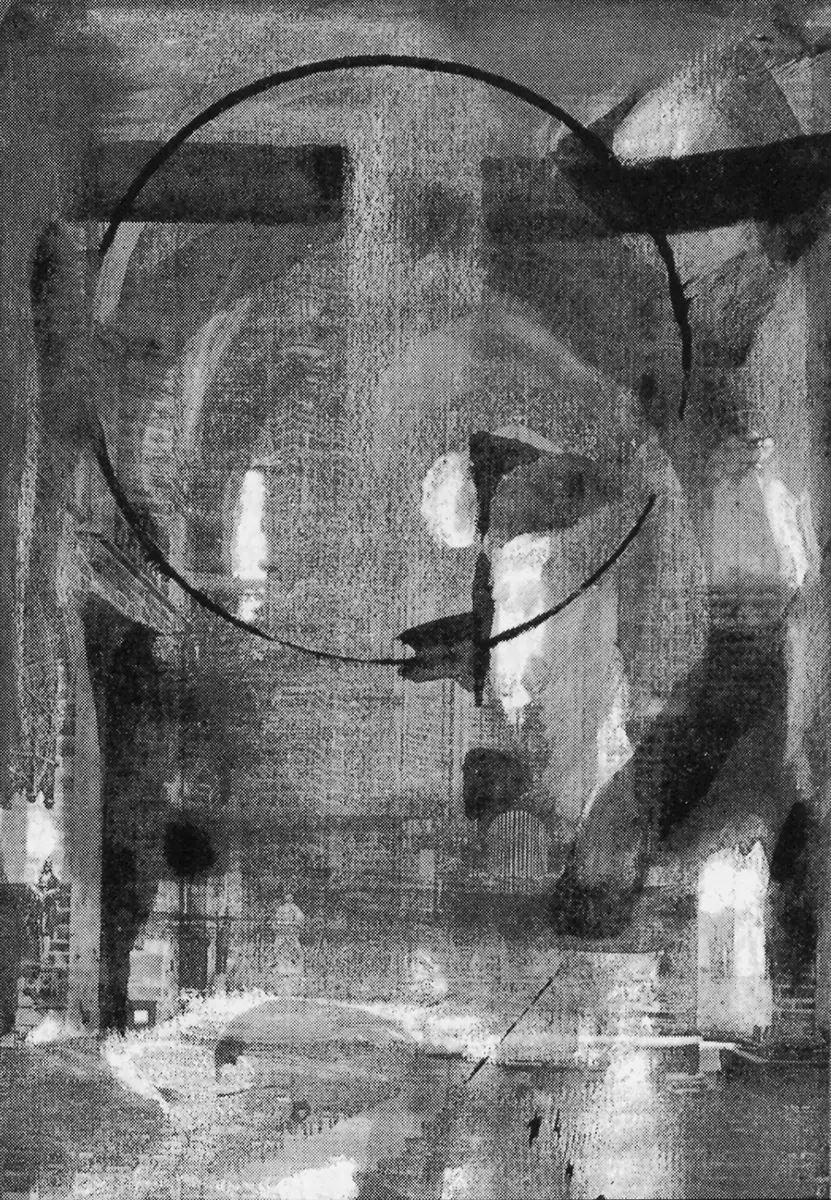
The first works in the Imagosophia exhibition appear to be very convulsive. Without doing so in a fully conscious manner, the pictures show spaces of death, chaos, and confusion. The illness of Julia, the artist's mother, and the proximity of her death (hence the title - she was also called Sophia) are experiences that found an echo in the artist and which in one way or another brought about changes in these spaces. Circular atmospheres, almost like hurricanes, destroy architecture and disrupt surroundings. Barely visible in the mists, stains, and brush strokes of varying degrees of intensity, are pieces of landscape, objects, or parts of buildings. They are the traces remaining from the old postcards which the artist has used as support for these tiny pictures. A passion for antique prints and old books is one of Márquez's interests. Postcards in particular permit the creation of rich and varied textures, depending on the way the inks are absorbed. All this allows the artist to achieve a wide variety of tonalities. In this way, the transparencies reveal what is covered and hidden, as the signs of some earlier presence remain ex-posed (the original image of the postcard). Transparencies, tachisme, and marks are the pictorial resources proper which, along with the printed image subtly perceived in the cards, creating illusions and ambiguous readings. The illusion of a third dimension, for example, takes us into a space beyond what we superficially see on first looking at the pictures. The spatial depth is both present and absent at the same time. This means that the pictures are not clearly abstract or figurative; they might be both, with no pre-conceived categories or classifications being possible.
The sense of depth is also evident in the color, with a predominance of somber tones, sometimes suggesting a whirlwind or vortex, and other times more silent and peaceful. The only intention here is to hear the sounds of a profound black or the convulsions created by an infinite number of different shades. This stimulation of our most sensitive forms of perception is made possible through the small format nature of the works. Without any surrealist pretensions, these pictures are in the final analysis the spaces of dreams, the result of a passion for drawing and paper. Anything else would be a matter of purely visual "special effects", devoid of any intimacy or personalization.
SUSANA BENKO