
In the paintings which Gachi Hasper recently presented at the new premises of the Ruth Benzacar Gallery, the forms play with the gaze of the spectator, while the colors dance. The exhibition included seven large format pictures which, although able to breathe freely because of the enormous space given to each in the montage, competed through their individual power to catch the eye of the visitor. The series of works with full and emphatic colors contrasted with those with powerful yet ethereal brush strokes.
Hasper, who was born in Buenos Aires in 1966, is one of the most representative artists of the decade, a decade in which a debate began, which is not yet over, about the supposedly "light" art being produced by certain artists, in contrast to the political nature of works by other figures. In a conversation I had with Hasper, the artist said that at "all events I believe that art by definition is useless, it is an abyss, it comes into conflict with the world in which we live. I do not believe that art has a social function, and if it does serve some such purpose, then it is by accident. It might be that an artist has political intentions, but if the work is good enough to go beyond these intentions, they cease to matter. I do, not believe that we can even think in terms of arguments like 'the public should be educated in art.' My work does not try to send any messages. Neither is it representative of a feminine sensibility. This matters to me outside my work."
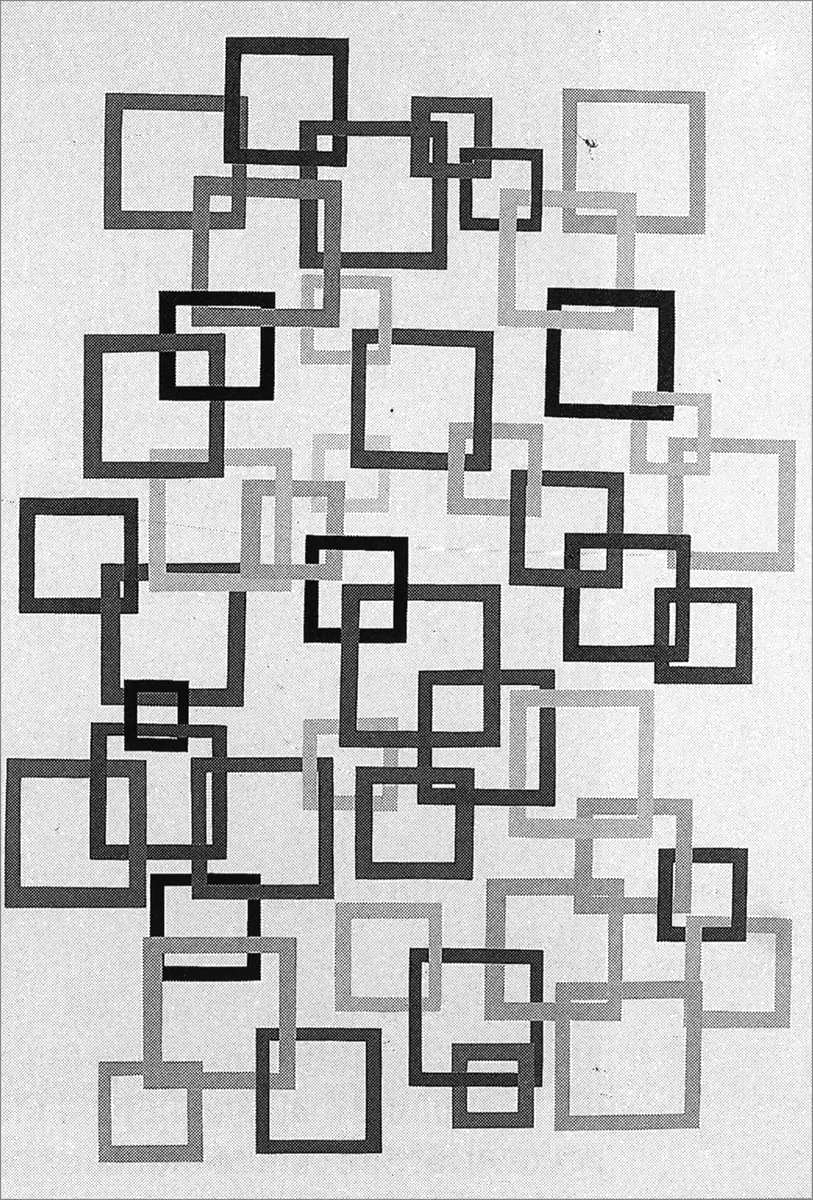
Far from proposing free abstractions and distant geometries, Hasper's deceptively seductive painting avoids conventional metaphors and shuns all kinds of categorical meanings. It is an intimate and honest work that operates through strictly private coordinates, and which refuses to reveal itself completely. Hasper does not want to condition the spectator and therefore does not give any titles to her works. For some viewers, there is a mystical component here, while others will discover personal keys. Only the artist knew how she felt on the day that she painted the pictures or to which parts of her experience the colors or forms refer. What we do perceive is a great deal of pleasure in these works, something of the intelligence with which they have been thought through, and the sensitivity of the artist who made them.
"There are more questions than answers in these pictures." Hasper admits that in this show she is returning to work with her mistakes. "Usually, I work with a grid, a mathematical thought, but my works are not perfect, I speak about imperfection and contracture. I use secret mathematical formulas and absurd numerology. But I bastardize, I dismantle the grid and change the variables. I use the grid to support weak structures." Hasper knows about the principles of composition, but enjoys disregarding them, because "rules are made to be broken".
The arguments that she invents or takes from nature, the street, bazaars, objects from popular culture, and anonymous designs all become unrecognizable and appear in a far from random manner. But what is more important is the light and the colors, which, as Hasper says, are the essence of the vision. "Painting is a luminous construction, but the mind has its doubts, it does not know if the light is merely a dream and the darkness —outside the picture— reality."
The result is a work that is above all about painting. It is presented with a festive austerity that frees the color, plays with imperfection, and surreptitiously promotes dissolution. The arbitrary manipulations of Acrylic are camouflaged by the tension between the colors, which constitutes the main drama, the main theatricality of her painting.
Hasper's interest in speaking about the problems of painting was evident from the time she first began to show her work in 1989. And although her work acquires different material aspects simultaneously —most of the time she paints sometimes works with photography— everything takes her back to painting and to a discussion of the dynamics itself of pictorial language.
Here, in distant Argentina, she has felt free to take elements from a given North American pictorial tradition, from the constructivist avant-gardes and Argentinian concrete art, to look back and in the process leap forward. Her audacious references have fared well in the birthplace of minimalism, with her 1998 show at the Annina Nosei Gallery in New York being well received.
In this context, the works in this new exhibition seemed to confront the past and at the same time point towards a promising future, or at least one with a few flashes of hope. Even if for only a short time, the impeccable exhibition room was filled with the brilliance of technique and color. From which the world might be absent, but where Hasper's works were very present.
VICTORIA VERLICHAK