
Jorge Orta was born in Rosario, Argentina in 1953 and now lives in Paris. Since he began his artistic work at the beginning of the 1970s, his proposals have been focused on the internationalization of his art.
Orta reaffirms his sense of belonging to a culture that goes beyond the national level, a culture that belongs to a world that, in the wake of globalization, is tending to use common symbols. It is as though Orta is trying to reach humanity as a whole, irrespective of the differences between people. Hence his use of multiple technical resources and visual symbols which involve recourse to both intuition and reason. His signs are constructed with various referents, whose initial meanings are stripped away, leaving only the most elemental resources. Orta believes that his works make use of two key elements: the construction of what he calls a "planetary alphabet", signs that he takes from cultural memories of very different places, from Machu Picchu to contemporary photographs; and his use of state-of-the-art technological resources, as in his light interventions on the facades of French churches, in Machu Picchu or in the Turkish city of Cappadocia.
His intervention in such different places is related to his desire to open up art to a wider public-the spectator who cannot visit the usual places where works are presented, for example. It is therefore not surprising that several of his macro-projects involve the formation of interdisciplinary groups, particularly when the project requires the use of complex technology. Orta seeks to replace individual discourse with that of a group of collaborators working towards the configuration of a collective proposal, an encounter of sensibilities.
His reflections focus on the theme of injustice, the lack of solidarity, and excessive ambition, in an attempt to break the circle of indifference and insensitivity.
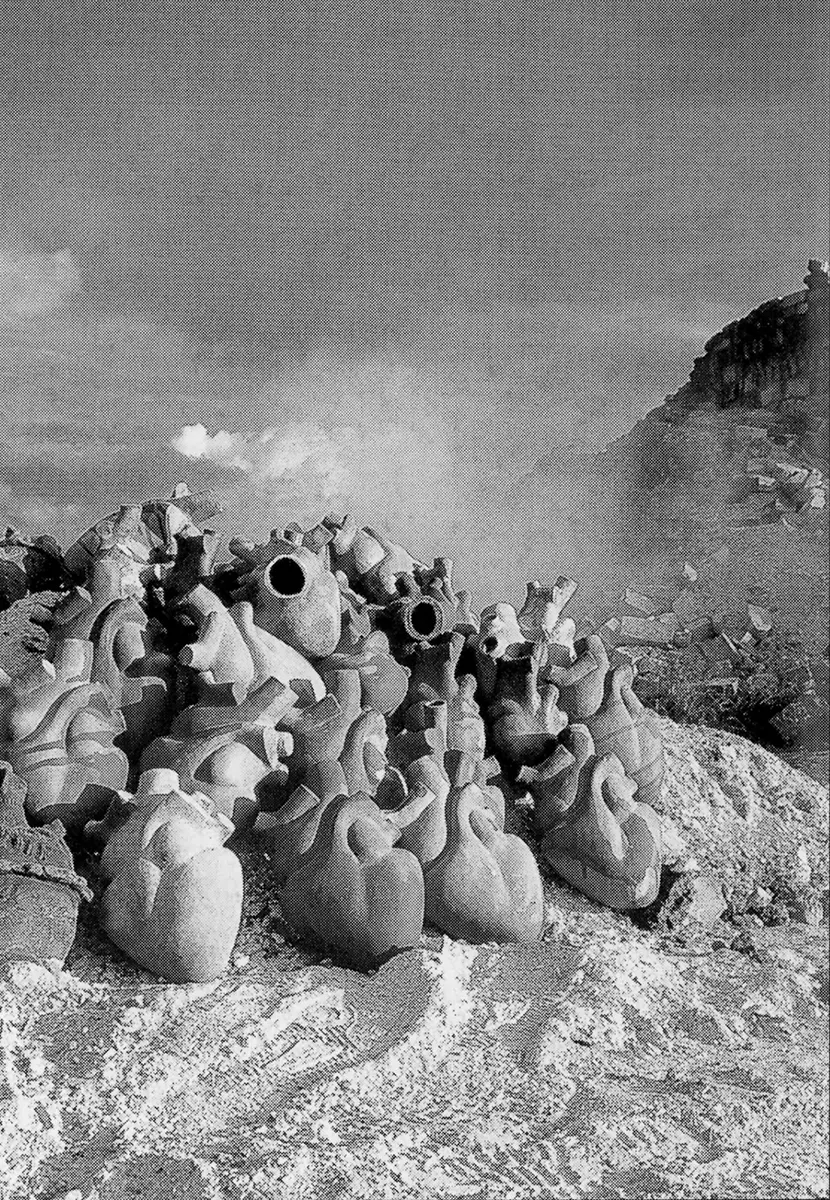
Ten years ago Orta began a new project that takes the symbol of the art as its main theme. He has made hundreds of thousands of hearts in different places throughout the world, with the heart being identified with the idea of life and solidarity, as well as being a universal symbol. This project, which will continue until 2006, has been produced in the most varied kinds of materials: French porcelain from Limoges, Japanese raku, and now, ceramics from Ráquira and Zipaquirá, two Colombian towns with a tradition of producing ceramic works.
Once again the heart becomes a symbol. What is important is not the object in itself, but the metaphor woven around it. And these hearts will begin to travel to very varied and remote places, beginning in France and extending as far as the Antarctic. They nurture the utopia of someone who uses art as a means of transformation and not as a source of contemplation, promoting artistic practice in terms of communication and sharing.
IVONNE PINI