This exhibition by the Argentinian photographers Julio Grinblatt and Bibi Calderaro at the Institute of Ibero-American Cooperation (ICI) last August began with Grinblatt's Corridors, a series of black and white images of halls, stairways, elevators, and other places through which the public moves and all shown in a state of total emptiness. The photographs, in a size barely larger than that of a contact print, were exhibited like a collection of miniatures which, when viewed up close, became extensive —just as our vision suddenly expands when we look through a peephole. An image is seen from some external space —the dark space of the photographer— desperately closed in on itself. The origin of this disassociation between the photographer/spectator and the image undoubtedly lies in the radical abstraction of the public architectures which Grinblatt decided to photograph —an abstraction which, amongst other things, seems to be the result of the total distancing of these places from the canonical architectural structure— the house.
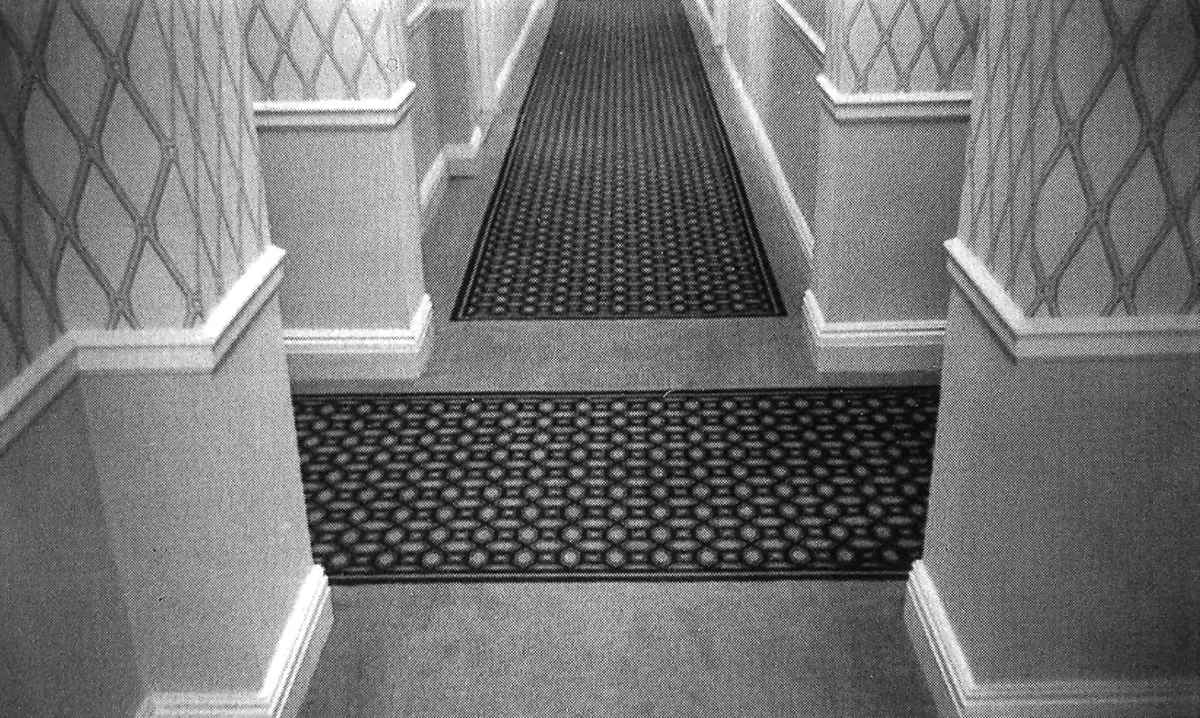
The thirty-odd photographs were prefaced by a prologue by Reinaldo Laddaga, who described the photographs as "hallucinations each one different- of the actual inside, the entrails, of the camera." Abstract, desolate abstractions, bordering on some kind of terror, which for the artist are intimately linked to his impressions of "not belonging" and of "exclusion" during his first two years as an immigrant in New York. The photographs are taken frontally, and in most cases, there is a central vanishing point. The miniaturization of the image means that the latter is viewed in an abstract way, which heightens its emblematic quality. It is in this sense that the series is similar to a collection; at the same time that it presents Grinblatt's vision of the city, it seems to be focusing on a specific kind of image which through its miniaturization becomes a pure abstract design. What is particularly interesting is that Grinblatt inverts the more conventional process of abstraction in photography, where the abstract elements generally emerge from the details of some larger figure; however, in the case of Corridors, the abstraction is the result of the extraordinarily tiny vision of totality. The sequence of corridors and stairways, i.e. perspective paths, is interrupted by a few anomalous photographs which introduce moments of closure and enclosure into the sequence: elevator doors, a lit hall, and a kind of enormous blind screen. While the corridors make up some imaginary labyrinth, these anomalies are there to indicate that Grinblatt's drifting is of the infinite kind.
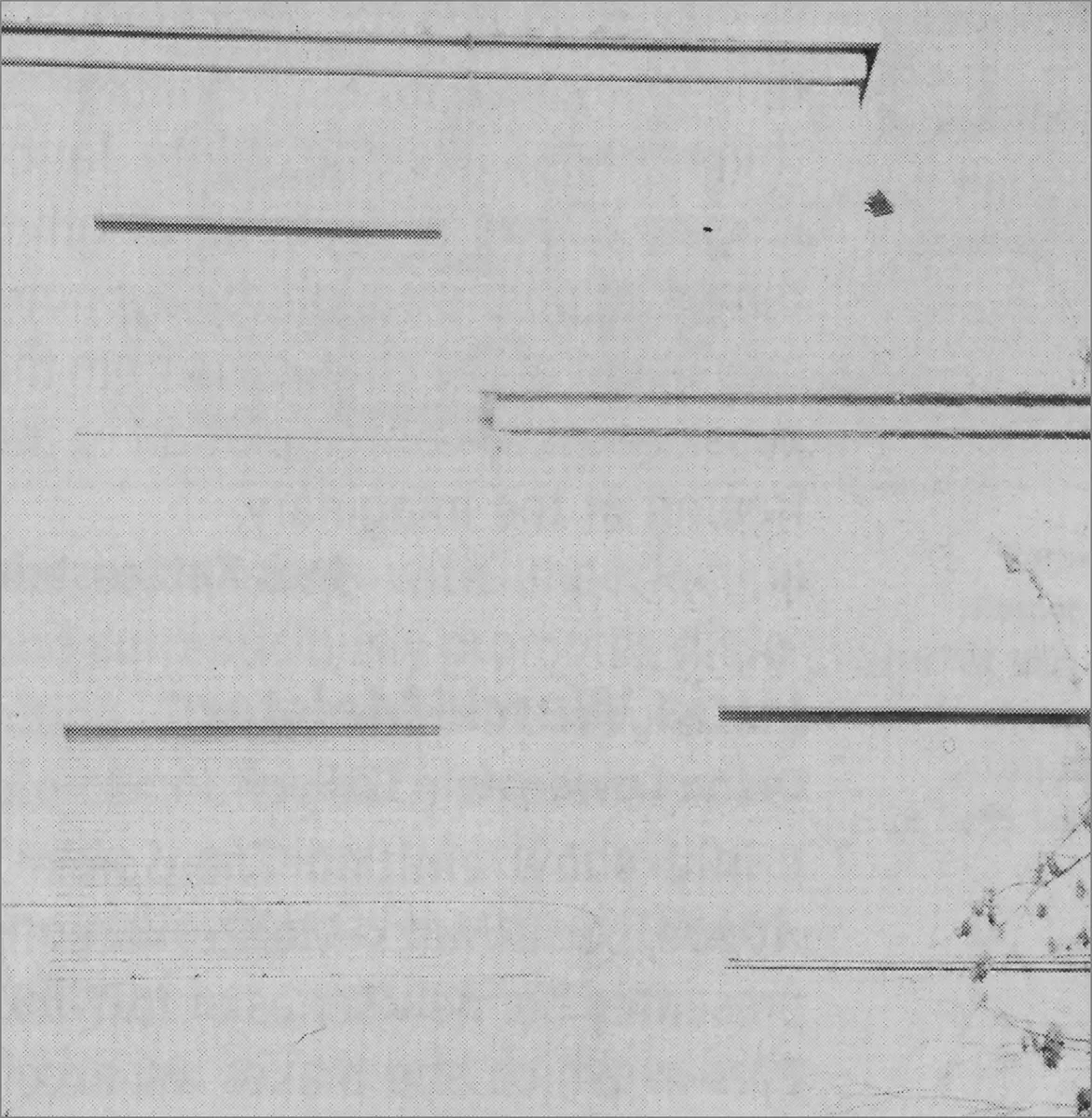
The second room in the ICI building, where the works of Bibi Calderaro were presented, seemed, at first sight, to be empty. Her 35 small transparencies, measuring 6 in. x 6 in., were strategically laid out on the walls of the room in such a way that if the spectator did not move around the space, the photographs could not be seen. Grouped together |in a random fashion, they were set on the wall at an angle of 45°, quite high up so that the spectator was required to look upwards to see them.
The photographs show landscapes on the point of disappearing, out of focus, and over-exposed to light; veiled landscapes where the theme is an excessive and blinding light, light that burns. In creating her work, Calderaro experimented with the limits of vision: she allowed the image to be swamped with white light and explored these limits until she assembled a group of works which, taken together, shun any sense of anecdote, exposing the spectator to images which cannot be seen, images which frustrate us and flee from their own existence.
Calderaro entitled the series Suprematist Psycho-geography, in tribute to "Malevich's situationist drift and search for abstraction." The work is therefore influenced by the complexity of this twofold homage, in which the perception of something that is multiple —landscape— is combined with an absolute synthesis, the concept of white photography. The work does not aspire towards radical iconoclasm, in the sense of making white its object; the whitish haze over the trees, buildings, and seas ends up creating an unavoidable sense of melancholy.
Pursuing the defense of the nothingness implied by a decision to exclude any kind of anecdote, and thus the image, almost completely, Calderaro presented in an adjacent room a 3-and-a-half minute film in Super 8, which showed the movements of a man and a woman skating on ice. "I am interested in making these three and a half minutes very present for the spectator, to make him feel the passing of the time," says the artist. The image of the skaters, like the white landscapes, allows us to think of other things, to pass through the hypnotic movement of the characters from the passiveness of contemplation to the freeing of the imaginary.
INÉS KATZENSTEIN