In a show entitled The Spider's Abode, Lucía Warck-Meister recently presented her new series of text-textiles in which she makes excellent use of a domestic technique hitherto foreign to the world of art. Using a glue gun which, through the effect of heat, softens the plastic material contained inside, the artist has transformed the transparent substance into a thread with which she constructs, in the manner of an artisan, threads similar to those of a spider's web. She uses this thread to write phrases that in their uninterrupted sequence provide a commentary on the ambivalent nature of her constructions. "I construct/ l deconstruct," "I construct my desire," "She devours," "This is the end," "Your mind is fragile" are some of the texts which are mingled with the basic textile work and which can be read, sometimes with difficulty, in a kind of filigree effect.
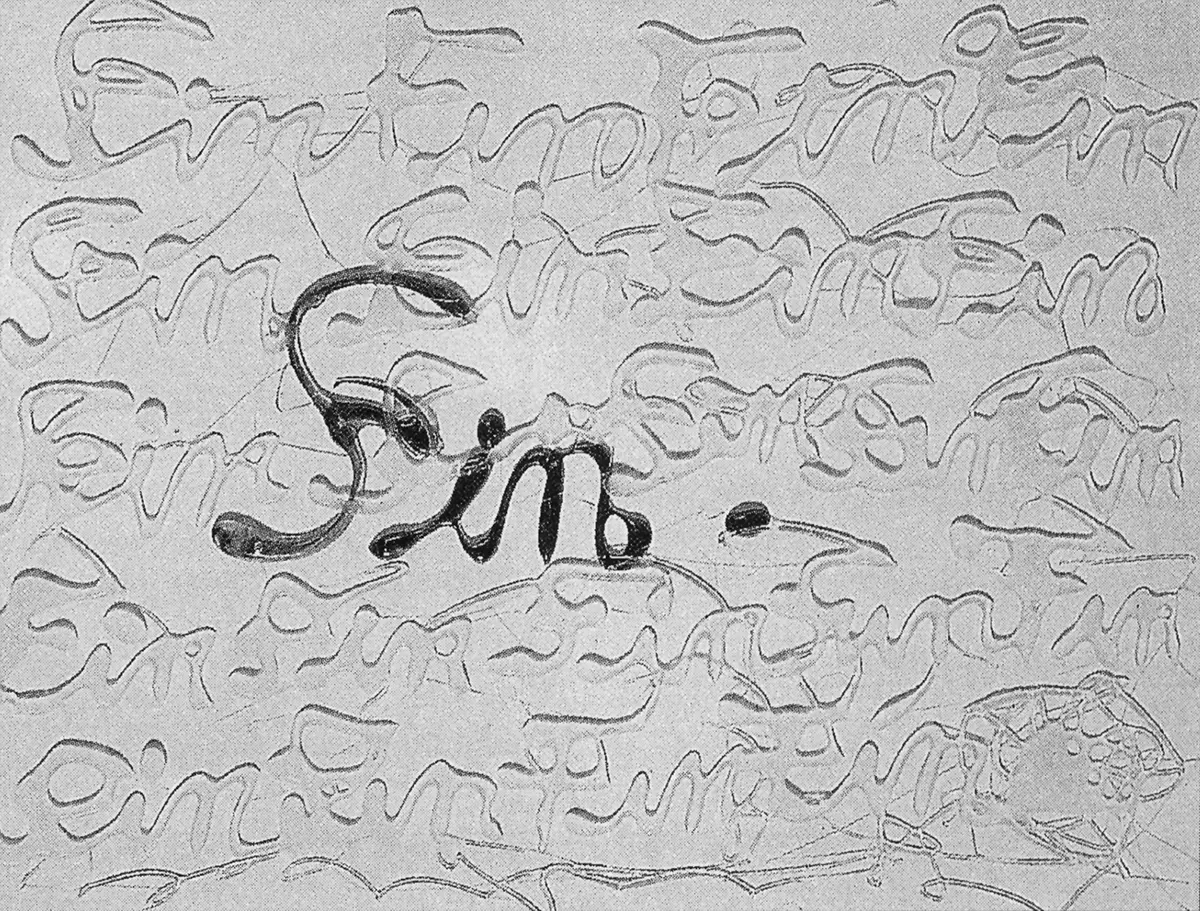
The technique used in the works on show is similar in all cases, although the disciplines vary. In some cases, as in the reliefs, reference to the flat surface is maintained, while in others, there is a clear emergence of the work in space, as in her objects and installations.
The text-textiles of Warck-Meister evoke a typically feminine activity, intimate and domestic. But the connotations go well beyond a gender-based art and address essential questions affecting all human beings, such as the confluence, in many of her actions, of the construction-deconstruction theme. The shift from one term to the other, which is sometimes imperceptible —through weaving which is unwoven and then begun again— provided the thematic axis of the show.
Warck-Meister has chosen the spider's web as the archetypal image of the construction-deconstruction theme because it embodies a primal instinct. The spider does not have to learn how to weave its web, although the act of doing so may be adapted to different circumstances. But although the spider is able to construct naturally, the abode that it builds can easily be destroyed. Similarly, for the creature which falls into its soft and seductive trap, the web is a space of annihilation.
Like the roses, thorns, and cards of her previous series, the spider's web is the site of a drama: it is the fragile habitat of a living creature and the shroud of the other which is caught in the web. It is a twofold symbol of attraction and repulsion, pleasure and pain. That is why the (repulsive) body of the spider comes to adopt the (attractive) shape of a heart.
Like the spider, Warck-Meister creates each of her pieces with patience. This is because the showing of time is essential to her aesthetic objectives. It would be impossible for her to devise the work and entrust others with its production. It is essential to her purpose to show the process of maturity of an idea, and its gestation over a period of days. This time is always subjectivized, modulated by moods, emotions, and the concerns of the moment, by love and hate, success and frustration, all of which are subjective variants that, in different degrees of intensity, have left their marks on the various stages of her work. While some pieces may be dominated by black or white, in others color provides a note of greater vitality. These are subtle signs that we too, with patience, can learn to decipher.
In this show, Warck-Meister has confirmed once again her interest in direct communication with the observer. It is not by chance that, in speaking of the vulnerability of human beings in the contemporary world, she chooses emblematic elements of great evocative power. Before it was the rose, now the spider's web, the symbol of our latent fears. The emotion and sensibility which seem to lie just below the surface of these works act as a caution against excessive intellectualization. By means of the direct communicability of her work, the artist invites us to draw our own conclusions. In this way, the aesthetic dimension becomes inevitably fused, in its poetics, with that of ethics.
ELENA OLIVERAS