
Heidegger said that "only what is conceived in the mind is actually seen, but that what is conceived is what is invented." The observation is revealing, especially when applied to the process of historical narration, i.e. the interpretation of historical facts. At a time when people had to rely on verbal descriptions of events and on what someone had seen in certain places, the period between what happened, what was seen, and what was narrated gave rise to the most unlikely fiction being taken as historical truth. As a result, we now have available to us such magnificent narratives (a fusion of historical testimony and literary invention) as the account of Fray Gaspar de Carvajal of the first-ever navigation of the Amazon, undertaken by the expedition of Francisco de Orellana.
This narrative was the ideal argument for the artists Sergio Vega and Miguel Ángel Ríos, who based their exhibitions on these facts. Ríos and Vega took the approximate chronology of Orellana's journey along the Amazon, between 1541 and 1542, combining, like Carvajal himself almost 500 years ago, history with personal fantasies and with our contemporary and collective imagination.
Orellana was under the orders of Gonzalo Pizarro (brother of Francisco), whose expedition lost its way near Quito. In an attempt to provide assistance, Orellana went downriver with a group of soldiers. However, the current inevitably swept Orellana and his men towards one of the tributaries of the world's biggest river, resulting in a journey which would last approximately one year. Carvajal's narrative is famous for having introduced to the fantasy-loving minds of Europe the myth of the Amazonian women (hence the name of the river), the sirens, and other extraordinary creatures which, according to Carvajal, the Spaniards found during their journey.
In this exhibition, the historical facts provided a framework for the works, but with the events being subject to a process of adaptation or contemporary footnotes. While Ríos and Vega reconstructed the details of the river's geography through the combination of a series of branches painted blue, another installation titled Cosmic Bites (referring to the fact that the conquistadores were constantly besieged by mosquitoes throughout their journey) showed a skin-colored wall in which a series of red dots were used to mark out various historical events, including of a contemporary or recent nature, referring to politics, the economy, and sports.
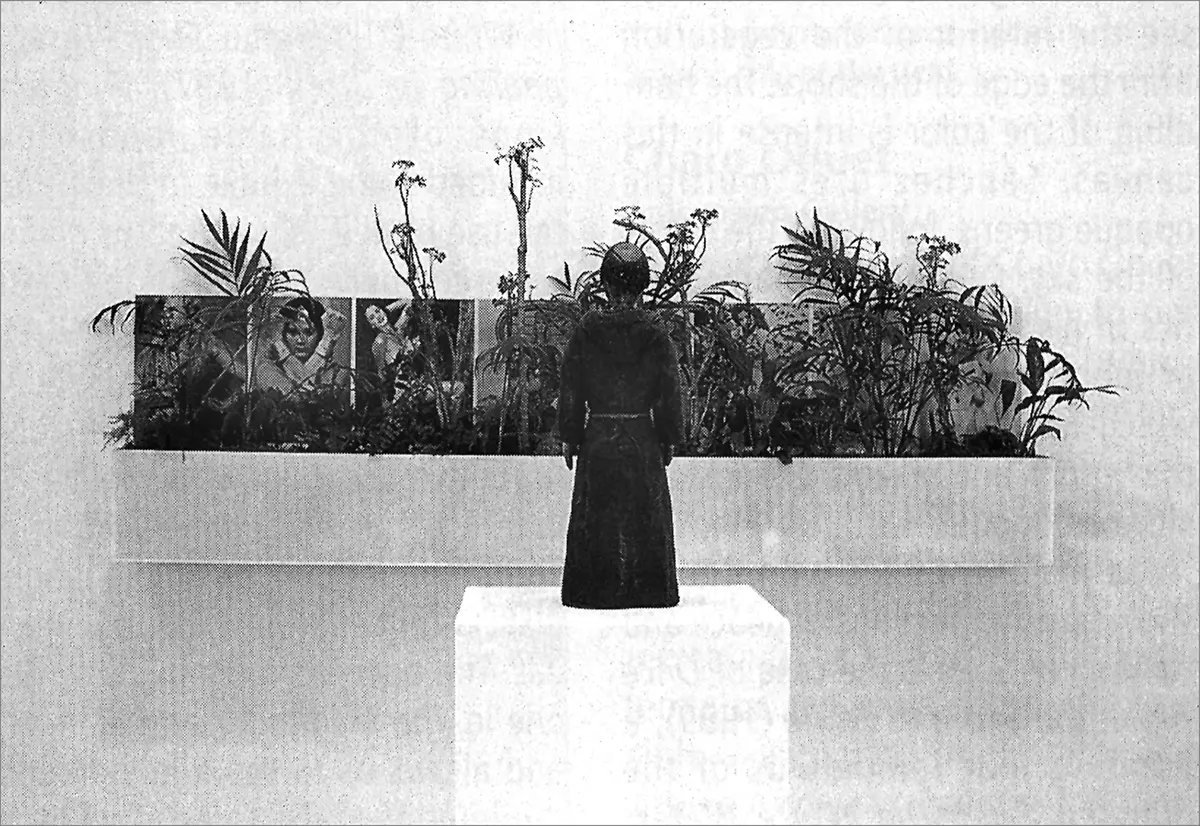
Ríos and Vega opted for a combination of objective historical fact and a refusal to take themselves too seriously, thereby creating a deliberately playful tone that offsets the solemnity of the epic history which formed their starting point. The clash between historiographical objectivity and the caricatural updating of events was evident in The Big Cobra, which consisted of a plexiglass box, the surface of which was decorated with a chronology of Orellana's journey, and with a snakeskin inside, the head of which was replaced with a ceramic cup bearing the effigy of Betty Boop. Another example was the humoristic Amazing Amazonas, which included another effigy —in the style of some sacred object from a church— of Fray Gaspar de Carvajal looking with astonishment at a plexiglass box with plants and photographs of women who might now be considered our contemporary Amazonians (Linda Carter as Wonder Woman, or Daryl Hannah as the mermaid from Splash) —history contemplating the continuity of the Amazonian myth.
Then, in a series of crudely executed drawings by Ríos, the artists themselves became travelers as the historical periods fused, with Orellana being shown in the middle of a river with a portable telephone in one hand, communicating with artists. In general, Vega and Ríos seemed to establish a kind of dialogue between themselves, as if they were narrating the events of history to each other —like Beavis and Buthead making ironic comments on a serious film, but whose sharp remarks cut deep into our collective unconscious and make us think about our own contemporary myths.
In a sense, one could not have wished for a better story to distort, adapt and refurbish. As Heidegger's remark seems to suggest, in the final analysis history can never be separated from the series of subjective narratives and the projection of our own anguish and desires which, depending on the validity bestowed on them by society, may end up being accepted as truths. This exhibition was refreshing, in the sense that it dealt with a subject which in many cases has been made into a myth and metaphor, or politicized in excessively self-satisfied and romantic ways. Ríos and Vega make us realize that history is not only a means for understanding history itself, but for examining and understanding ourselves.
PABLO HELGUERA