
Despite his brief career, Oskar Salamanca has revealed his firm belief in painting. We all know that it is not easy to paint today. But we also know that for the painter there is only one option: his or her primordial commitment to the medium, a complete and total immersion in pictorial specificity and its semantic possibilities. With these assets in hand, Salamanca has embarked upon his pictorial adventure, speaking in his own voice and with contemporary relevance.
The first thing that captures our attention in his paintings is their physical presence. Salamanca discovers the right information about his pictorial elements, in both his small format works and the larger or more irregular-shaped pieces. In the small works, drawing predominates over spaces sensitized with the presence of subtle chromatic contrasts. In the larger format works, whether circular, oval, or triangular, the images are linked in free and unusual ways, with the artist establishing a continuous and organic 'relationship between forms and space. Everything is done through careful use of drawing, color, and the proper saturation of pigments to create rich surfaces that highlight the pictorial space.
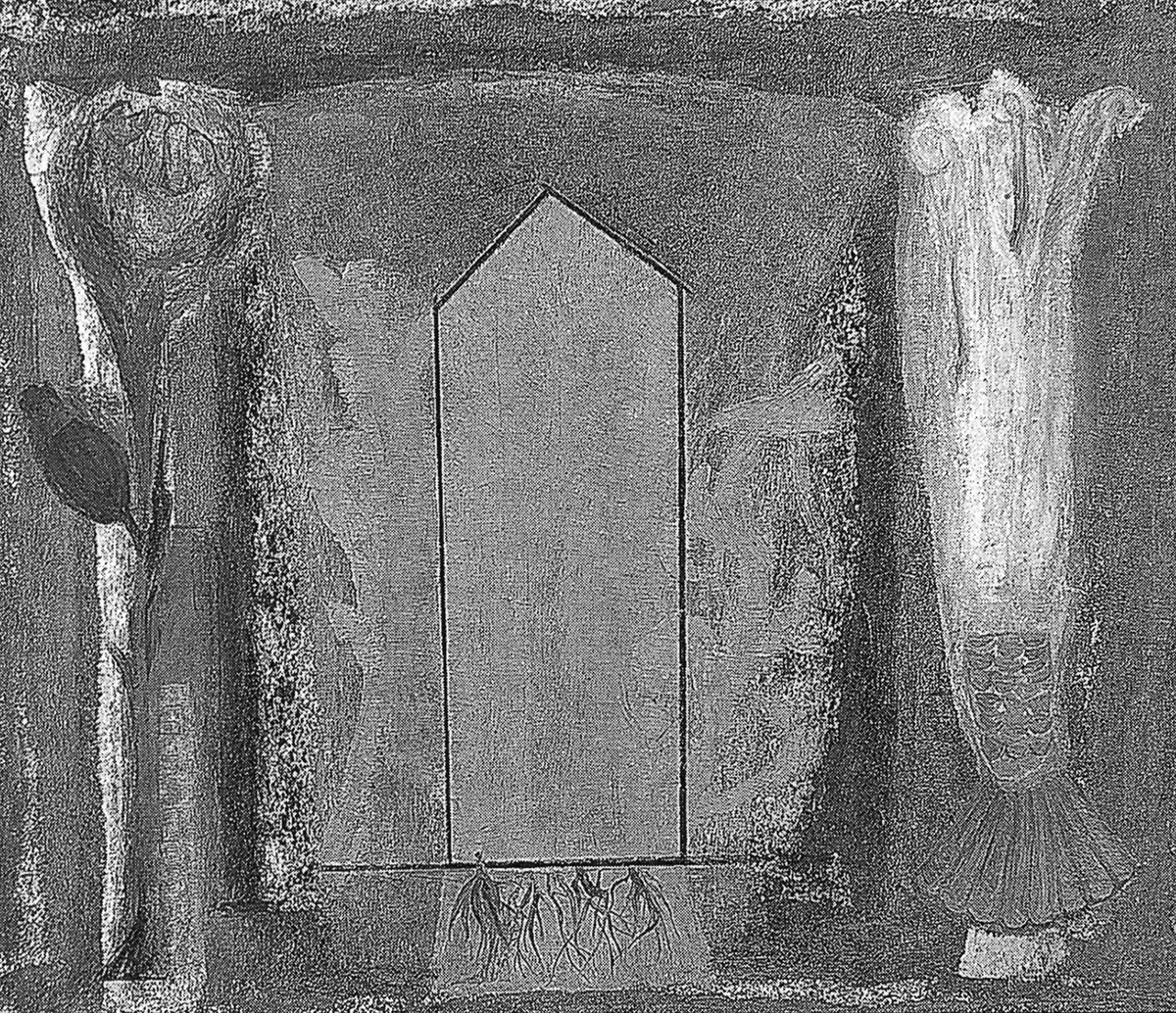
The series of paintings titled Internal Landscape evokes an intimate and psychological state in which Salamanca proposes an open-ended and evocative visual discourse. Using a very personal pictorial repertoire, the artist conjures up a constantly ambiguous space through the free juxtaposition of full forms that are translucent and combined in unusual ways. This allows the artist to avoid adopting a single and direct position in his pictures and encourages readings that are suggestive, based on changing poetics that transgresses the image.
Indeed, there are no precise or pre-determined meanings in Salamanca's paintings. His images referring to the relationship between culture and nature constitute personal mythologies based on fragments of the body, organic elements, and archeological vestiges. In this way, Salamanca creates visual metaphors that evoke profound memories where no dominant categories exist. The combination of human, vegetable, and solid material elements results in an enigmatic sense of poetry.
There is thus a certain opacity in Salamanca's pictures. The constantly elusive nature of his visual constructions creates an intimate and psychological kind of painting that encourages contemplation and reflection beyond the conscious and subliminal levels. As in much contemporary art, Salamanca proposes complex paintings that make the spectator look more carefully. In fact, nothing is resolved in these pictures, which are authentic visual puzzles based on a strategy of fragmented pictorial space and time. Salamanca is aware that good painting should stimulate thought, with special attention accorded to memory and purely visual elements.
RAÚL CRISTANCHO