
Writing on the 48th Venice Biennial, the critic of The International Herald Tribune unintentionally, but correctly, described the general tendency: "The works of both artists would be perfect decorations for public gardens and other open civic spaces. On the less serious side, there are some amusing tricks." The tricks to which he refers correspond to a work by the Russian artists Komar and Melamid that includes photos taken by a chimpanzee after it was taught to use a camera.1
The critic thus describes the dominant frivolity. However, it must be stated that the Venice Biennial is still alive and, although this is the last one of the century, we cannot speak of the death of the biennial. This fact is a small miracle performed by Harald Szeemann, a mythical curator on the contemporary art scene. Szeemann is the organizer of a series of memorable shows, among them Documenta 5 (1972) which went down in history as the most important of its ten editions and as an example of the fact that it is possible to use the curatorial activity as a form of artistic expression. This biennial does not possess the hierarchy of Szeemann's best exhibitions, but considering that he only had four months to prepare it and that the national shows are out of his control, the result is remarkable.
The art in this exhibition is not extraordinary—there is a tone of lightness and playfulness in the majority of the things which winds up being irritating—but unlike other editions of the biennial, this time the selection does not seem to be at the service of the galleries. The art displayed is impressive as a well-chosen profile of what is currently being done. If anyone is to blame it is the artists themselves.
This does not mean that Szeemann has decided on absolute objectivity. There is a series of small homages to artists who have recently died and who had been supported by him several decades ago (Dieter Roth, James Lee Byars, Mario Schifano, Martin Kippenberger, and others).
There are recoveries of forgotten, yet active, artists like the musician Max Neuhaus, who creates spaces with sounds. And there is personal dazzle, like his discovery of China as a prolific source of contemporary art, even though this stopped being a secret several years ago. China is the country, after the USA, with the most artists participating in the show Dappertutto (the USA has 25, China 16, then Germany with 13, and Italy with 11), which is Szeemann's private selection.2
The old "Aperto" section, created by Szeemann himself in conjunction with Achille Bonito Oliva in 1980, was a space reserved for young artists. It was an attempt to make them independent of the national and politicized circuits that dominated the pavilions of Venice. The director of the last biennial, Germano Celant, canceled the section. Szeemann reintroduced it this time, enlarged and without the age limit. In a play on words, the name went from meaning "open" to something that could roughly be translated as "all-inclusive." The immense Italian pavilion was "confiscated" in order to accommodate even more artists in this section. The Italian national pavilion was declared "virtual" and the Italian artists were distributed within the Dappertutto show. Small signs placed everywhere that an Italian artist's work was displayed explained this fact. The inevitable chauvinistic protests were placated with the prize for "best national show." The most virtual pavilion, however, was Bulgaria's and not Italy's. In a card created by Nedko Solakov indicated in the catalog as a work of art and distributed throughout the biennial, Bulgaria announced that after an absence of thirty years, "it will participate adequately in the biennial that will take place in the year 2001."
Apart from the possible deliberations on the quality of the art shown in Dappertutto, it is the first time that in the biennial a change of emphasis may clearly be detected. This biennial is no longer an accumulation of national exhibitions with supplemental shows. Dappertutto is a biennial in a way that makes it more similar to the rest of the biennials organized today (and to Documenta itself). The national shows take on an air of folkloric appendix, not necessarily lacking interest, and at times complementing the principal show. There are common themes, techniques, and ideas that are spread out in this biennial beyond borders that are no longer national, but curatorial. The apparent need for the spectacular nature, for a focus on the ludic or joke element, for the consummation of the work through a fleeting glimpse, and even the use of video, robots, watches, and multicolor powders, all form a fabric of continuity throughout the entire show.
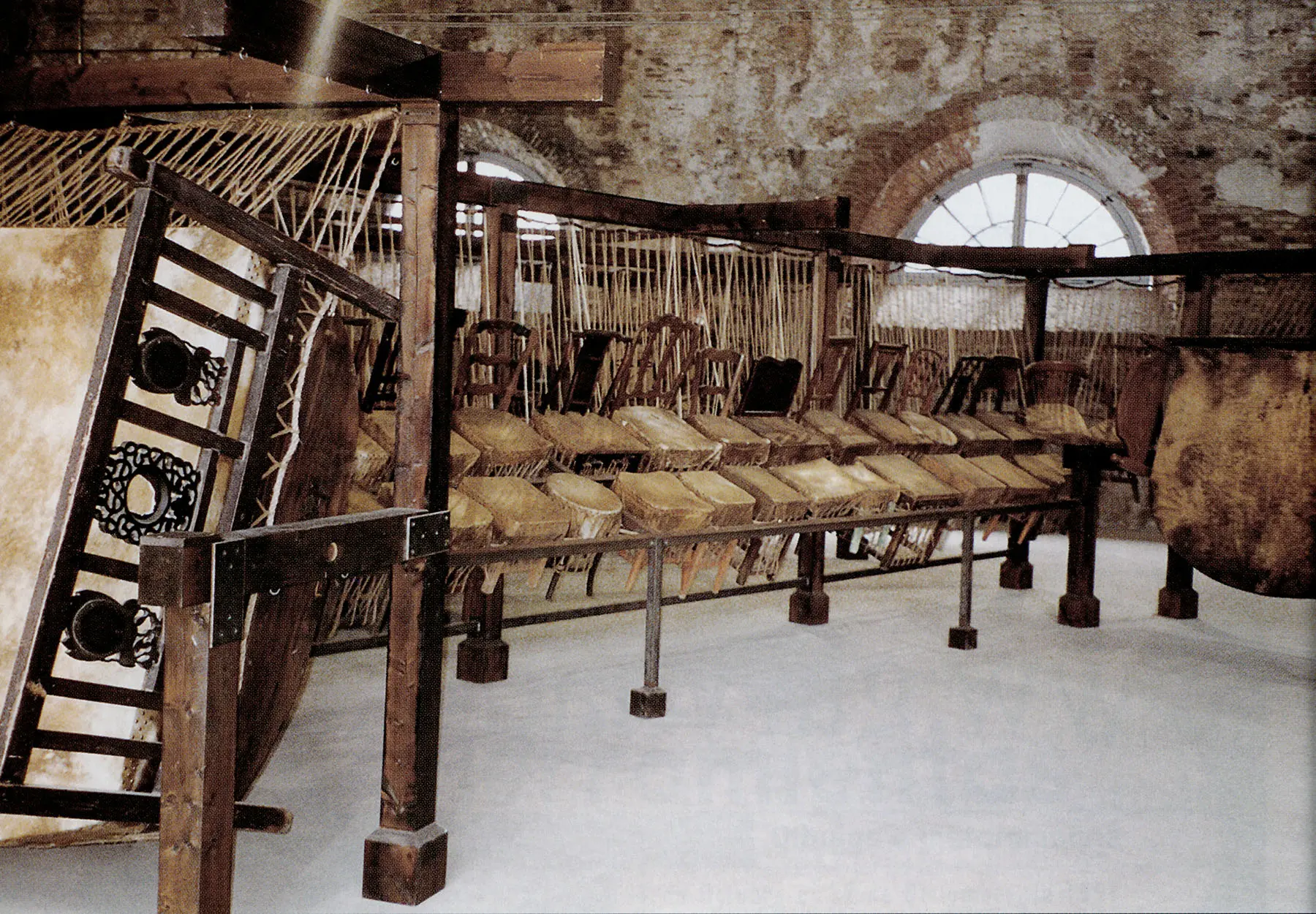
Having explained all these coordinates, the most impressive piece is the installation by the Chinese artist Chen Zhen. It consists of an enormous accumulation of beds (5) and chairs (100) that, instead of pillows and mattresses, have taught leather and thus act as drum surfaces. The viewers have access to sticks (essentially police machetes) in order to beat the surface to their pleasure, creating a racket that can be heard from quite a distance. The title of the piece is Jue Chang (50 bangs on each one), referring to different uses of the blows in the Chinese Buddhist tradition.3
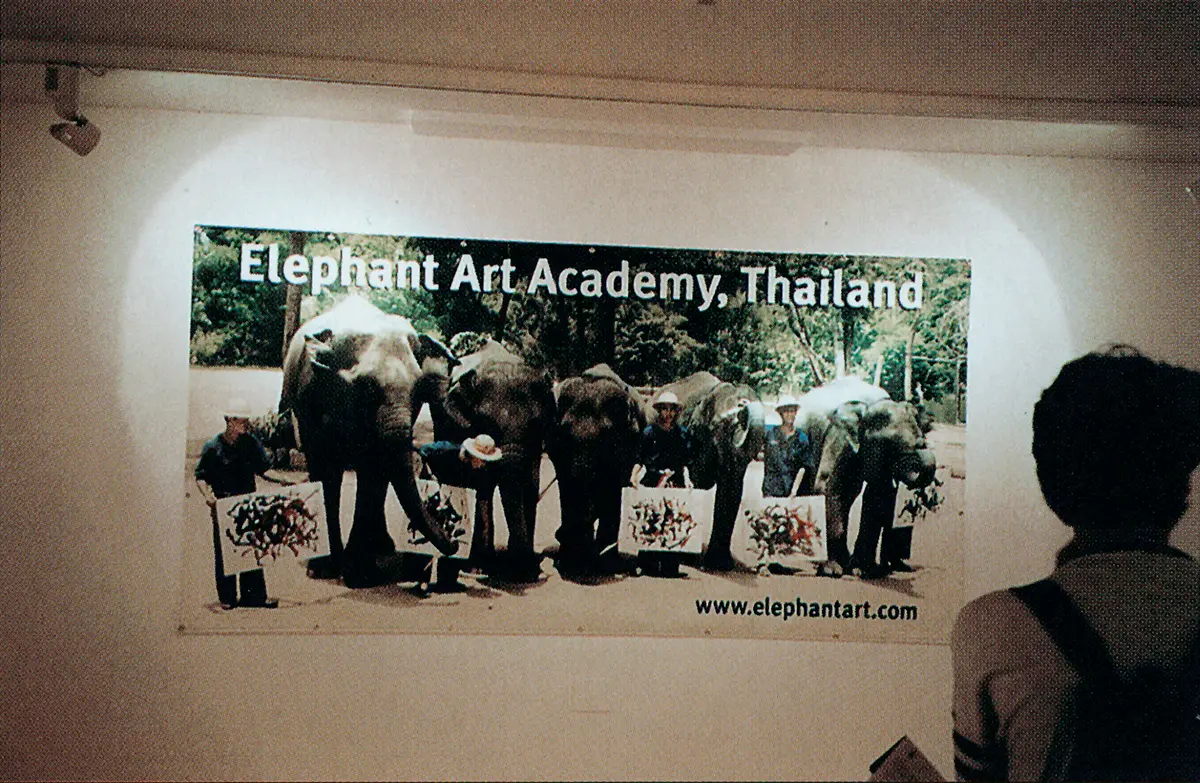
Almost on the extreme opposite is the work of Komar and Melamid in the Russian pavilion. Aside from the chimpanzee's photos, they also display paintings made by an elephant in Toledo in 1995. The experience, it is announced in the show, led them to found two art academies for elephants in Thailand. Equidistant from these two extremes is the work of the Colombian Fernando Arias, effective through simplicity and concision: a collection for the composition of an aria for Colombia. The donation box, two weeks from the inauguration, contained around forty dollars. Considering that at the moment of this writing the biennial will continue for another four months, it is possible that sufficient funds will be collected for an entire opera.
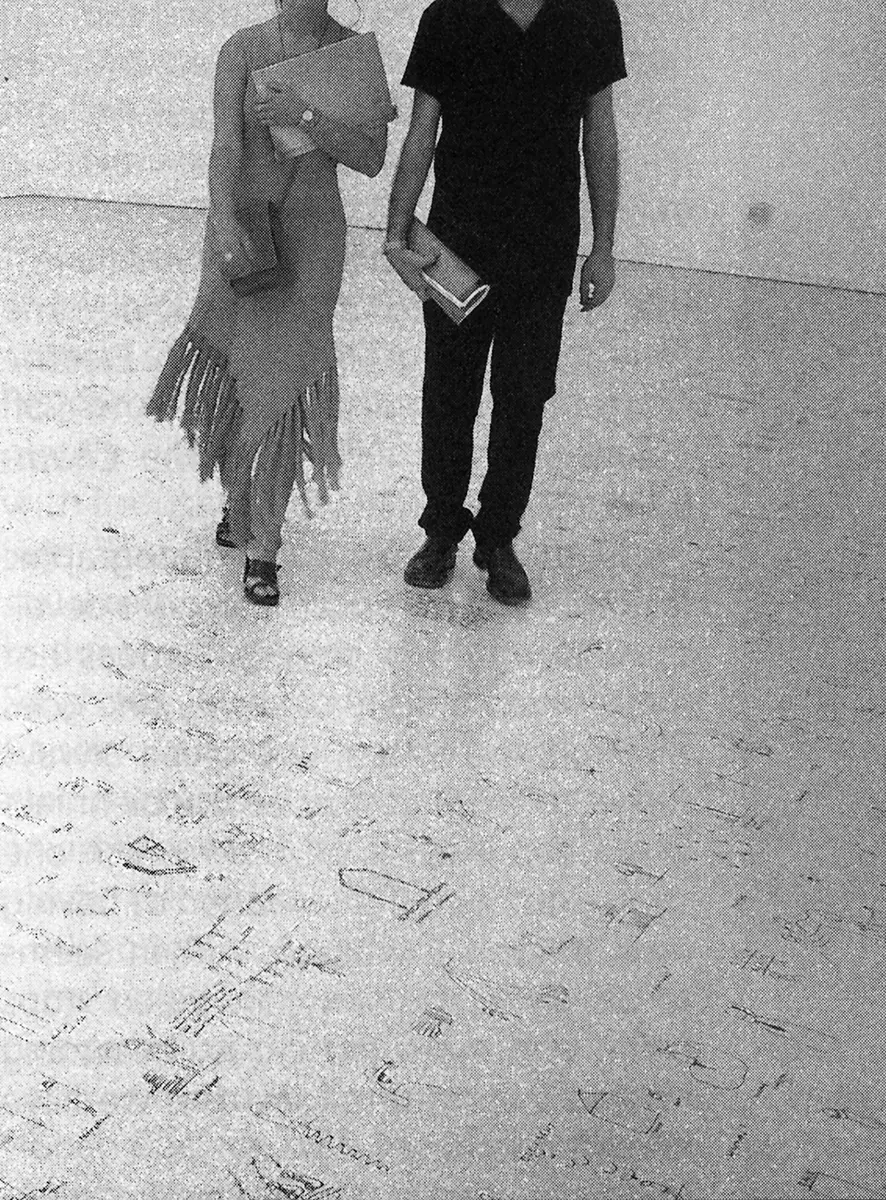
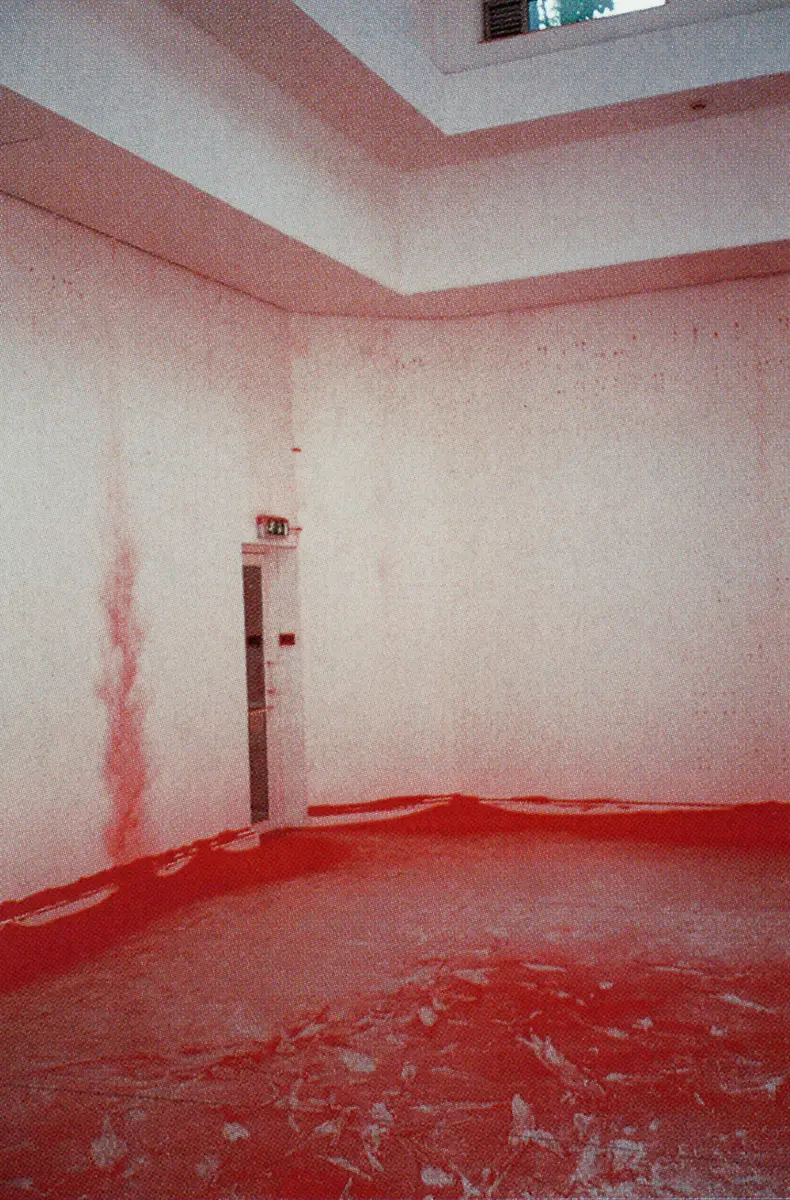
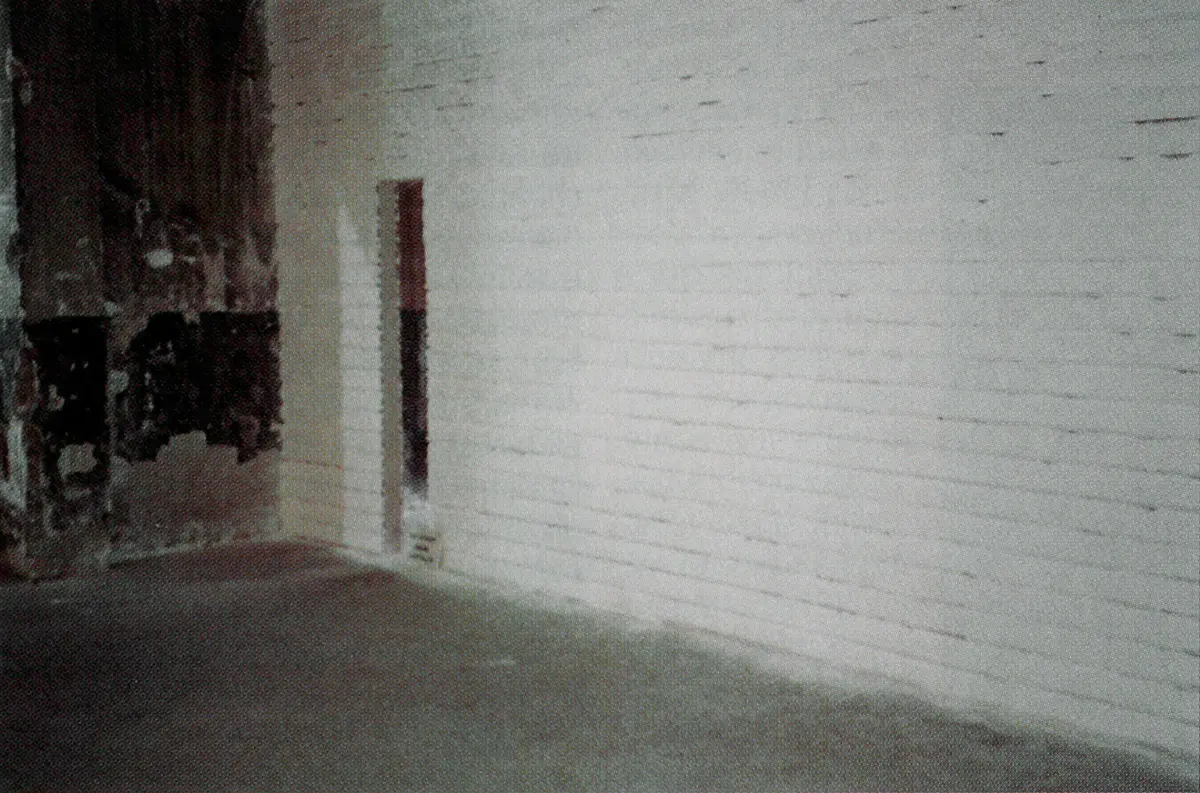
The use of various pigments linked the American Ann Hamilton, the German Wolfgang Laib, and the Dutch Job Koelewijn. Hamilton, representing the USA, installed a mechanism in the open air that allows a red pigment to trail down the length of the walls. The piece would be effective if it had limited itself to that. The viewers walk and write on the pigment that remains on the floor, and the space fills with a certain mystery. The problem is that Hamilton seems to have been afraid of holding something back. She filled the walls with Braille texts that stand out with the pigment that remains attached to the relief, she put on a soundtrack of some poems, and she separated the pavilion from the rest of the gardens with a textured glass screen. The glass does not hide the Greek temple that serves as the USA's pavilion, but at least it doodles over it. The catalog's introduction discusses the difficulty of using the space of the building, inspired by the architecture of Jefferson. But it explains that Hamilton was influenced "by the values of clarity, order, and individual freedom inside the social democratic space that Jefferson articulated." More modest and clear is Laib's work: a rectangle of yellow pollen on the floor creates a blinding intensity. And even more stirring, this time because unexpected, is Koelewijn's piece Talcum Powder Wall (1998). It consists of a platform wall that has as its only immediate distinction a strong perfumed aroma. It is only after a more detailed observation that one discovers that the planks are no such thing, but rather are molded in talcum powder that slowly disintegrates in order to accumulate on the floor.
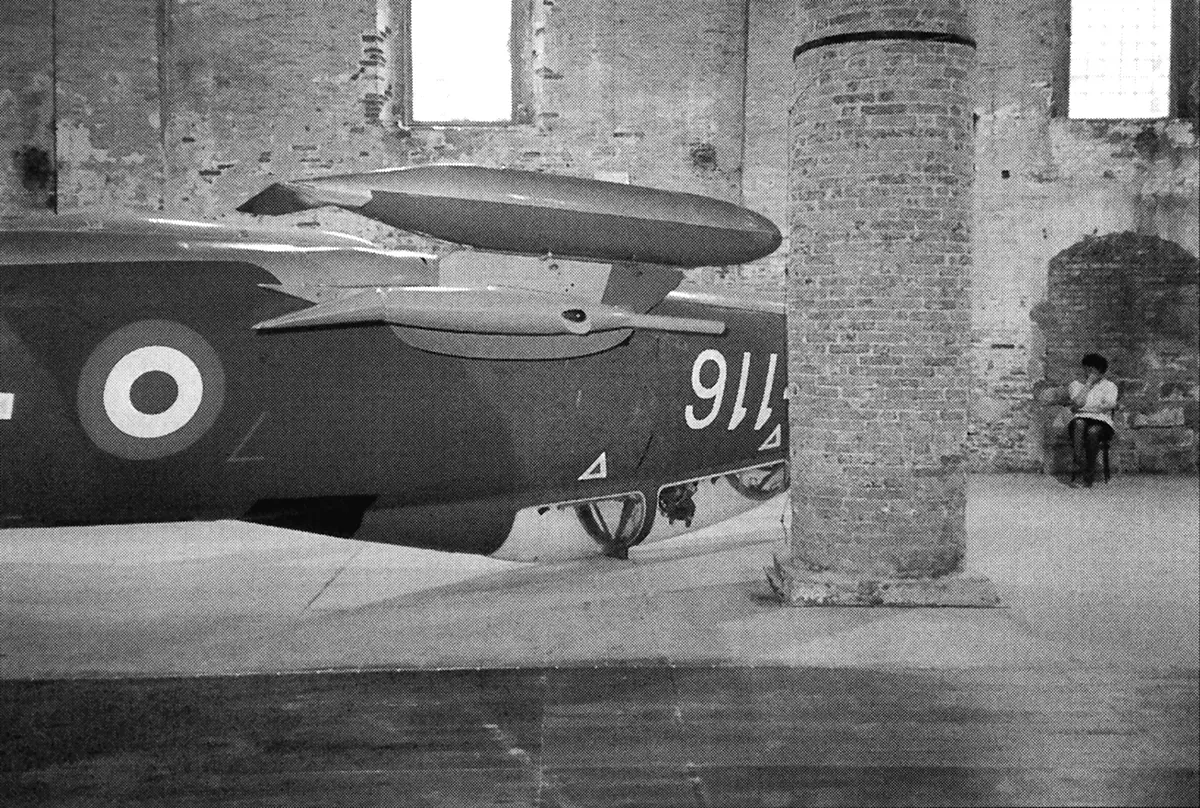
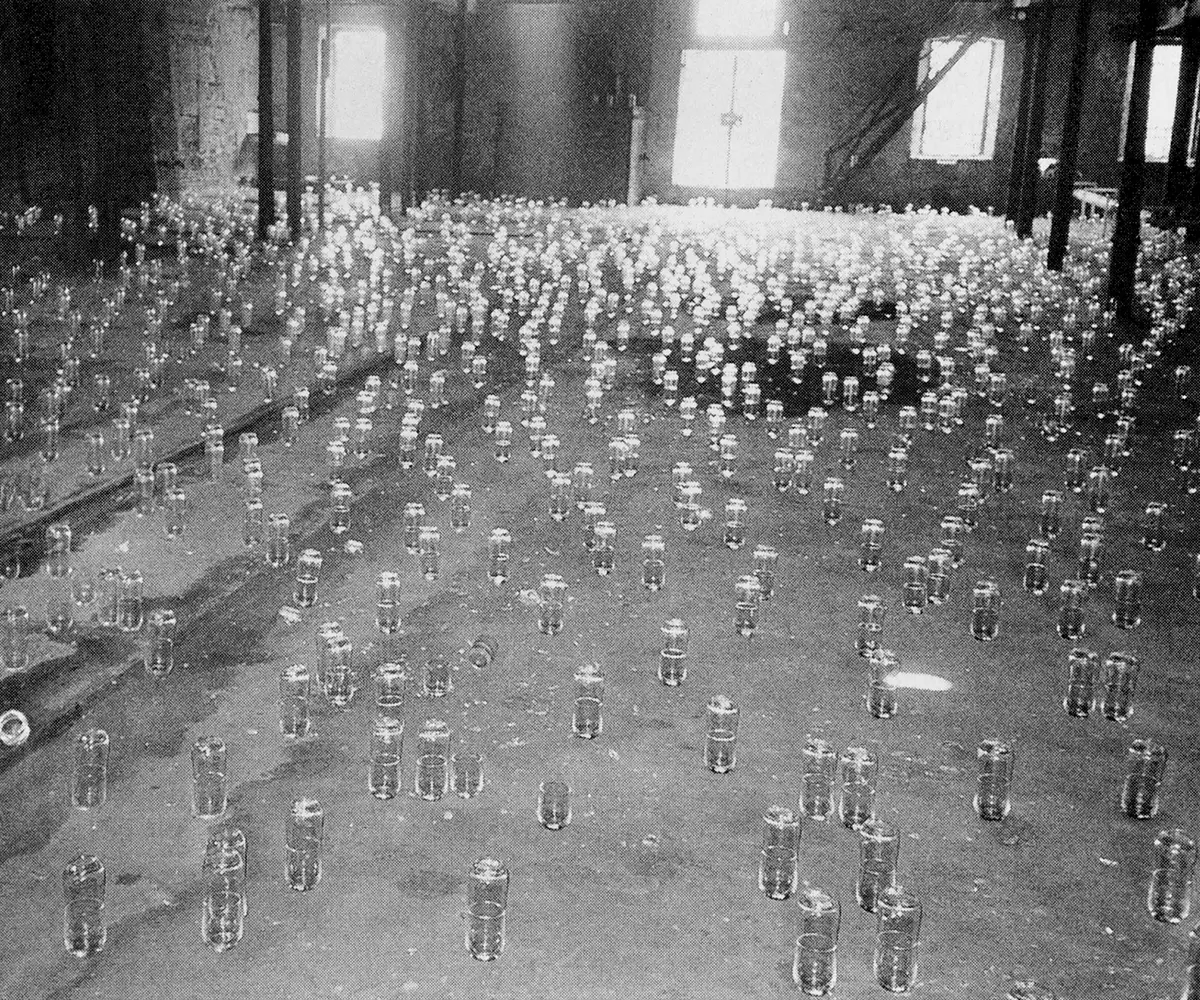
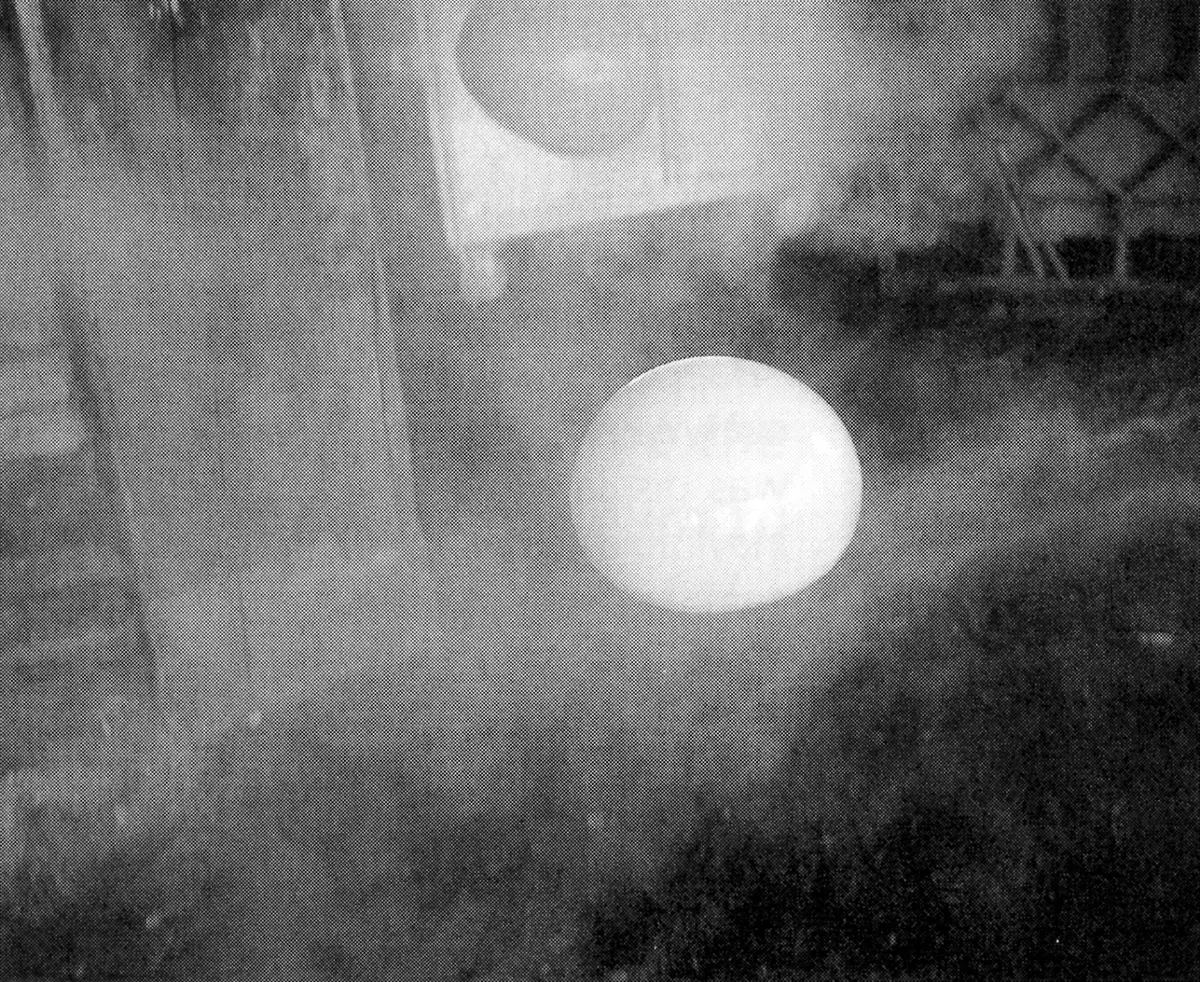
One of the things left unresolved in many of the works is the balance between the production scale and the idea that supports it. A lot of visual fireworks are based on an idea that is too small or passing, with the hope that the huge scale would compensate for what it lacks in the complexity of its conception. Paola Pivi (Italy) places an Italian WWII airplane, belly-up, in the middle of the Corderie dell'Arsenale (Aerial, 1999). The image creates an impact, but it wears out after the first second. The same thing occurred with the Bulgarian artist Serge Spitzer who, with his Reality Model-Re/cycle (don't hold your breath) (1999), covered all the important surfaces of one of the deposits of the Arsenal with glasses. The play of lights, mixed with the atmosphere of fragility, is pleasing, modestly dramatic, and, in sum, exaggeratedly grand and superficial. Anne Veronica Janssen filled the Belgian pavilion with artificial fog. The phantasmagoric sensation is interesting, but not necessarily stronger than what one feels in the middle of a true fog. The Swiss Pipilotti Rist, probably understanding the heart of the matter, presented a machine that blows enormous soap bubbles. Thanks to a special mix of oil and steam, the bubbles come out the size of soccer balls and are white instead of transparent. The hypnotic machine shoots its product every three minutes, and some of the bubbles lead into the sea where they disappear in a puff of smoke. The title is Nothing.
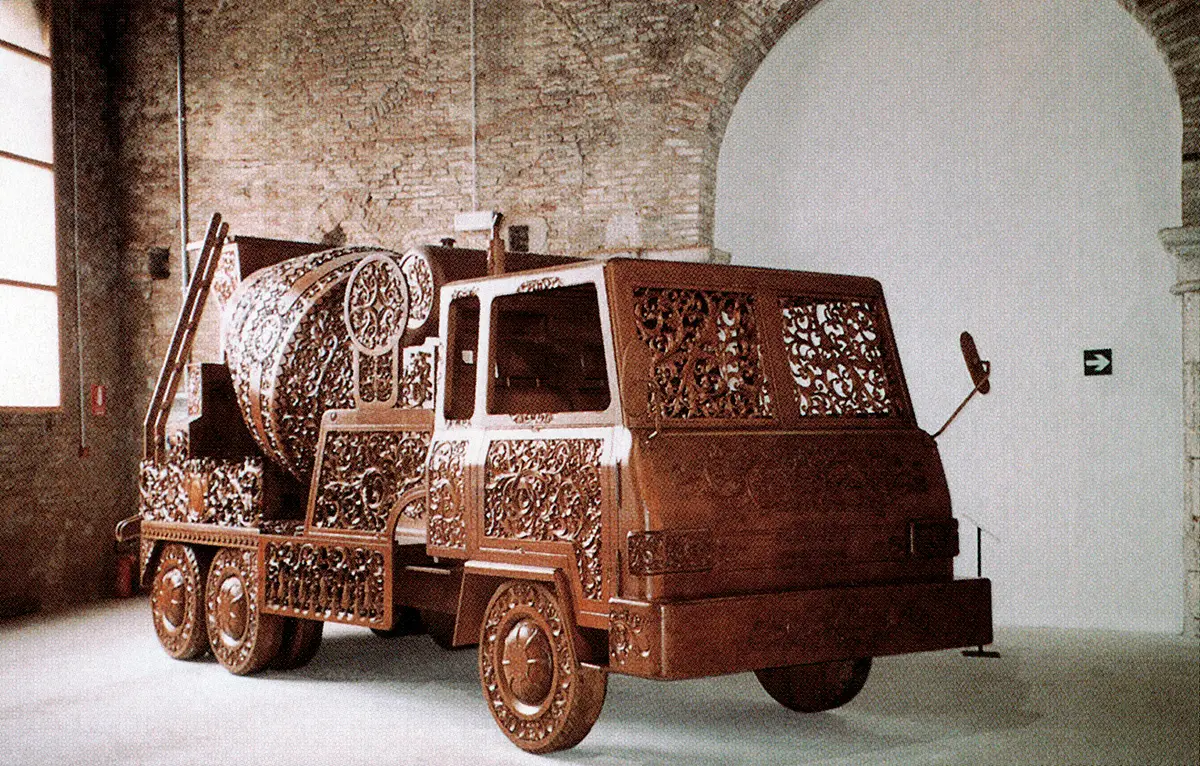
In many cases, the works demand a time for contemplation that the viewer may or may not be willing to grant. Jason Rhoades's and Paul McCarthy's gargantuan work, Proposition (1999), in spite of some interesting parts, oversteps the limit. The Belgian Wim Delvoye's cement truck, on the other hand, makes the public continuously circulate, searching for new details. Carved to scale in wood by Thai craftsmen, its surface is completely and absurdly decorated.
The question of the viewer's use of time is particularly notable in many pieces that employ video. There are videos that work as a secondary stage design for other things; there are videos that aspire to be cinema; and, in general, few of these works are adapted to the temporal perception dictated by a show like this biennial. The viewer immediately tries to guess if there is a narrative thread to follow in order to be able to decide whether or not to stay. Some pieces are realized while the viewer circulates. In an installation with several screens by the team of Mauricio Dias (Brazil) and Walter Riedweg (Switzerland) on daily life (Tutti Vereziani, 1999), the most effective part is the projection on the floor of people who seem to be walking under the viewer visiting the show. Other videos consist of small "gags," as is the case with the Scottish Roderick Buchanan and the Spaniard Antoni Abad. In Sodastream (1995), Buchanan limits himself to showing how soda bottles, which he allows to fall rhythmically, explode against the floor. In his Historia de amor (History of Love, 1998), Abad shows mice eating a heart-shaped cracker covered with red jam and the word "love." These are light pieces that do not surpass the smile, but at least they provoke it.
Some artists tried to go much further. Two stand out among them: the American Doug Aitken with Electric Earth (1999) and the Swiss Ann-Sofi Sidén with her Who Told the Chambermaid (1998).
Aitken assembles a cinematographic history through evocative images developed on multiple screens. It does not matter how quickly or slowly one goes through the space, the piece always seems to work. It may be the biennial's only video installation from which one comes out with the sensation of having seen a good exhibition. Aitken seems to discern a future where the video stops being one more technique, becoming instead a substitute for art as we have known it to date.
Sidén is more subversive and manipulating. Just after seeing her work, one begins to remember that TV monitors, like the ones used for surveillance, were seen distributed throughout the Italian pavilion. They were anonymous, with no artistic indication, but they showed spaces that somehow did not correspond. When the viewer arrives at the, let's say, the center of Sidén's installation, more monitors (15) are found on shelves with towels and other accessories that the chambermaid uses to tidy up the rooms. Presumably in her spare time both she and we can spy on what goes on in the rooms of the hypothetical hotel. Each screen alludes to the interaction of people, nothing concrete, everything suggestive and fascinating, at times with semi-hermetic references (a couple playing chess, the woman is naked, as in Marcel Duchamp's famous game). The viewer tries to follow the dissimilar lives that are simultaneously developed in the entire building, aware that this is an illegal, impossible, and futile undertaking, but one charged with enough mystery that we continue to watch.
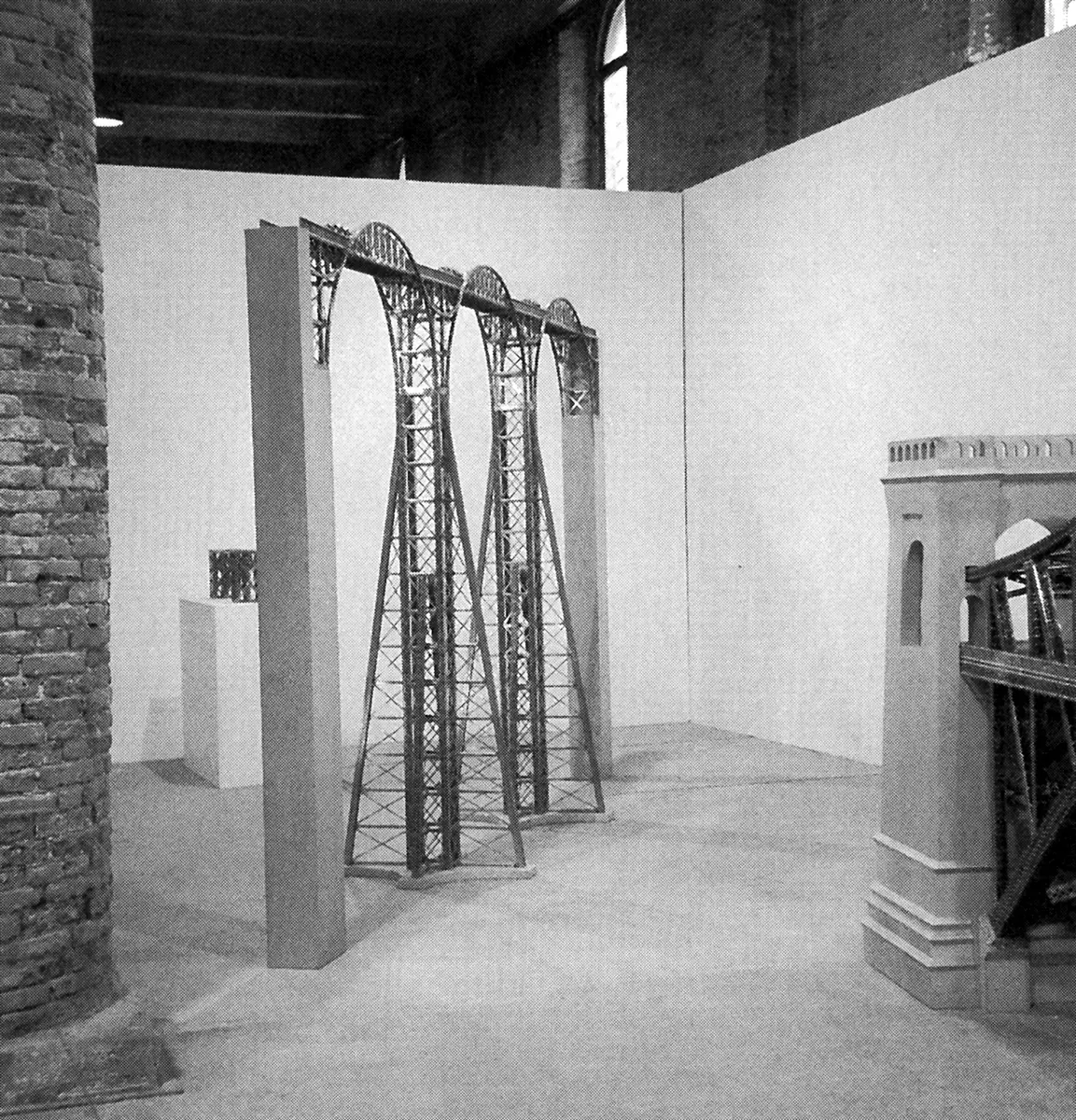
Games and humor continue throughout the rest of the biennial. Slovakia offers "lasting and gratuitous art." Petra Hamákóva and Alexandra Kusá set up a tattoo parlor. The designs of various artists shown in the hall and the labor involved are totally gratuitous. The only condition is that the result be documented in a photo that is attached to the chosen design. The most interesting tattoo project, although without customers up to that date, is one by Marco Blazo. It consists of a replica of the spots on Gorbachev's forehead. In a style somewhere between tattoo and comic strip, Rumania shows Dan Perjoschi, who on this occasion completely filled the floor of his pavilion with thousands of small cartoon drawings. The American Chris Burden constructed enormous and beautiful bridges with games by Meccano. And Sarah Sze, also from the USA, with her Capricious Invention of Prisons (1999), manufactures labyrinthine and tenuous environments with games and small plastic discarded cards.

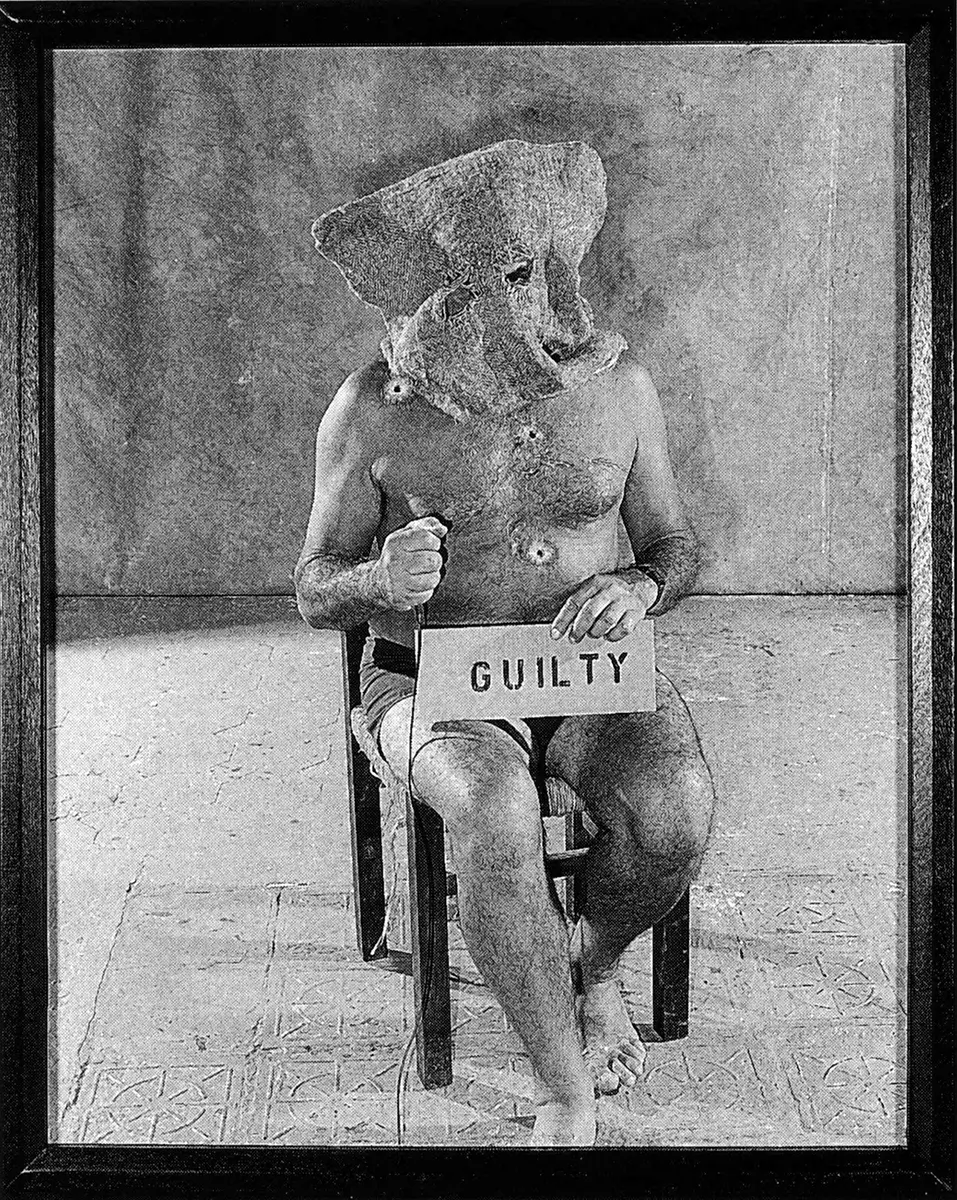
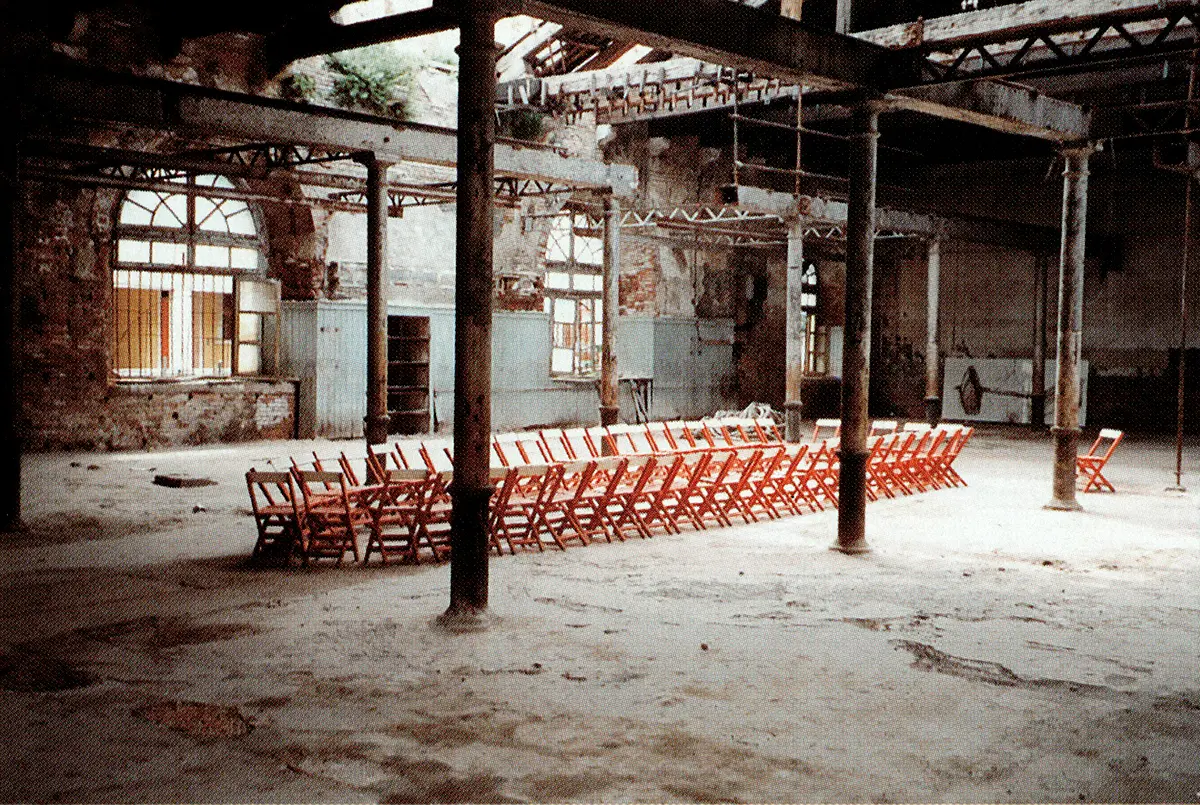
Although not many, there are also some serious concerns. The pavilion has two participations directly related to the crisis in Kosovo. Irene and Christine Hohen Büchler, with the help of the architect Martin Feiersinger, designed Madre/niho(s) (Mother/child[ren]). It consists of a modular room for refugees that allows for adjustments according to the size of the family, and has been studied to be not only a quick and eco; nomic, but also dignified, construction. The collective Wochen Klausur, further removed from aesthetic activity, decided to use its space to promote an education plan for refugees in Macedonia and to solicit funds from the visiting public. The Chinese artist Cai Guo-Qiang dedicated his time at the biennial to manufacture (with a team of sculptors and Chinese craftsmen) a variation on a sculptural group sponsored by Mao Tse Tung's Cultural Revolution: The patio of rent collection. The original work consisted of more than a hundred sculptors, a number that they tried to emulate here. The sculptures, full-scale people, begin to crack as the clay dries up, and the result is interesting and dramatic, but showy. The Argentine Oscar Bony displays the series Culpable/lnocente (Guilty/lnnocent): photos of a prisoner, seated and hooded, with the work itself perforated by real bullets. Kcho worked (once again) with the theme of Cuban balseros, although this time with less success. In an excessively large space, he distributed some of his excellent drawings against the wall and occupied the center of the room with a series of folding chairs that describe the silhouette of a boat.
Zhao Bandi, an artist who lives and works in Beijing, shows a poster that sums up the contradictions of the biennial atmosphere. The image displays the luminous signs of the nightlife of a metropolis, with one sign in neon, stating with supreme irony: "Never forget the class struggle." But the general spirit of this biennial was epitomized in a subtitle of one of the large posters and in the catalog, that accompanies a show of contemporary artists from Albania. In accord with Edi Muka, the curator, they are (and we are) in "The time of ironic optimism."4
NOTES
1. Roderick Conway Morris, “Biennale Celebrates the Local," The International Herald Tribune 12-13 June 1999: 6. The two artists to whom the critic refers are Danae Stratou from Greece and Ricardo Pascale from Uruguay.
2. There are only two Latin Americans, the Cuban Kcho and the Brazilian Mauricio Dias.
3. In case of discord, each part receives fifty blows in order to resolve the conflict, and in prayer, given that the “Buddhist heart" is not accessible through the written or spoken word, whoever wishes to pray must be beaten in order to drive him or her into self-awareness. Jue Chang (Vancouver: Anne Wong Foundation, 1999). This publication accompanies the show.
4. The Biennial runs from 13 June through 7 November 1999. The international prizes went to Doug Aitken, Cai Guo-Qiang, and Shirin Neshat. The prize for the best national participation went to Italy (Monica Bonvicini, Bruna Esposito, Luisa Lambri, Paola Pivi, and Gracia Toderi), and the Golden Lions were awarded to Louise Bourgeois and Bruce Nauman. Honorable mention went to Georges Adeagbo, Eija-Liisa, Katarzyna Kozyra, and Lee Bui.
LUIS CAMNITZER
Uruguayan artist and Professor of Visual Arts at the State University of New York, College at Old Westbury.