
When the men of the artistic avantgarde in Venezuela, in the 1960s, had the opportunity to travel in order to complete their studies and broaden their view of the world, Alirio Palacios (1938) decided to settle in Beijing and study drawing and print-making with old masters. This was between 1961 and 1966. Subsequently, between 1968 and 1974, he studied printmaking in Warsaw. So when Palacios returned to Venezuela in 1975, he brought with him a conception of work and image that was different from that which characterized the art scene in Caracas at the time (kineticism, narrative, or politicized figuration). And so Palacios used drawing to propose other expressive certitudes, focused on man and the violence of nature.
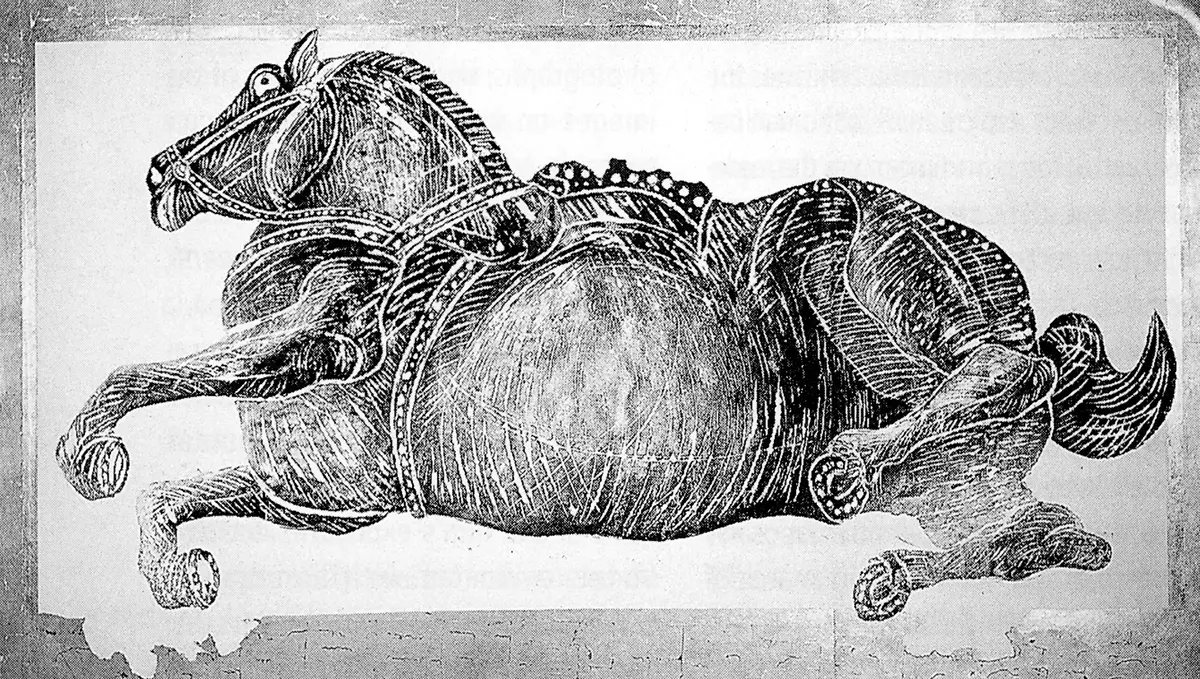
Palacios' work reaffirms and renovates figurative language and expression. His work on paper is systematic, rich, and experimental. His technique combines concepts of drawing, graphic arts, painting, and even collage. His formats are enormous. In 1992 he held an exhibition in the Museum of Fine Arts in Caracas, titled Between the Real and its Signs, which revealed the quality of his craft and the delirium of his imagination, as well as the validity of his pictorial phrasing, at a time when there seemed to be a negation of studio work in Caracas. Now, in the same museum, Palacios has just presented a show titled Xylographs and Concretegraphs, monumental prints on paper, wood, and concrete, consisting of memories and images of a land and a collective consciousness we call Venezuela.
This exhibition reaffirmed the continued validity of Palacios' artistic craft and his creative sense of risk-taking. Both qualities are a single expressive fact for the painter. The wood is a plate, a support for a discourse on painting as well as a unique piece of art, the whole in the process. The engraved wood is taken to extreme situations, based on a simple motif, a vase, a face, or a horse. In these compositions, he adds a parallel detail of a dog or devil, and mysterious elements, with perforations, additions, and parts removed. Thus, each time the result is different and original.
The economy of color that defines the printmaker's intention is at the same time a profusion of expression. The network is open, always different, in establishing the object or figure, where everything ends in fantastic revelation. Palacios exults the tradition and technique of wood printing. Medieval images, tributes to Vermeer, and centuries-old warriors from the imaginary east all make up his repertoire. Perhaps we might see here an opening up of themes with respect to the cultural wealth of Venezuela, the spiritual confluence of our society, and the voracious nature of the artist's native Delta.
By the scale of the formats, the intervention of the wood, the conception of the plate as a pictorial work, the just economy of color, the creation of chromatic nuances based on an imperious black, the limited edition, and now the concrete support as a new kind of expression for printmaking, this exhibition by Alirio Palacios revealed a complete and unequaled printmaking artist.
JUAN CARLOS PALENZUELA