
Eduardo Abaroa (Mexico City, 1968), a founding member of "La Panaderia,1 presented a selection of his work done over the last eight years at the Carrillo Gil Museum in Mexico City in the summer of 1999.2
The installations, video installations, objects, and painting Abaroa presented in this show focused on the textualization of art, a tendency common among contemporary artists. That is to say, the works are more a matter of conceptual and discursive meaning than an aesthetic expression. This discourse is accompanied, in Abaroa's case, by a certain ironic and perverted tone in the intention of his works.
In two video installations, the artist attempted to establish an equivocal interplay of meanings. In Limit (Debut of unknown pastry-making), he tried (albeit rather unsuccessfully) to create a series of images of explosions transmitted on the television screen, and a kind of archaeology/dissection of sliced bread which the artist placed in front of an elegant tray. He holds it in his hand for a while until someone asks him why he is holding the bread. He then rolls it into a ball and puts it onto the tray, as indicated in the technical fiche. Although this work intended to create a sense of disconcertion, both for the spectator looking at the composition, as well as those persons who at the time were intrigued by the sliced bread, the mise en scene was not clear. On the one hand, the confrontation between the video and the sliced bread did not produce much effect. On the other hand, the reading and explanation of the exercise on the technical fiche made any intention it might have had quite obvious. Text, image, and/or contradiction?
In Portable broken obelisk for street markets, which was more successful than the previously described piece, Abaroa designed a monument that could be assembled with plastic canvas and tubes for moveable street markets, which are also assembled on the spot. The intention was obvious: he wanted to mock the solemn use of the obelisk in culture. Although the concept was interesting, the resolution failed, I think, to communicate the discourse. The artist did not seem to fully involve himself in his work with these technical supports and, in general, with the three dimensions and interior volumes that characterize the language of the installation. But at the same time, there was a vital distancing with these kinds of objects, whose cultural referents are more of a social and popular kind, rather than intimate or personal.
The pictorial work, on the other hand, was more successful, closer to something that is characteristic of his aesthetic intention: irony. The polyptych My adventure in Space had a greater clarity of discourse and intent.
It consisted of a series of stories-with scripted by Abaroa and produced by Marco Arce-combining monstrous elements, science fiction, erotic perversion at the intentional level, and a certain kind of narrative characteristic of the comic strip or storyboard. The game established with the spectator has a subtlety that is not generally present in Abaroa's installations: an immediate visual reference to the story through the narrative structure based on the repetition of the pictures and the use of certain representation typologies, both in the figures and the texts. Once this is perceived and seen in detail, the violence and the chaos of these polyptychs become clear. It is interesting to note how the hyperbole of the gestures of pain or pleasure, and even the exaggeration in the depiction of the male and female genitals, produce a kind of attraction-repulsion in the spectator.
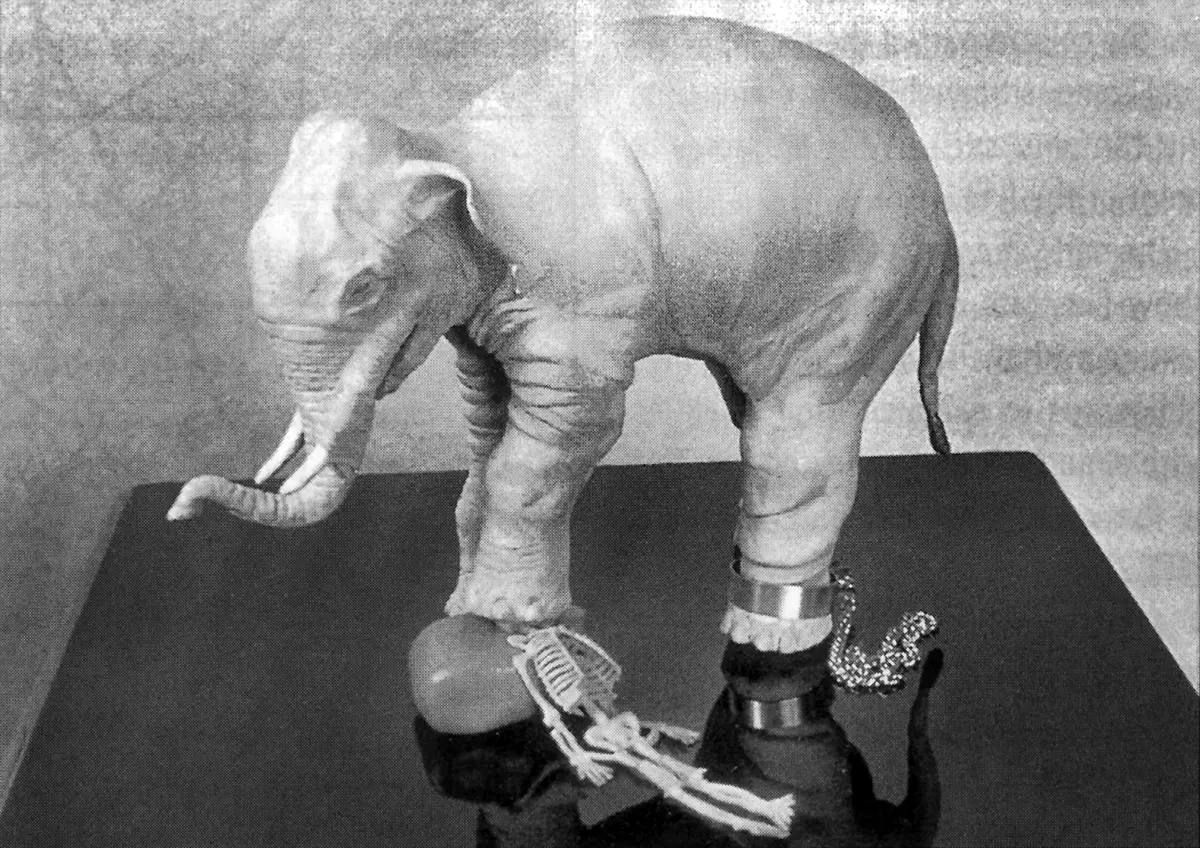
The most successful works were Abaroa's objects. The series Anatomical Pertinence and Little action figures reveal the basis of the artistic discourse: the combination of manual elements, childhood memory constructed through caricature and toys, and the perversions characteristic of children's games. Undoubtedly these series reflect an iconoclastic treatment of memories and memory itself. They seem to take us into the world of toys, where each object is the reply of some fantasy-especially those which deal with the violence of the now classic North American serial killers or children's television programs in Mexico, such as the "Chavo del Ocho." Abaroa does not pass any value judgments on these icons but offers instead a mix of memories, impulses, and fantasies in constructing these toy kits. Something similar occurs with the little Nativity figures in the series Anatomical Impertinence. In these works, the artist dislocates traditional iconography, by reworking the typologies of the caricature figures; but he also inverts the actions, functions, and representative roles that the Nativity figures traditionally play. It is not the horse, elephant or camel on which the Three Kings ride, but rather the reverse: the animals ride on the Three Kings. Something similar occurs with the interpretation
of the role assigned in the traditional Nativity story to the ox, the ass, Mary, and Joseph. It is the animals that adopt the devotional position in front of the Christ child, while the Virgin and her husband are on all fours, providing warmth for the newly born child. The caricature of the roles is both iconoclastic and ironic. A further element completes the construction of these ludic manual kits: the almost obsessive reference to the relationship between sexual perversion, monstrous caricature, and childhood memory.
There is a final element that predominates in Eduardo Abaroa's work, which has to do with irony as a value of artistic discourse, an irony which in his case is the reflection of his generation: the mass media and their associated imaginary worlds. Constructed by means of a combination and breaking of signifiers, this exhibition was a fusion of memory, the transgression of childhood memories, and cultural images. It is true that the pieces, in particular those evoking the childhood world of games and toys, made the spectator burst into laughter but they are very far from being transgressive works. Rather they are simply very witty but essentially childish pranks.
NOTES
1. The Panaderia, established in 1994, is an alternative art space outside the traditional art exhibition circuit, located in the Hipódromo-Condesa district of Mexico City.
2. The title of the show was Monsters of Idleness and Hypocrisy, 1991-1999, curated by Patrick Charpenel.
JOSÉ LUIS BARRIOS