
An exhibition of the work of Enrique Guzmán, curated by Luis Carlos Emerich, was held in 1999 at the Museum of Contemporary Art of Monterrey (MARCO), the Museum of Modern Art of Mexico City (MAM), and the Museum of Contemporary Art of Aguascalientes. Guzmán is an artist whose production has undeniably influenced the development of the plastic arts in Mexico.
Despite his short life (Guadalajara, Jalisco, 1952 - Aguascalientes, August 1986), Guzmán left in his work one of the most significant lessons for his generation and for those who with time will see his work as one of the starting points for reworking and modifying apparently static symbols previously considered untouchable.
An example of this was the recent exhibition by Nahum Zenil (reviewed in ArtNexus No.33), an artist whose work is full of direct references to Guzmán and the iconography he repeatedly used, such as patriotic symbols (in particular the Mexican flag), religious imagery, and the large number of kitsch elements that appear ironically in his pictures. Adolfo Patiño, another important Mexican artist, was also influenced by Guzmán's iconography.
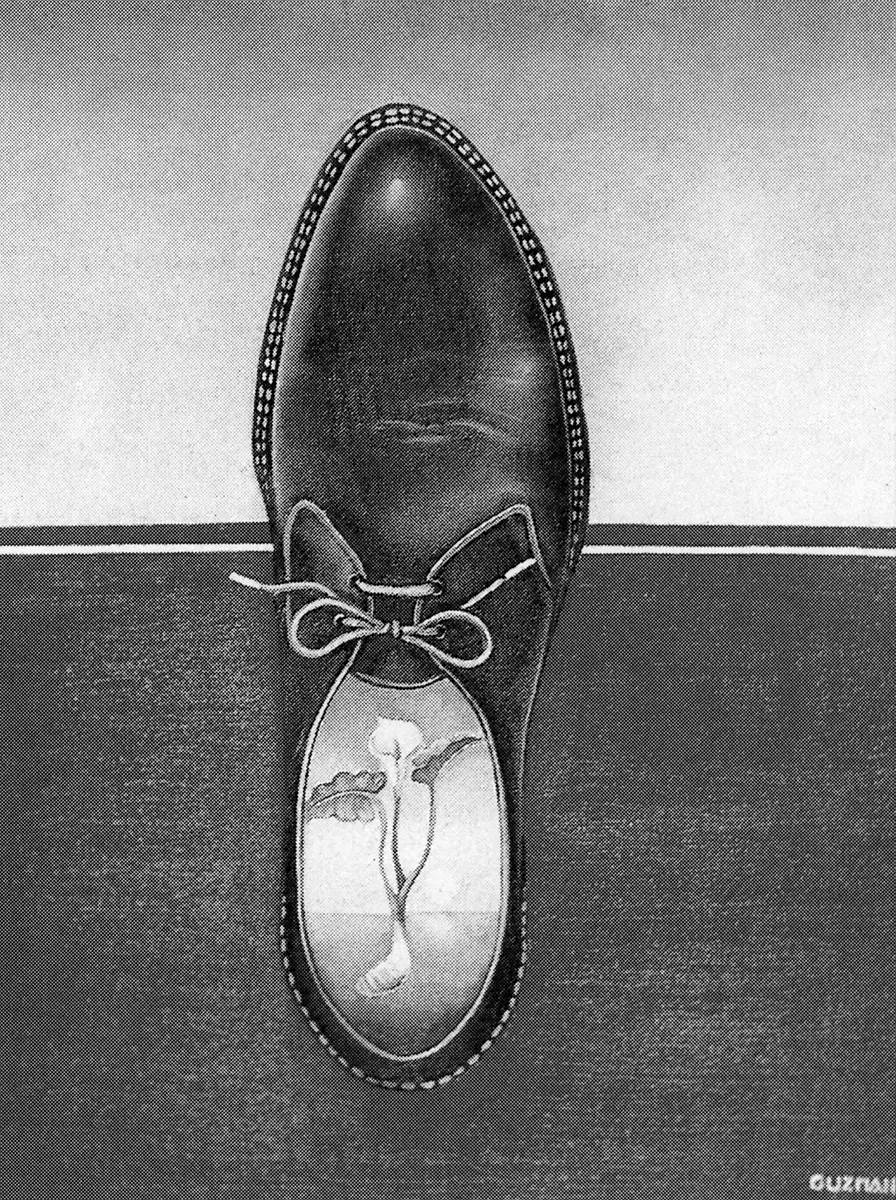
Considered irreverent in his time, he did not hesitate in changing the national coat of arms for a pre-Hispanic death mask, a shoe, or an enormous open mouth. In this particular case (The Fatherland, 1977), an elegant shoe literally steps upon the Mexican flag, whose coat of arms has been changed. There is also a completely opened rose on the flag, which refers back to sacred iconography (in particular that associated with the Virgin of Guadalupe), that has been a very strong expressive force in Mexico and, as experience has shown, is practically untouchable, except for the purposes of expressing, with customary orthodoxy, the faith placed in this Virgin.
Although Guzmán was not exactly a political militant in the current sense of the term, he worked carefully with a mixture of iconographical elements which in the process acquired new meanings. The proximity of the flag to a toilet, a shaving razor, and the picture of children playing in a cold space filled only with disordered geometrical objects indicated that nothing in his work was either accidental or innocent.
However, this wisdom, which was generally achieved with a significant economy of means, becomes all the more impressive because the visual docility of most of his pictures is only inoffensive in appearance.
Though he sought inspiration in the work of such painters as René Magritte, Guzmán achieved a symbolic combination which recalls children's guessing games based on images, whose position within the surface of the canvas gives them a reading that is different from that which they might have separately and individually. Thus, a shoe with a sea inside or an albatross (or calla lily) emerging from a seashell can come as a metaphor for an endless number of stories.
In his final years of creation, Guzmán was clearly engaged in a search for new meanings produced by states of mind and creation through the use of drugs. Suicide was not something unexpected in his case, although when it happened it was still a surprise for those who were close to him. Three years before his death, on May 31, 1983, he wrote on the back of a picture, among other things, the following lines: "I could not understand how to give up everything if life is for living. Now I think that the secret lies in the subtle direction we give to thought, directing it towards real feeling; it does not matter what we work on."
Guzmán was a creator whose introspection moved clearly towards a plastic proposal which, over the years, pointed to and anticipated the future, towards a way of approaching both thematically and conceptually the creative act and, in his case, the final product, his painting.
The almost geometrical work that he produced during a period in the 1970s seemed to distance him from the careful narrative that was his. Would this have marked a new beginning? We shall never know. In the works from 1983, there seems to be no room for a recognizable figure beyond pure forms. In other works, despite the geometrical presence in his final pieces, there are faces, knives, arms, birds, the figure.
Already his architecture had become perfect in his irrational and illogical existence, fantastic constructions of his personal and intimate inner cities. The stairs lead only to his dreams, the enormous sky which filled a large part of his work, a sky in which good and salvation are present and count. Of whom? Guzmán seems to ask himself. It would appear that he discovered in time that happiness is like a ship grounded in the desert: a couple (his parents?) stare, realizing that the hull of the enormous ship is in fact an enormous sky to which one travels but from which one never returns.
SANTIAGO ESPINOSA DE LOS MONTEROS