
Esteban Lisa (1895-1983) was one of the pioneers of abstract art in Argentina in the 1930s. But despite the significance of his work, he has until recently been an unknown artist.
There is no doubt that his personality did little to encourage his recognition. His was a strange case of voluntary marginality which went totally against the habits of the artistic circuit. Born in Cardiel, in the province of Toledo, Spain, and a naturalized Argentinean, he lived in Buenos Aires since 1907. There he had absolutely no contact with artists, gallery owners, or marchands. Nor did he participate in any exhibitions during his lifetime: he merely showed his paintings to his most intimate friends and disciples.
What transpired before and after the recognition of his work is recounted in a monograph by Nelly Perazzo and Mario Gracowczyk, published in 1997, in which they analyze the various stages of his development, establish parallels with certain European artists and define his place within Argentinian modernism.
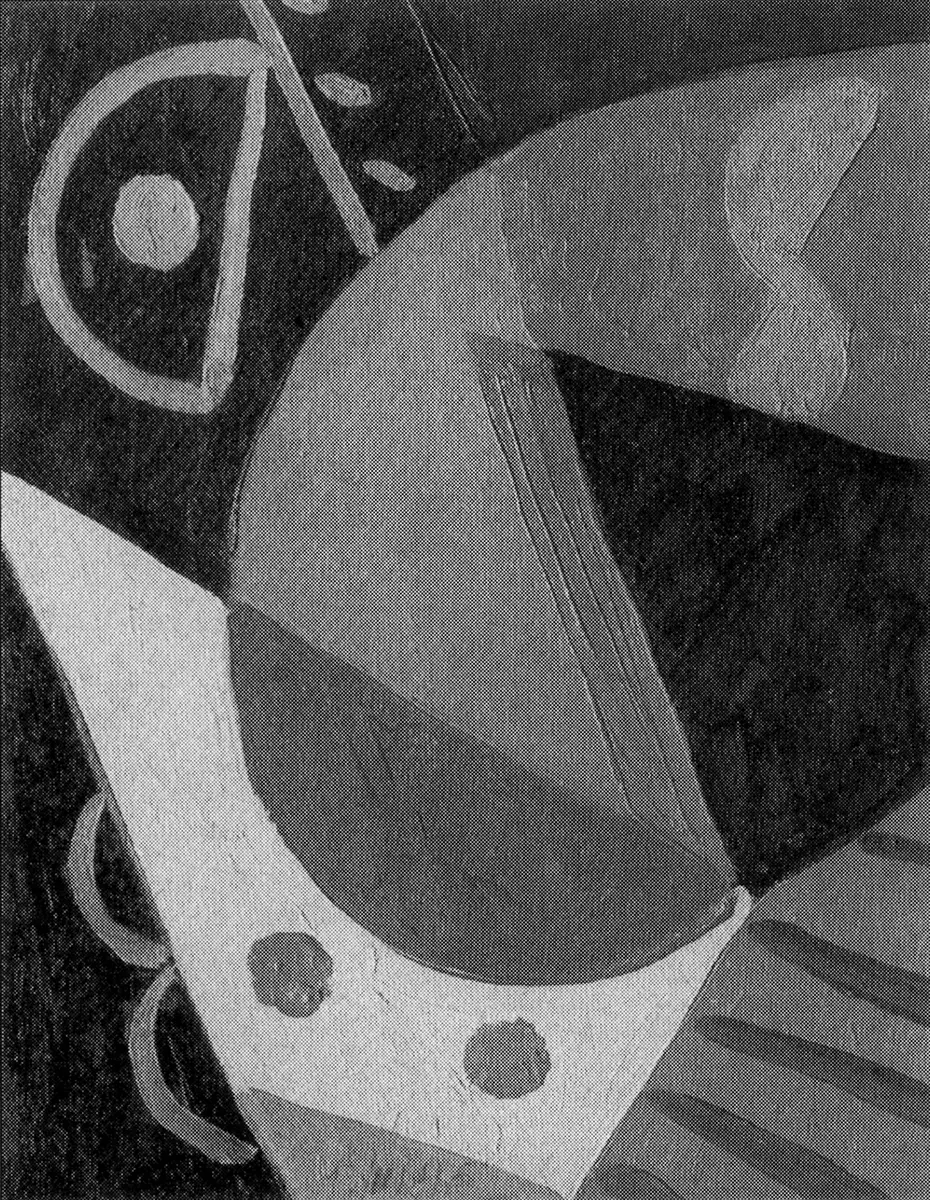
In his pictorial work, Lisa gradually moved towards abstraction, beginning with models taken from nature, for example, the triangular form of the calla lily. After an initial "figurative" period, the lessons of cubism appear in a series of abstract works, sometimes characterized by their austere chromatism. In the mid-l930s, his paintings consisted of geometrical forms-cylinders and spheres placed before a system of planes. Combining geometry and the organic, reason, and feeling, these works helped establish the basis of what would subsequently be considered one of the vocations of Latin American art: "sensitive abstraction".
With maturity, Lisa achieved the spontaneity of a child. "To paint like a classic artist," he said, "Picasso needed only two years, but to paint like a child, he needed 40." In Lisa's final production, with much less use of geometry, he emphasized the lyricism and vitality of his line work and color. These works are full of playful spirals, vortices, curves, and arabesques. Indeed, the title of his paintings from the 11950s and the 1970s is Games with lines and colors. They encompass poetics based on time-space, reflecting the artist's interest in the fourth dimension, which was a recurring element in his research.
Lisa liked to work in small formats and on humble supports: board, ordinary paper, sheets from encyclopedias, or advertisements. He sometimes painted on both sides of the support, indicating the experimental nature of his work and reinforcing the idea that it was intended for himself, and not the market. There is no doubt that his practice was at all times at odds with the usual concept of the "complete" artist.
His lack of interest in the "profession" of the artist and the critical fortune of his work contrasted with his great interest in research and teaching. A self-taught artist, he also studied philosophy, theology, the sciences, aesthetics, and ethics, and was a patient investigator of anything relating to the spiritual formation of man. His interest in reading was no doubt the result of his wise use of time when he worked as a librarian in the Correo Central.
This interest in the study of works by philosophers and scientists can be seen in his book Kant, Einstein y Picasso (1956), and in his own Teoría de la Cosmovisión, published in 1972.
Lisa, the humanist, believed firmly in the development of man through art. Hence his great devotion to teaching at the School of Modern Art of Buenos Aires. He created his Four Dimensions in 1955, the year of Perón's fall and the emergence of a new interest in culture.
Lisa told his students that a "full" man is a man of aesthetics and that a harmonious being reflects the harmony of the universe. In this ideal man, rational and sensitive elements are perfectly balanced. In accordance with this line of thought, his interest in geometry was not a cold one but nurtured by constant observation of nature. This organic affiliation, which remains throughout all his work, places him at the opposite extreme to the concrete avant-garde of the 1940s in Argentina.
The connection that work, as a microcosm, should maintain with the macrocosm, is part of the expansive nature of Lisa's compositions. "On a surface measuring 10 x 10 cm. it is possible to introduce the whole universe," he used to say. And that is why his paintings, with their reduced size, do not seem to be intimate, but rather expansive, extendible in the imagination-through space.
Why did he not show the same activism in his art that he sought in more than a dozen pieces of published research, or in his work as a teacher and in his more than 400 lectures? Perhaps it was a question of self-sufficiency, pride, fear of criticism, or the fact that his personal development of abstraction had no counterpart in the work of his contemporaries. But above all, perhaps, the desire to make his pictorial work a place of reservation, to which only the initiated would have access.
With the presentation at the National Museum of Fine Art of more than 80 works done between 1930- 1975, the circle opened up, leading to the historical reappraisal of the work of this singular artist. In this way, our Museum is without a doubt helping to pay a debt.
ELENA OLIVERAS