
After the relative excesses of his past few exhibitions, Fernando Cánovas seems to have decided with this recent group of paintings that less may be more. His current works still engage with ideas of flatness and space, abstraction and figuration, and timelessness versus the passage of time but in time, he has dramatically simplified his compositional strategies with very strong results.
His current exhibition consists of a group of paintings, which are all of a uniformly large scale, 200 x 200 cm. Each painting features an isolated geometric construction, rendered in deep perspective and set in a formless abstract field that suggests a barren landscape. The forms he has chosen are basic geometric ones —the classic circle, cylinder, and square— but they are also very architectural, evoking labyrinths and hypostyle halls, or basic construction blocks and holding cells. The utilization of modeled forms in perspective with our reading of space, especially when the forms occasionally cast shadows despite any actualized setting or apparent light source. To add to the visual paradox, Cánovas places flat rectangular shapes in his compositions, which counter the illusionism of the constructions and remind us that the picture plane is essentially fiat.
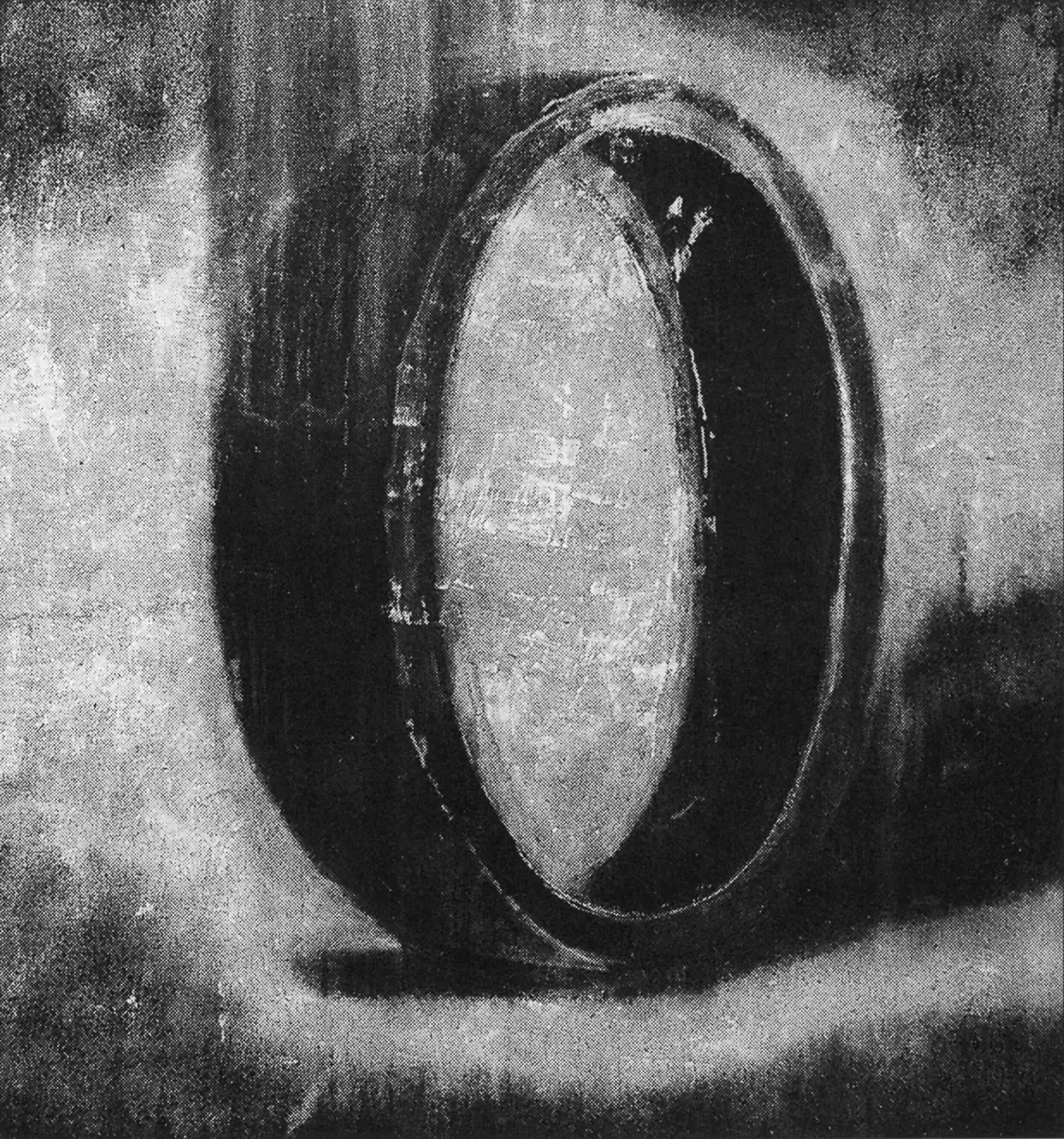
The timeless abstract setting and traditionally sacred forms such as the circles, labyrinths, and post-and-lintel constructions lend an unquestionable sense of the spiritual and meditative to these paintings. At the same time, there is a very material and tangible sensibility to these works. Cánovas makes the acrylic on canvas (occasionally supplemented with sand) look like oxidized steel. His raw, scuffed surfaces with flecks of white paint throughout also resemble old frescoes. These are paintings that for all of their conceptualized illusionism, are acutely aware of physical reality and surface. The references to rust and flaking plaster also mark the passage of time and the corruptibility of material things, which sets up a visual tension with the dematerialized settings and pure geometries that express the timeless and eternal.
With these new works, Cánovas has managed to maintain the themes that have been preoccupying him for years while reducing his approach to its most effective essentials. While he is not the first artist to explore such dichotomies as figuration/abstraction, space/flatness, and material/conceptual, rarely has an evocation of the spiritual and transcendental been grounded in so earthy and concrete a visual language. With these paintings, Cánovas joins a small but potent group of painters who are finding new ways to render abstract painting fresh and compelling.
JOHN ANGELINE