
Recognized as one of the great living masters of Latin American Art, Fernando de Szyszlo continues to challenge materials and the wisdom of the sacred in the creation of his ever-evolving exploration of the visual revelation of human-nature-spiritual relations. Long dedicated to preserving the ancient mysteries of the Andes through his work, Szyszlo incorporates the language of the stones, textile patterns, pottery designs, and Kechwa titles to develop a personal and modern Peruvian iconography. He imbues his paintings with a mysterious resonance through sonorous chiaroscuro and radiant color contrasts that speak of volcanic eruptions and spectacular sunsets over the highest peaks. There are altars, architectural remnants, solitary idols, and soaring condors. Over the years, Szyszlo has captured the immense drama of the Andean landscape in a style that has become definitively his own, a combination of modern abstraction and poetic sensibility that manifest itself in towering stelae and primordial artifacts elegantly revealed through transparent veils of color.
The rituals of the Andes that have inspired so much of his work over the years are still very much evident in this exhibition of paintings and sculptures produced within the past five years. Titled as a continuation of the series Camino a Mendieta (Route to Mendieta), which he began in the 1970s, these works are from the series Dos Caminos a Mendieta of recent years. Although they may be described as the second manifestation of the series, they still involve the creation of enigmatic images that have the effect of transporting the viewer along a sacred road. Along the way, we experience the arcane powers of archeological remnants standing in isolation against a deep azure sky and witness the flames of the sun illuminating a magenta altar. Offerings left in the arid desert become metaphors for human loneliness and the inexplicable travails of daily existence. Mountain landscapes are revealed as the home of the great condors, awesome birds that communicate with the world of the spirits and guard the entry to another realm. The power of Szyszlo's ritual environments has never been stronger.
There appears to be a lightening of the palette and an opening of space in the paintings. One pale blue abstraction is reduced to a simple rectangular form. It pays homage to arcane ruins and the beautiful blue of the Peruvian sea and sky with fluid strokes of color and minimal attention to detail. Another, a diptych, consists of all neutral tones with the color of bleached stones and ashen grays never diminishing the vitality of the strange stele that is its subject, a painterly translation reminiscent of the Staff God or Goddess of the early Peruvian peoples of the Chavín Horizon. The complexity of the Peruvian ritual vocabulary has been mastered by Szyszlo and incorporated into his own works to create a unique and recognizable pictorial language.
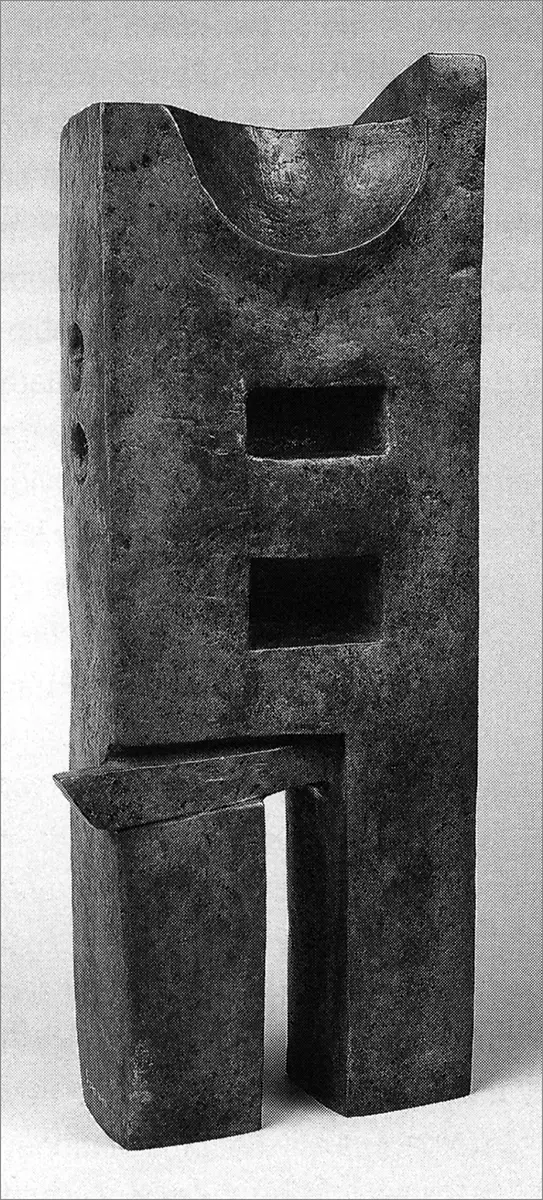
The same pictorial language that employs the Andean Pre-Columbian iconography as its basis in paintings informs a dramatic installation of bronze sculptures of various sizes. Like the stylized monoliths of Tiwanaku or guardian idols of Chavín de Huantar, the sculptures command a majestic presence and telluric power. The majesty of stone is captured in these bronze objects, and Pre-Columbian Peruvian designs are maintained on their surface to further preserve Szyszlo's formal concerns and ritual iconography within the context of his rich cultural heritage. Huarmi, 1997, one of the largest of the bronze pieces, combines a modern vision of spatial harmony and volumetric control with the carefully inscribed Andean designs that place it in an archaic and otherworldly context. There is an anthropomorphic character in Passenger, 1995, and many of the sculptural objects in the exhibition. Although there are architectural references to the great stone monuments and temples found throughout the Andes in the fragmentary quality of the works, there is also a strange personification that occurs that speaks of idols, stelae, and mythical creatures that turn to stone in Inka legend. Bronze replaces the stone masterpieces of the past for Szyszlo, but he retains their energy and sacred presence.
CAROL DAMIAN