
As part of its annual program From the Studio: Artists in Residence (AIR), The Studio Museum of Harlem presented between July 28"1 and October 31st the exhibition Flip, Funk and Fantasy, which included installations by Manuel Acevedo, Xenobia Bailey, and Elia Alba. All works were produced during the year of residence under a program for emerging artists of African or Afro-American descent.
Guest-curated by Jorge Daniel Veneciano, who was also involved in the selection of artists, the show offered an intelligent presentation of different works, contexts, and procedures. The installation selected by the curator allowed the artists to present their work in a fluid and independent manner. They were, however, subtly linked by shared ideas.
The works dealt with the reconstruction of memory, based on personal or cultural experiences. Elia Alba's installation was the first work the visitor encountered upon arriving at the Museum's second floor, where the show was held. It was surprising not only for the beauty of the apparent uniformity of the red color used but for the repeated motif of small children's shoes made of muslin. The shoes were rigid in appearance, as if starched or petrified; they could be differentiated only by the intensity of their color and the different sizes. Hundreds of little shoes were thus distributed around the room, making up different forms in the space. Some hung from the ceiling and created a thick, impenetrable curtain that the spectator could not enter, while others were placed inside bags. Thousands of other shoes were piled up in the corner, like abandoned objects or waste material somewhat like the candies of Félix González-Torres. In the form of a carpet, on which paradoxically, the visitor could not walk, Alba placed little shoes all pointing in the same direction, forming a squadron on the floor. The shoes were arranged to make up a uniformed army, with bands of color, like the stripes of a flag, or combined in a way that recalled the work of Carl André.
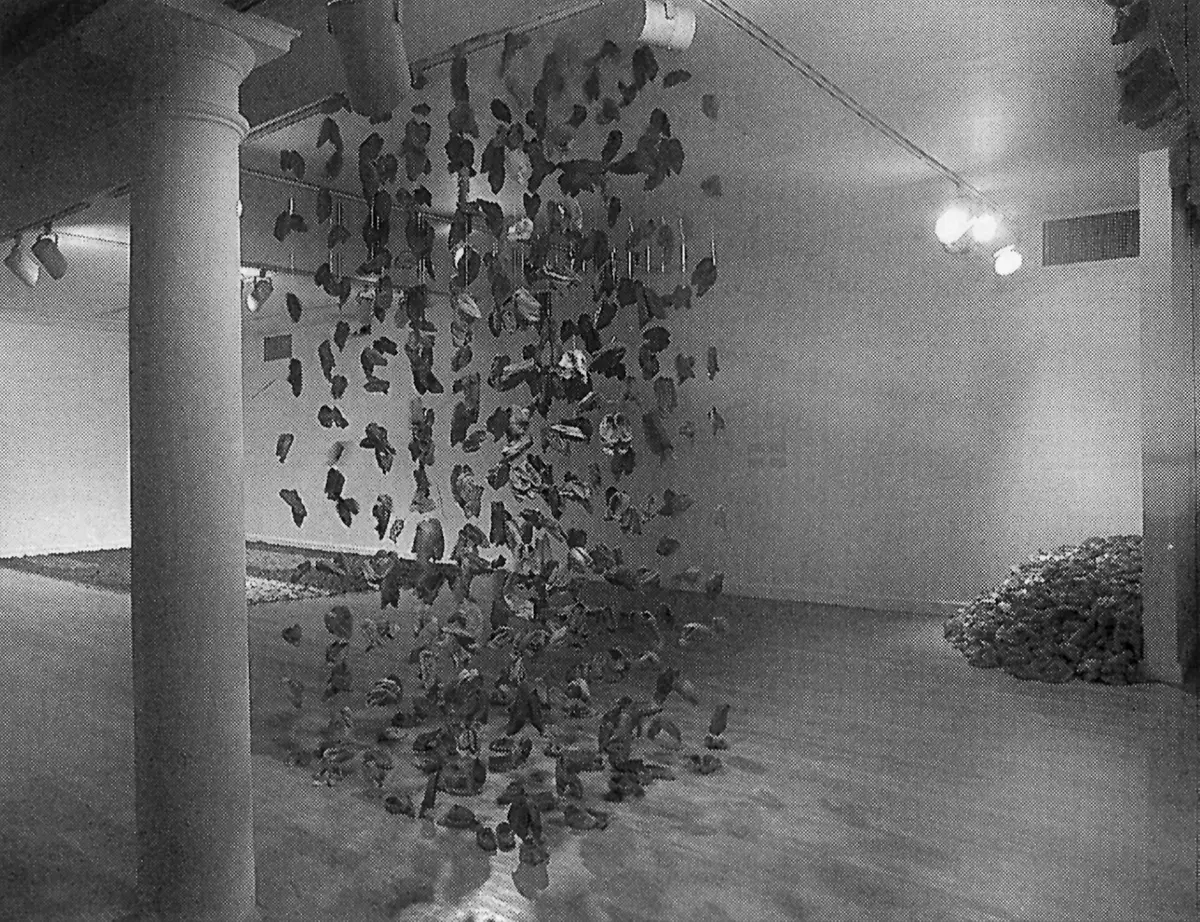
Obviously, the first thing that springs to mind here is the nod to minimalism, along with the aphorism by Robert Morris about antiform. The work adopted the form which the material permitted in terms of physical qualities, and the only variation concerned the montage. But the ambivalence of this repeated object and its evocation of a body fragmented in space is more reminiscent of the work of Eva Hesse. Elia Alba’s intention was to present different ways of structuring an object at different points in the room. In this way, the work reconstructed a space already classified as conventional, or "colonized", and at the same time subverted its meaning by introducing elements rich with personal associations. The installation proposed a dialogue or negotiation of the space in which the art object has been historically placed but did so from the intimate standpoint of a female subject.
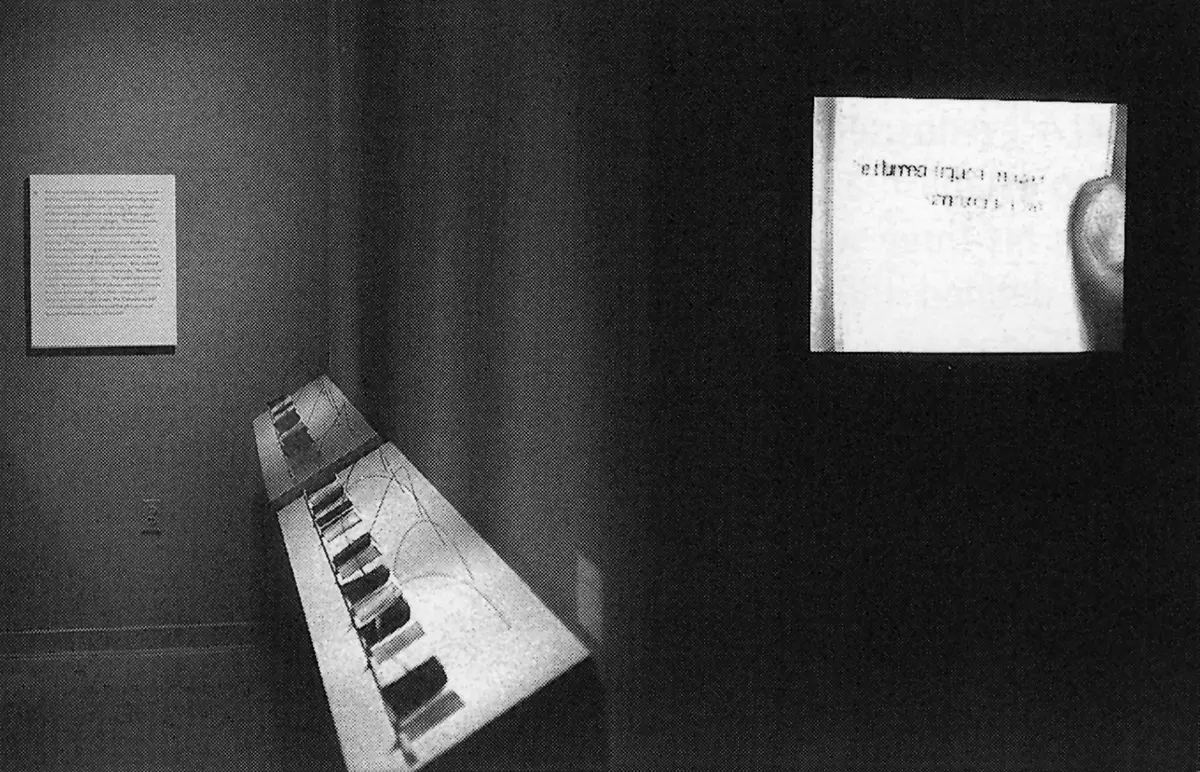
This was a feminist strategy that the artist used in a subtle manner. She chose not to personalize the experience yet made it socially meaningful-anonymous yet at the same time reiterative. In contrast, Manuel Acevedo's The Persistence of Memory created an intimate space between the spectator and the work that could be manipulated with the hands. Acevedo proposed a game using his 25 "flip books"—books whose pages show figures in motion when flipped quickly-which did not contain drawings, but poetic writing created by the artist himself. The words that clash or join together as a result of the rapidly moving pages form a visual poem whose structure is like a Japanese haiku. The writing once again becomes that image or sound that Mallarmé recovered in poetry. Acevedo revoked this poetic experience but related it to his own memories of childhood and his dead father. At the same time, his game, taken from popular culture, was itself a metaphor for the way memory works. This sequential handling of the "flipbooks", the technique of which was in a sense a forerunner of film, was repeated in a video of the same name. In a separate room, hands were projected performing the same action of running through and flipping the pages. The reiteration of the same movement transferred to another medium reinforced the idea of "visual writing": two resources with forms of representation based on the same principle. Time is also an important part of Acevedo's work. His other three book projects were in fact kinds of diaries with the dates they were made. This subtle detail of the Untitled reference, as well as the date in brackets, emphasized the temporal sense which gives the work a process-based nature. The books, which unlike the flipbooks had to be handled with gloves, contained notes for utopic projects which were never carried out and that the artist has kept over the years. They have remained only as ideas or imaginary sketches and architectures of written, visual, and spatial language. Some construct spaces that can be inhabited, whereas others are merely recollections. Time, space, and memory combine to form a visual impact that is based on all forms of two-dimensional representation, but one which in itself remains only a project.
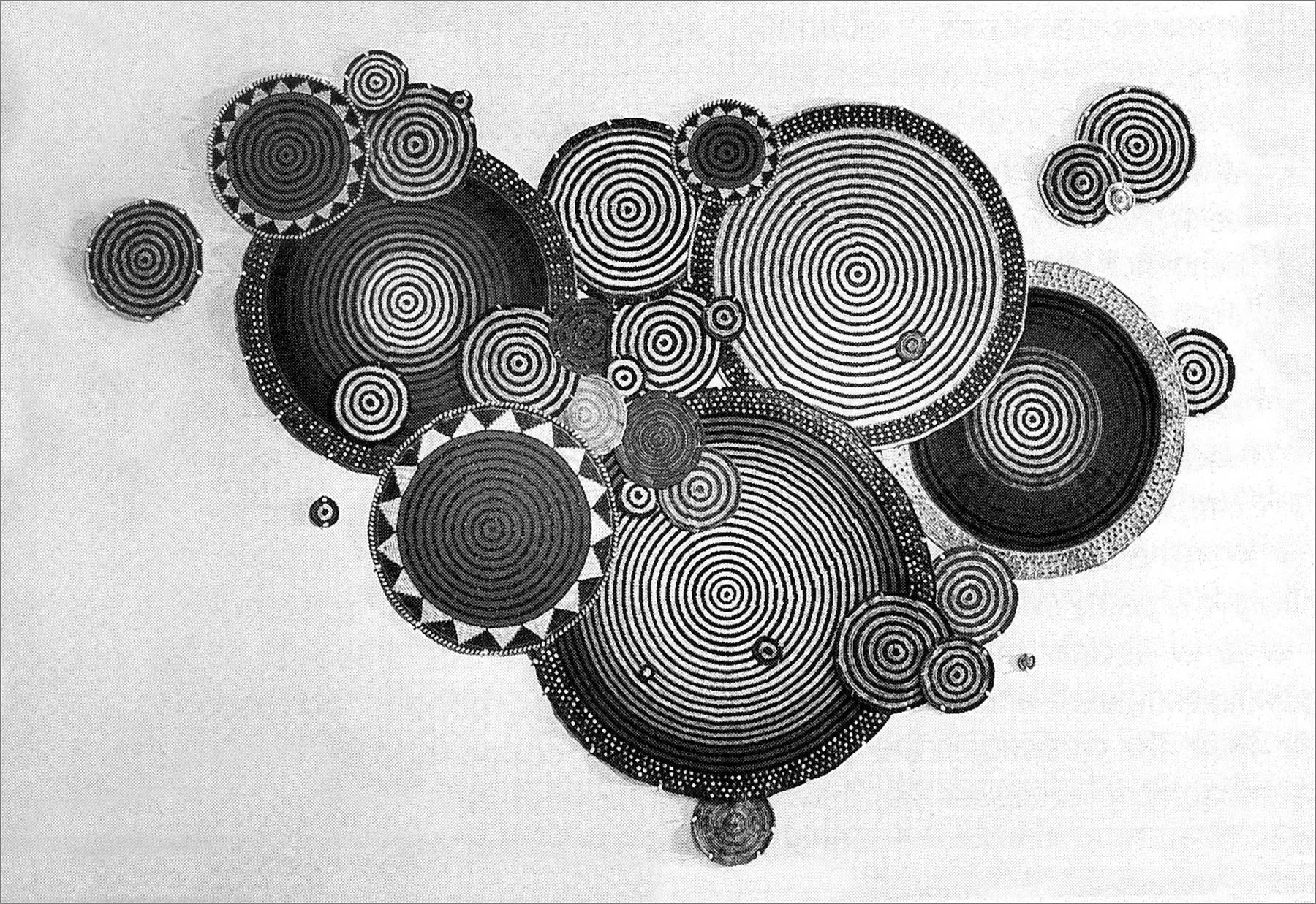
The work of Xenobia Bailey was, in its appearance, completely different from that of the other two artists of Latin origin. The curator Daniel Veneciano defined it as the construction of a visuality that recuperates and extends "funk" culture-which found expression in a form of music in the 1960s and 1970s but does so now with a spiritual, transcendent meaning. The installation began with a little altar containing photographs of trees, glass objects, and other items, which could be identified with certain divinities associated with African religious cults. They represented beliefs, myths, and a return to values that resignify nature as part of a cosmic or divine world, to which offerings had to be made. Bailey recovers a sense of transcendence that includes concepts taken from everyday life, such as ecological awareness. The rest of the installation expressed a kind of syncretism of op art, feminist criticism, color, and the use of symbols from the West Coast of Africa. The cosmic Tapestry (Mandala) was made up of circular mats which were superimposed and placed on the wall. The weaving, in the form of concentric circles or bull's-eyes, suggested the representation of a cosmogony.
Another significant work was Moon Lodge, a room constructed architecturally with weaving yarn. The work created a private space of confinement that included certain feminine "objects". The place recalled the practices of certain African groups which isolate women, for example, during their monthly period of menstruation. The work could also be seen as a representation of the cosmic house, the point or axle of the world, according to Mircea Eliade’s definition in his book The Sacred and the Profane. Or perhaps both. Using a feminine perspective, the work used crochet to make a "sculpture" of Egungun, a Yoruba male divinity, which in this case was obviously given female characteristics through the material and brilliant colors recalling the dress of women in some regions of Africa. Bailey used crochet or thread to create, like Elia Alba, architecture and spatial sculpture.
Flip, Funk, and Fantasy at the Studio Museum depicted three different ideas which sought to unite three separate proposals. Manuel Acevedo used the idea of "flip" to establish a connection between his three works, while "funk" defined the aesthetics used by Xenobia Bayle. However, "fantasy" did not fully cover the complexity of the work of Elia Alba. This was one of the best shows during this year's miserable summer season of exhibitions in New York.
DERMIS PÉREZ LEÓN