
"This morning I bought this notebook to make some drawings... Afterward, I went to a dinner at the Guggenheim for Rauschenberg. I could begin the diary by telling something about the event, but the truth is I don't feel like it and I prefer to write about my drawings. I had completely forgotten some of them, and I am happy to see them again."1 Guillermo Kuitca New York, September 18, 1997.
These words, taken from Guillermo Kuitca's diary, are the beginning of a dialogue between the artist and nearly two decades of his drawings and sketches. Diary entries were made available to viewers as made their way through Beds, Theaters & Drawings, an exhibition that brought together a selection of installation work, paintings, and drawings displayed within the modernist galleries of The Arts Club of Chicago.
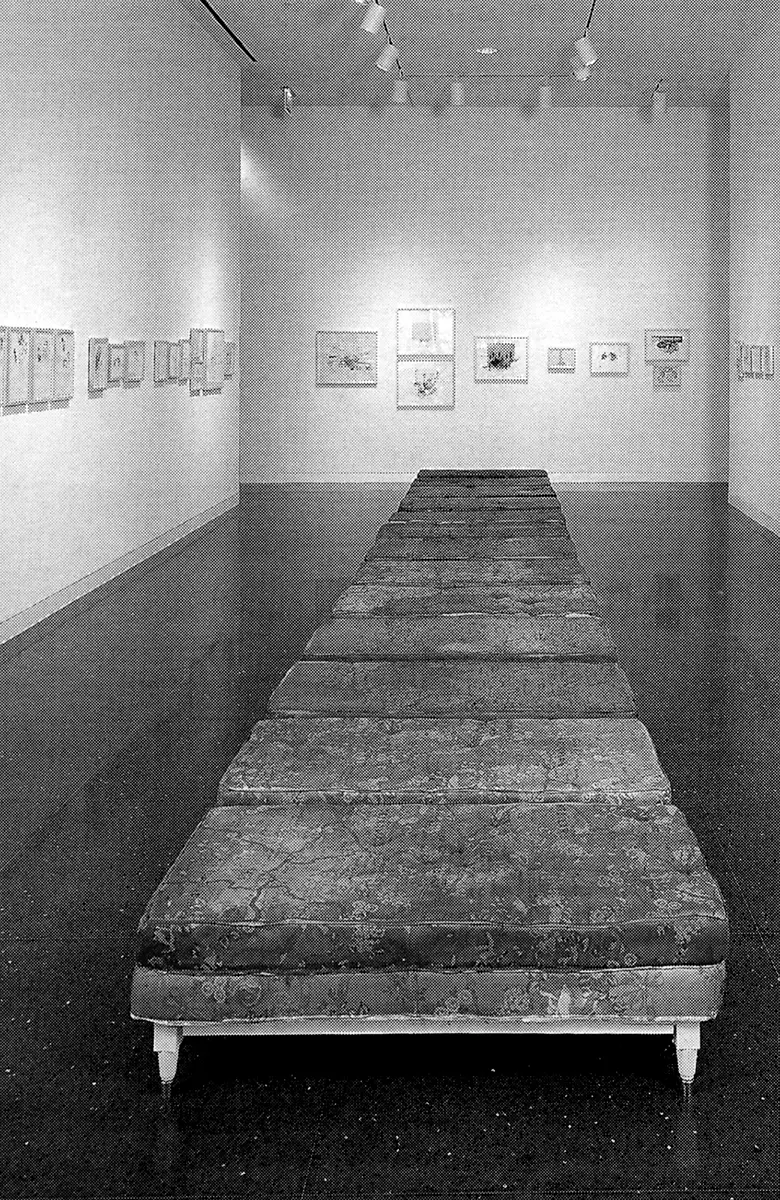
The eighty-one drawings from 1981-1996—the majority of which were being exhibited for the first time—provided a historical trajectory of the artist's career. Begun when the artist was twenty, the drawings seem to function as notational thoughts, roughly and schematically delineating Kuitca’s ideas and emotional states. The early works are simple and often comic, integrating text such as popular songs and various forms of wordplay together with representational drawings rendered with irregular and agitated lines, idle scrawls, and scribbles. Chronologically displayed around the perimeter of the gallery, the drawings traced the development of Kuitca's themes from his intimate and expressionistic depictions of figures in psychologically charged space, to his more intellectual and conceptual renderings of genealogical charts, apartment floor plans, street maps, theater seating, and diagrams of public and institutional spaces.
The visual ordering of these stages created interesting associations. Moving through Kuitca's exhibition, one had the feeling of starting close to the individual subject and moving further and further away, to a point where human subjectivity became a mere abstraction. This sense of withdrawal away from lived experience toward a reduction and distillation of human life into ordering systems and abstract information is analogous to the process of writing or visually representing history where the specificity of human interaction is abridged and necessarily loses its gestalt.
Kuitca's installation Untitled (Beds), 1991-1992, provided an interesting contrast to the small and intimate scale of his drawings. The twenty painted mattresses, installed in one row of 13 and another of seven, employed an obvious use of directional space. The artist's fascination with mapping and organizational systems was clearly felt by the viewer who ironically became a relational part of Kuitca's carefully mapped-out exhibition plan. Kuitca's interest in the ways in which institutional spaces regulate behavior and activities was echoed by his paintings of theater seating charts, a peep show and video booth floor plan, and a baroque opera house interior, as well as by numerous renderings from his Capitonée House Plan, Tablada Suite, Puro teatro, and Poema pedagógico series included in the exhibition.
Spatial logic, in many of Kuitca's works, is shown to be provisional and fluid in nature. By substituting fictitious or incorrect place names on his map-inscribed mattresses, they cease to function as utilitarian guides, becoming both a Borgesian questioning of metaphysical time and space and on a more mundane level, a questioning of systems of knowledge and institutional conventions. According to Kuitca, "no identification is reliable, no order is sacred ... no referentiality is definitive."2 Kuitca's depictions of private and public spaces—from his expressionist and emotionally charged domestic interiors to his cool and rationally articulated diagrams, plans, and blueprints—visually underscore the abstract nature of all representation in its attempts to accurately convey the complexity of human relations, whether they be at the micro or macro level of engagement.
NOTES
1. Diary excerpt by Guillermo Kuitca in, Guillermo Kuitca: Drawings 1981-1996, edited by In6s Katzenstein and translated by Jane Brodie, (New York: Sperone Westwater, 1998).
2. Kuitca, Guillermo, "A Body of Work," in Cynthia C., ed., Anybody (Cambridge, MA, and London: MIT Press, 1997) pp. 132-137.
CHARMAINE PICARD