
Object and volume were two features stressed by Gustavo López Armentía in his recent show in New York, which included painting, sculpture, and drawings. In these recent works, the artist develops his permanent focus on the entering/leaving of forms, spaces, and figures, and on fusing/vanishing, as can be seen in the "boat" in The Siesta. The sculptures included two earlier works that were successfully integrated into the group; black pieces in iron and wire rod that make up a delicate three-dimensional drawing and contrast with the powerful whiteness of most of his recent pieces. The works on the walls were unframed and were characterized by a much more irregular treatment (as if the support were hand-made paper) than previous works. These changes produced a less rigid and more expressive visual effect. In fact, they are technically not paintings by virtue of their two-dimensionality or in their technique since the artist constantly uses mixed resolutions in which he introduces changes and reincorporates wires. These elements give a less frozen and perfect finish to the works using drawing, transfers, layers of marble dust, metal, wire, plaster, pigment, quartz, and acrylic.
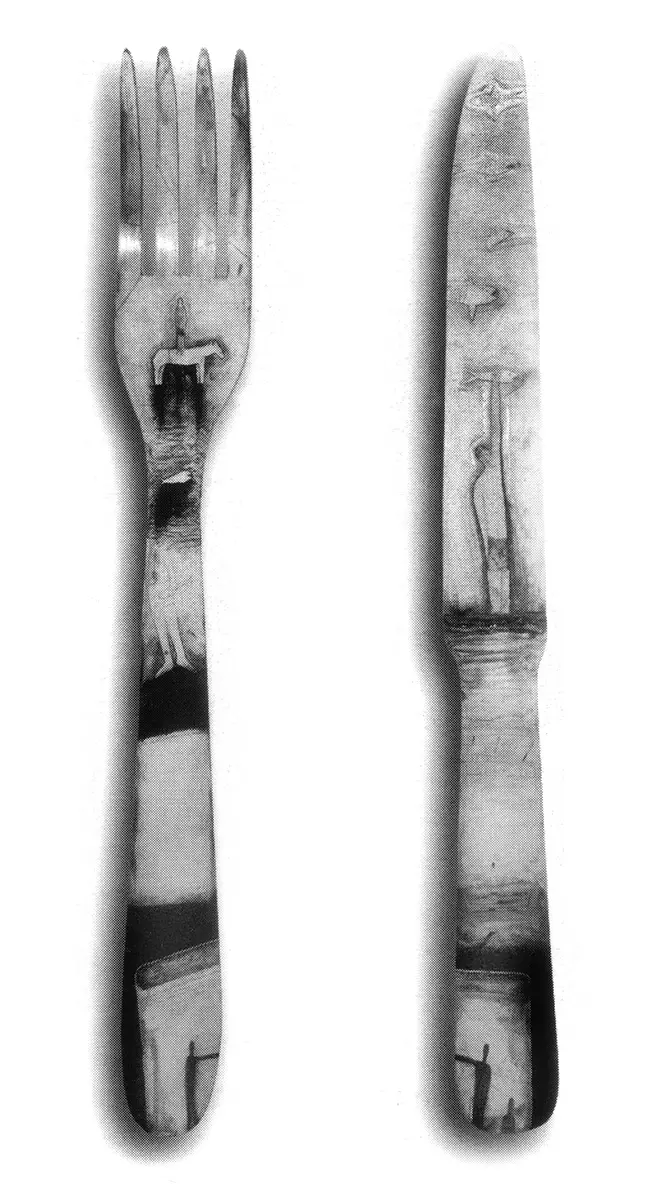
The cutlery service and "hopscotch" bowl table which formed part of his installation at the XLVII Venice Biennale in 1997, where he represented Argentina, were presented in this gallery in 1998. With different images that were less cryptic than before, the cutlery service is now full of the sea (Cutlery Covered with history, 1999). The spiritual reasons for this independence lie in the fact that the artist presents the cutlery with a sense of contradiction in both its composition and concept. The landscape scenes, the horizon line, the ocean, and a lake all normally require treatment on horizontal support; López Armentía presents them in the reduced 17-24 cm. width of the cutlery service. Reduction, destruction, or a memory of something which no longer exists? Whatever the case may be, there is a reference to reality, a call for attention to the ecological situation. A figure with echoes of Picasso, on a donkey that separates him from the flood, is one of the human characters who, along with the water, make up the various scenes of these works, resolved in the form of non-delineated superimposed registers.
At the end of the handle, we can see the powerful black race and the books in support of humanity. But it is humanity that devours everything and does not respect reason. This is nature both aggressive and the target of aggression in an enlightening presentation: the animal saves man and vice versa. The earlier bowl table has now acquired plastic independence. In this exhibition, it was a large round kind of molding that incorporated memories of railways, a meeting of paths, and little figures in the artist's idiosyncratic style, with planes, hangars, and bicycle wheels.
There were more Argentinean elements in some works than in others: however, a general "Southern Cone" kind of atmosphere was evident in the miniature portrait of Jorge Luis Borges, as well as in the railways and planes of so many other Argentineans who emigrated, so-called "citizens of the world." The references to immigration and emigration conjure up the physical, emotional, and cultural sacrifices at the regional and personal levels.
The Siesta and The Ship show groups of workers resting near the ship. The ship has a multitude of secret passageways, bearing on its surface the marks of the infinite landscapes of individuals living on it and the oceans over which it has traveled.
Jorge Glusberg, director of the National Museum of Fine Arts of Buenos Aires, notes in the prologue text of the exhibition catalog that, "López Armentía combines the different times and creations of human beings, and at the same time mixes the materials with which he prepares his works." The artist tries to avoid anecdotal and literary elements. The ships and railway lines are not only memories or enunciations but are the symbolic elements of a society that provided for and anticipated the balance of the migrations, and in particular, the migrations of Latin Americans to supposedly more developed countries, in search of unachievable social respect.
GRACIELA KARTOFEL